Rutkowska Izabela, Bednarczuk Grzegorz, Molik Bartosz, Morgulec-Adamowicz Natalia, Marszałek Jolanta, Kaźmierska-Kowalewska Kalina, Koc Krzysztof
Department of Sports for Individuals with Disabilities, Department of Theo Movement, Józef Piłsudski University of Physical Education, Warsaw, Poland.
Department of Adapted Physical Activity,,Józef Piłsudski University of Physical Education, Warsaw, Poland.
J Hum Kinet. 2015 Jan 12;48:99-109. doi: 10.1515/hukin-2015-0096. eCollection 2015 Nov 22.
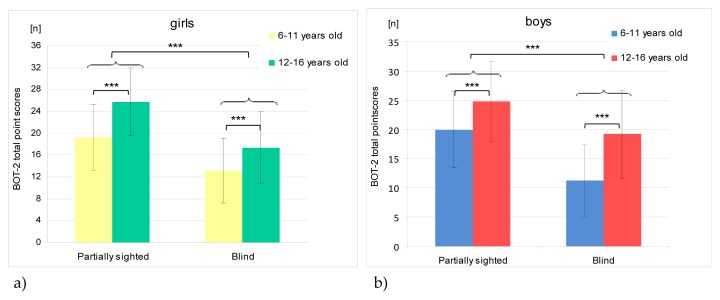
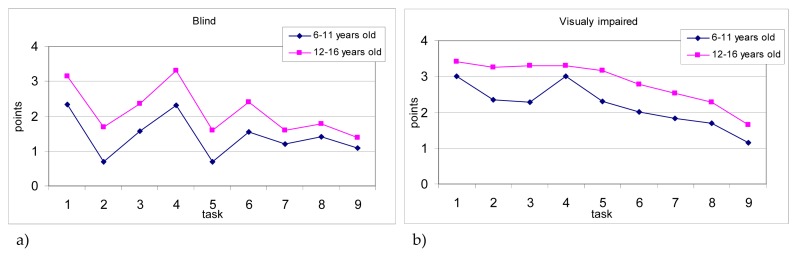
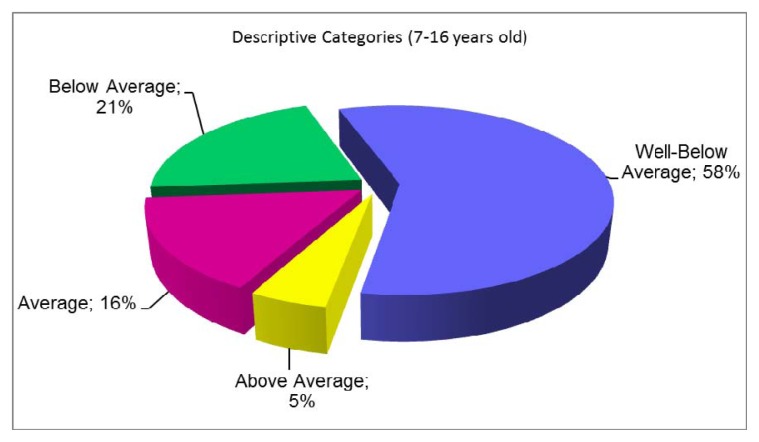
The aims of this study were twofold: to assess the level of balance of people with visual impairment against the BOT-2 standard scores for the able-bodied, and to identify in which trials subjects had the greatest difficulties in maintaining balance with respect to the degree of vision loss and age categories. One hundred twenty-seven subjects with visual impairment aged 6-16 years, participated in the study (68 girls and 59 boys). The division for partially sighted people (61) and the blind (66) was made according to the WHO classification. Functional balance assessment was made using a balance subtest from the Bruininks-Oseretsky test. Significant relationships were noticed between age and the level of balance (χ2 = 8.35 p <0,05), as well as between the degree of vision loss and the level of balance (χ2 = 24.53 p <0,001). The level of balance of almost all blind subjects was below (20%) or well-below (60%) the average for the able-bodied. The subjects' ability to maintain balance was not dependent on gender and was associated primarily with the degree of visual impairment and age. Partially sighted people had better balance than the blind and the decrease in visual acuity resulted in reduction of balance skills. The lowest level of balance was observed in blind students aged 7-11 years. Elaborating physical fitness improvement programs for children and adolescents with visual impairment, diversity of age, the degree of vision loss and limitations of ablility to maintain balance should be taken into account.
根据布吕尼inks-奥塞列茨基运动技能测验第二版(BOT-2)针对健全人的标准分数,评估视力障碍者的平衡水平;并确定在哪些试验中,受试者在维持平衡方面因视力丧失程度和年龄类别而遇到最大困难。127名6至16岁的视力障碍受试者参与了该研究(68名女孩和59名男孩)。根据世界卫生组织的分类标准,将受试者分为低视力者(61人)和盲人(66人)。使用布吕尼inks-奥塞列茨基运动技能测验中的平衡子测验进行功能平衡评估。研究发现年龄与平衡水平之间存在显著关系(χ2 = 8.35,p <0.05),视力丧失程度与平衡水平之间也存在显著关系(χ2 = 24.53,p <0.001)。几乎所有盲人受试者的平衡水平都低于(20%)或远低于(60%)健全人的平均水平。受试者维持平衡的能力不取决于性别,主要与视力障碍程度和年龄有关。低视力者的平衡能力优于盲人,视力下降会导致平衡技能降低。在7至11岁的盲学生中观察到最低的平衡水平。在为视力障碍儿童和青少年制定体能改善计划时,应考虑年龄、视力丧失程度的差异以及维持平衡能力的局限性。