Black Caitlin, Collen Ben, Johnston Daniel, Hart Tom
University of Oxford, Department of Zoology, Oxford, United Kingdom.
University College London, Centre for Biodiversity & Environment Research, London, United Kingdom.
PLoS One. 2016 Feb 3;11(2):e0145676. doi: 10.1371/journal.pone.0145676. eCollection 2016.
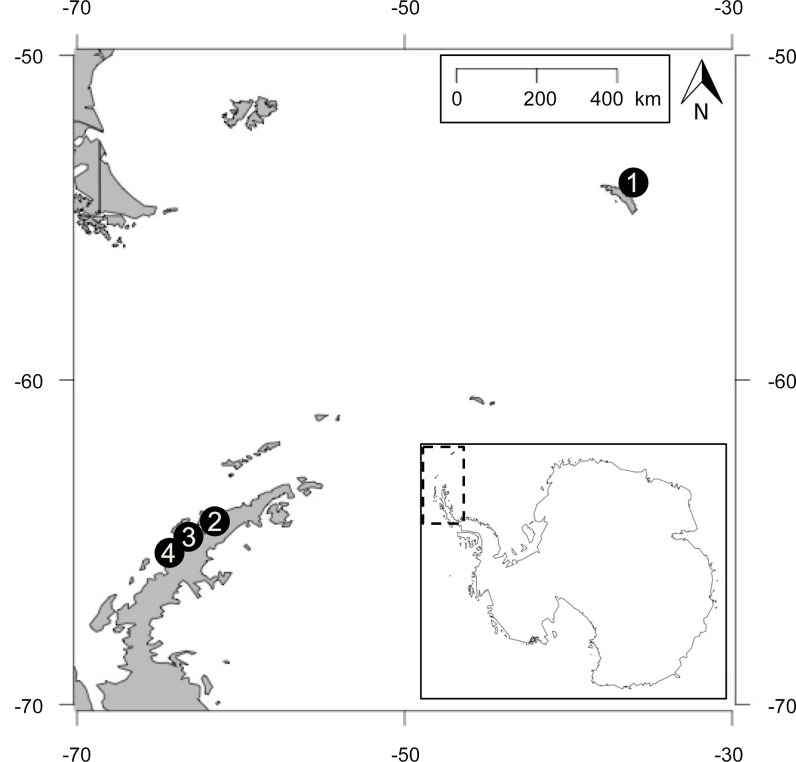
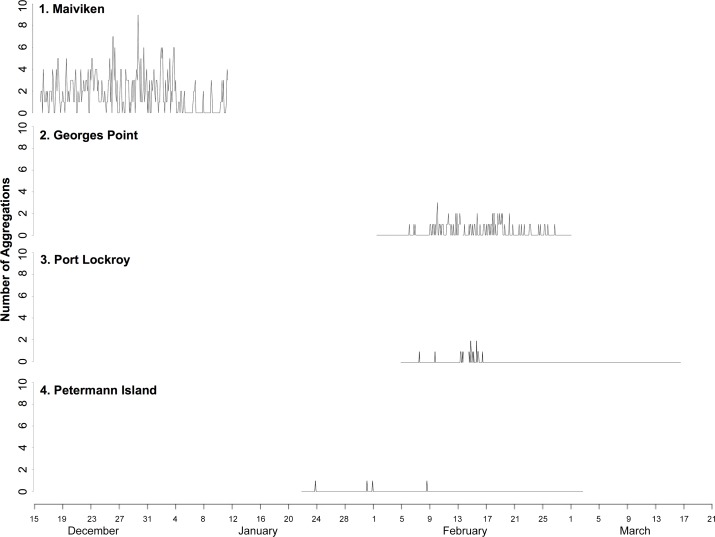
Aggregations of young animals are common in a range of endothermic and ectothermic species, yet the adaptive behavior may depend on social circumstance and local conditions. In penguins, many species form aggregations (aka. crèches) for a variety of purposes, whilst others have never been observed exhibiting this behavior. Those that do form aggregations do so for three known benefits: 1) reduced thermoregulatory requirements, 2) avoidance of unrelated-adult aggression, and 3) lower predation risk. In gentoo penguins, Pygoscelis papua, chick aggregations are known to form during the post-guard period, yet the cause of these aggregations is poorly understood. Here, for the first time, we study aggregation behavior in gentoo penguins, examining four study sites along a latitudinal gradient using time-lapse cameras to examine the adaptive benefit of aggregations to chicks. Our results support the idea that aggregations of gentoo chicks decrease an individual's energetic expenditure when wet, cold conditions are present. However, we found significant differences in aggregation behavior between the lowest latitude site, Maiviken, South Georgia, and two of the higher latitude sites on the Antarctic Peninsula, suggesting this behavior may be colony specific. We provide strong evidence that more chicks aggregate and a larger number of aggregations occur on South Georgia, while the opposite occurs at Petermann Island in Antarctica. Future studies should evaluate multiple seabird colonies within one species before generalizing behaviors based on one location, and past studies may need to be re-evaluated to determine whether chick aggregation and other behaviors are in fact exhibited species-wide.
幼崽聚集现象在一系列恒温动物和变温动物中都很常见,然而这种适应性行为可能取决于社会环境和当地条件。在企鹅中,许多物种出于各种目的形成聚集群体(又称托儿所),而其他一些物种则从未被观察到有这种行为。那些确实形成聚集群体的企鹅有三个已知的好处:1)降低体温调节需求,2)避免无关成年企鹅的攻击,3)降低被捕食风险。在巴布亚企鹅(Pygoscelis papua)中,已知雏鸟聚集群体在育雏后期形成,但这些聚集群体形成的原因却知之甚少。在这里,我们首次研究巴布亚企鹅的聚集行为,沿着纬度梯度考察四个研究地点,使用延时摄像机来研究聚集群体对雏鸟的适应性益处。我们的研究结果支持这样一种观点,即当出现潮湿、寒冷的条件时,巴布亚企鹅雏鸟的聚集会减少个体的能量消耗。然而,我们发现最低纬度的地点——南乔治亚岛的迈维克恩,与南极半岛上两个较高纬度的地点在聚集行为上存在显著差异,这表明这种行为可能因群体而异。我们提供了有力证据,表明南乔治亚岛上有更多的雏鸟聚集,聚集群体的数量也更多,而在南极洲的彼得曼岛则相反。未来的研究在基于一个地点概括行为之前,应该评估同一物种内的多个海鸟群体,并且可能需要重新评估过去的研究,以确定雏鸟聚集和其他行为是否实际上在全物种范围内都有表现。