
组合间促进作用:产洞甲虫的功能多样性驱动了利用洞穴筑巢蜜蜂的体型多样性。
Inter-assemblage facilitation: the functional diversity of cavity-producing beetles drives the size diversity of cavity-nesting bees.
作者信息
Sydenham Markus A K, Häusler Lise D, Moe Stein R, Eldegard Katrine
机构信息
Department of Ecology and Natural Resource Management Norwegian University of Life Sciences P. O. B. 5003 Ås NO-1432 Norway.
出版信息
Ecol Evol. 2016 Jan 8;6(2):412-25. doi: 10.1002/ece3.1871. eCollection 2016 Jan.
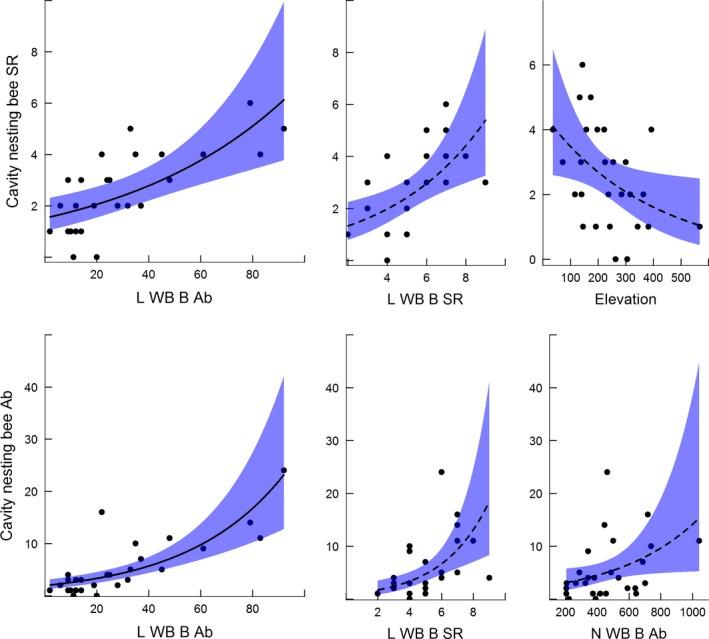
Inter-specific interactions are important drivers and maintainers of biodiversity. Compared to trophic and competitive interactions, the role of non-trophic facilitation among species has received less attention. Cavity-nesting bees nest in old beetle borings in dead wood, with restricted diameters corresponding to the body size of the bee species. The aim of this study was to test the hypothesis that the functional diversity of cavity-producing wood boring beetles - in terms of cavity diameters - drives the size diversity of cavity-nesting bees. The invertebrate communities were sampled in 30 sites, located in forested landscapes along an elevational gradient. We regressed the species richness and abundance of cavity nesting bees against the species richness and abundance of wood boring beetles, non-wood boring beetles and elevation. The proportion of cavity nesting bees in bee species assemblage was regressed against the species richness and abundance of wood boring beetles. We also tested the relationships between the size diversity of cavity nesting bees and wood boring beetles. The species richness and abundance of cavity nesting bees increased with the species richness and abundance of wood boring beetles. No such relationship was found for non-wood boring beetles. The abundance of wood boring beetles was also related to an increased proportion of cavity nesting bee individuals. Moreover, the size diversity of cavity-nesting bees increased with the functional diversity of wood boring beetles. Specifically, the mean and dispersion of bee body sizes increased with the functional dispersion of large wood boring beetles. The positive relationships between cavity producing bees and cavity nesting bees suggest that non-trophic facilitative interactions between species assemblages play important roles in organizing bee species assemblages. Considering a community-wide approach may therefore be required if we are to successfully understand and conserve wild bee species assemblages in forested landscapes.
种间相互作用是生物多样性的重要驱动因素和维持因素。与营养和竞争相互作用相比,物种间非营养促进作用的作用受到的关注较少。筑巢于洞穴的蜜蜂在枯木中旧的甲虫蛀洞中筑巢,蛀洞直径受限,与蜜蜂物种的体型相对应。本研究的目的是检验以下假设:就蛀洞直径而言,产生洞穴的蛀木甲虫的功能多样性驱动筑巢于洞穴的蜜蜂的体型多样性。在沿着海拔梯度的森林景观中的30个地点对无脊椎动物群落进行了采样。我们将筑巢于洞穴的蜜蜂的物种丰富度和丰度与蛀木甲虫、非蛀木甲虫的物种丰富度和丰度以及海拔进行回归分析。将蜜蜂物种组合中筑巢于洞穴的蜜蜂的比例与蛀木甲虫的物种丰富度和丰度进行回归分析。我们还测试了筑巢于洞穴的蜜蜂的体型多样性与蛀木甲虫之间的关系。筑巢于洞穴的蜜蜂的物种丰富度和丰度随着蛀木甲虫的物种丰富度和丰度的增加而增加。未发现与非蛀木甲虫有此类关系。蛀木甲虫的丰度也与筑巢于洞穴的蜜蜂个体比例的增加有关。此外,筑巢于洞穴的蜜蜂的体型多样性随着蛀木甲虫的功能多样性的增加而增加。具体而言,蜜蜂体型的平均值和离散度随着大型蛀木甲虫的功能离散度的增加而增加。产生洞穴的蜜蜂与筑巢于洞穴的蜜蜂之间的正相关关系表明,物种组合之间的非营养促进相互作用在组织蜜蜂物种组合中发挥着重要作用。因此,如果我们要成功理解和保护森林景观中的野生蜜蜂物种组合,可能需要考虑采用全群落方法。


 Zotero 插件