Department of Forest and Rangeland Stewardship, Warner College of Natural Resources, Colorado State University, Fort Collins, Colorado, United States of America.
Agricultural Biology, College of Agricultural Sciences, Colorado State University, Fort Collins, Colorado, United States of America.
PLoS One. 2020 Dec 17;15(12):e0237484. doi: 10.1371/journal.pone.0237484. eCollection 2020.
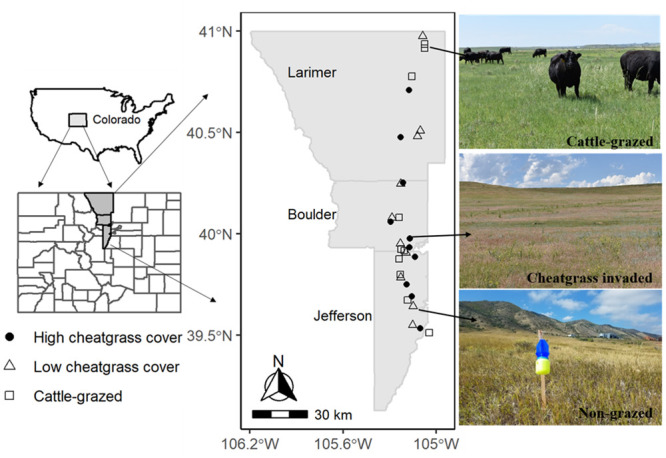
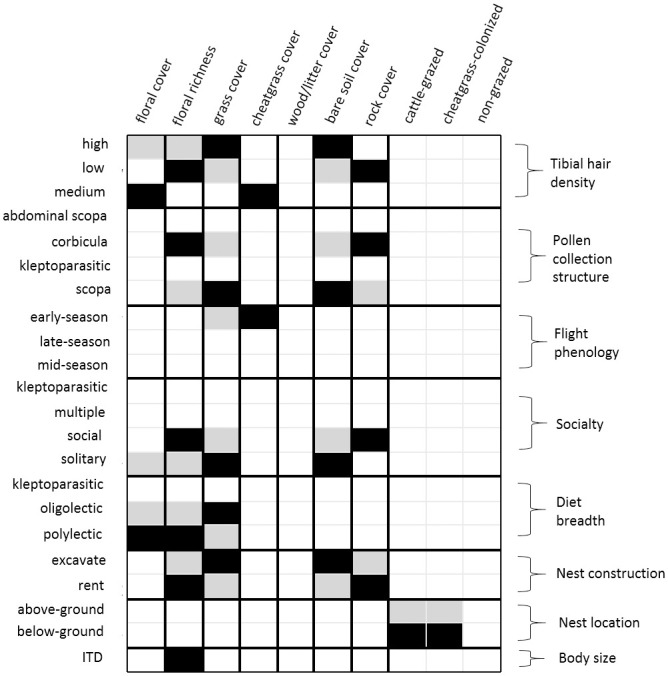
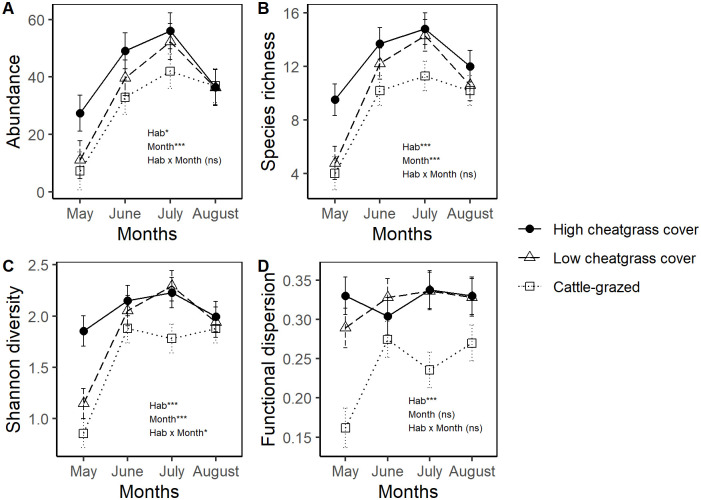
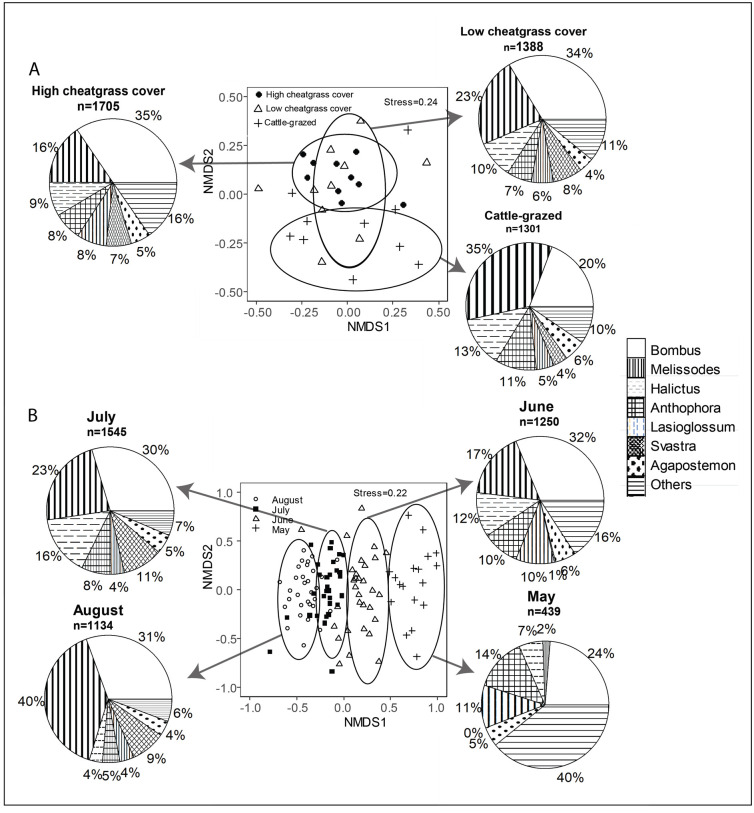
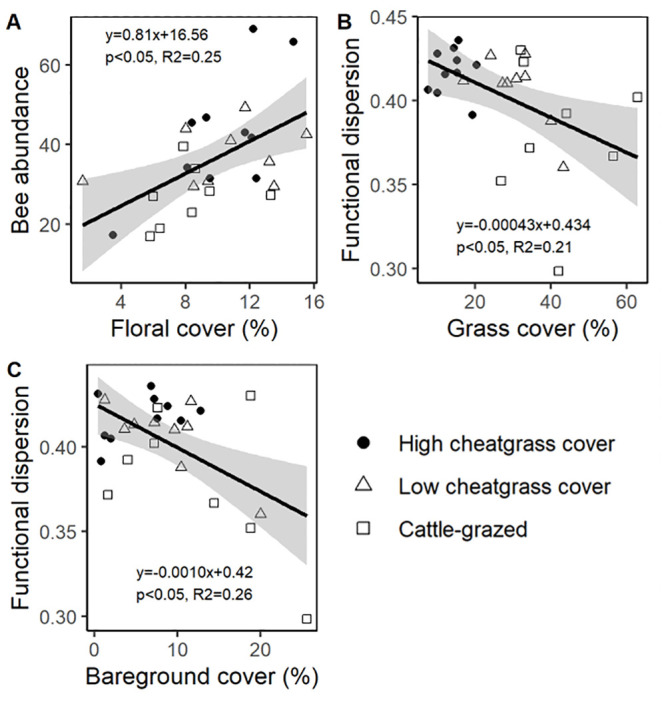
Livestock grazing and non-native plant species affect rangeland habitats globally. These factors may have important effects on ecosystem services including pollination, yet, interactions between pollinators, grazing, and invasive plants are poorly understood. To address this, we tested the hypothesis that cattle grazing and site colonization by cheatgrass (Bromus tectorum) impact bee foraging and nesting habitats, and the biodiversity of wild bee communities, in a shortgrass prairie system. Bee nesting habitats (litter and wood cover) were marginally improved in non-grazed sites with low cheatgrass cover, though foraging habitat (floral cover and richness, bare soil) did not differ among cattle-grazed sites or non-grazed sites with low or high cheatgrass cover. However, floral cover was a good predictor of bee abundance and functional dispersion. Mean bee abundance, richness, diversity and functional diversity were significantly lower in cattle-grazed habitats than in non-grazed habitats. Differences in bee diversity among habitats were pronounced early in the growing season (May) but by late-season (August) these differences eroded as Melissodes spp. and Bombus spp. became more abundant at study sites. Fourth-corner analysis revealed that sites with high floral cover tended to support large, social, polylectic bees; sites with high grass cover tended to support oligolectic solitary bees. Both cattle-grazed sites and sites with high cheatgrass cover were associated with lower abundances of above-ground nesting bees but higher abundance of below-ground nesters than non-grazed sites with low cheatgrass cover. We conclude that high cheatgrass cover is not associated with reduced bee biodiversity or abundance, but cattle grazing was negatively associated with bee abundances and altered species composition. Although floral cover is an important predictor of bee assemblages, this was not impacted by cattle grazing and our study suggests that cattle likely impact bee communities through effects other than those mediated by forbs, including soil disturbance or nest destruction. Efforts aimed at pollinator conservation in prairie habitats should focus on managing cattle impacts early in the growing season to benefit sensitive bee species.
家畜放牧和非本地植物物种会影响全球的牧场栖息地。这些因素可能对包括授粉在内的生态系统服务产生重要影响,但传粉媒介、放牧和入侵植物之间的相互作用仍知之甚少。为了解决这个问题,我们检验了以下假设:在短草草原系统中,牛放牧和假木贼(Bromus tectorum)在草原上的定殖会影响蜜蜂的觅食和筑巢栖息地,以及野生蜜蜂群落的生物多样性。在低假木贼覆盖的非放牧区,蜜蜂筑巢栖息地(落叶和木材覆盖)略有改善,而在放牧区或低或高假木贼覆盖的非放牧区,觅食栖息地(花卉覆盖和丰富度、裸土)没有差异。然而,花卉覆盖是蜜蜂丰度和功能分散的良好预测因子。与非放牧区相比,在放牧区蜜蜂的平均丰度、丰富度、多样性和功能多样性显著降低。在生长季节(5 月)早期,栖息地之间的蜜蜂多样性差异明显,但到了生长季节后期(8 月),由于梅利索德斯属(Melissodes spp.)和熊蜂属(Bombus spp.)在研究地点变得更加丰富,这些差异逐渐消失。第四角分析显示,高花卉覆盖的地点往往支持大型、社会性、多营养的蜜蜂;高草覆盖的地点往往支持寡营养的独居蜜蜂。牛放牧区和高假木贼覆盖区与地上筑巢蜜蜂的丰度较低有关,但与低假木贼覆盖的非放牧区相比,地下筑巢的蜜蜂丰度较高。我们的结论是,高假木贼覆盖与蜜蜂生物多样性或丰度的降低无关,但牛放牧与蜜蜂丰度和物种组成的改变呈负相关。尽管花卉覆盖是蜜蜂组合的一个重要预测因子,但它不受牛放牧的影响,我们的研究表明,牛可能通过除草本植物以外的其他因素影响蜜蜂群落,包括土壤扰动或巢破坏。在草原栖息地中保护传粉媒介的努力应侧重于在生长季节早期管理牛的影响,以造福于敏感的蜜蜂物种。