McMillan Sara S, King Michelle, Tully Mary P
School of Pharmacy, Menzies Health Institute Queensland, Griffith University, Gold Coast Campus, Gold Coast, QLD, Australia.
Manchester Pharmacy School, University of Manchester, Oxford Road, Manchester, UK.
Int J Clin Pharm. 2016 Jun;38(3):655-62. doi: 10.1007/s11096-016-0257-x. Epub 2016 Feb 5.
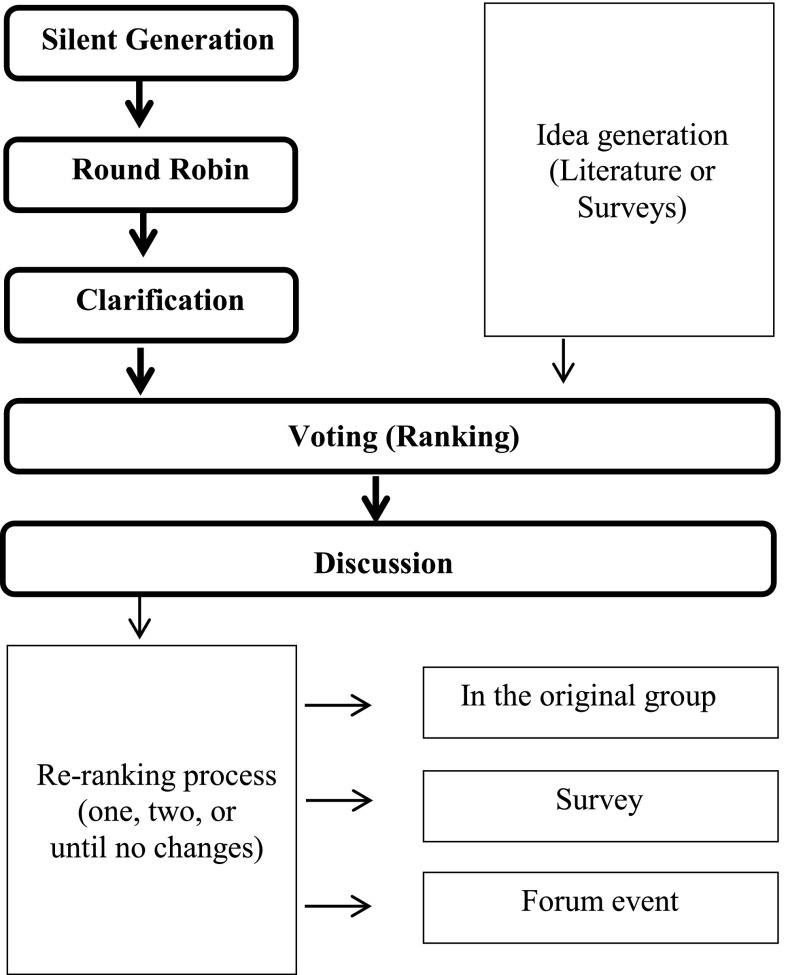
Introduction The Nominal Group Technique (NGT) and Delphi Technique are consensus methods used in research that is directed at problem-solving, idea-generation, or determining priorities. While consensus methods are commonly used in health services literature, few studies in pharmacy practice use these methods. This paper provides an overview of the NGT and Delphi technique, including the steps involved and the types of research questions best suited to each method, with examples from the pharmacy literature. Methodology The NGT entails face-to-face discussion in small groups, and provides a prompt result for researchers. The classic NGT involves four key stages: silent generation, round robin, clarification and voting (ranking). Variations have occurred in relation to generating ideas, and how 'consensus' is obtained from participants. The Delphi technique uses a multistage self-completed questionnaire with individual feedback, to determine consensus from a larger group of 'experts.' Questionnaires have been mailed, or more recently, e-mailed to participants. When to use The NGT has been used to explore consumer and stakeholder views, while the Delphi technique is commonly used to develop guidelines with health professionals. Method choice is influenced by various factors, including the research question, the perception of consensus required, and associated practicalities such as time and geography. Limitations The NGT requires participants to personally attend a meeting. This may prove difficult to organise and geography may limit attendance. The Delphi technique can take weeks or months to conclude, especially if multiple rounds are required, and may be complex for lay people to complete.
引言 名义群体技术(NGT)和德尔菲技术是用于以解决问题、产生想法或确定优先级为导向的研究中的共识方法。虽然共识方法在卫生服务文献中常用,但在药学实践中很少有研究使用这些方法。本文概述了名义群体技术和德尔菲技术,包括所涉及的步骤以及最适合每种方法的研究问题类型,并列举了药学文献中的实例。
方法 名义群体技术需要在小组中进行面对面讨论,并能为研究人员迅速得出结果。经典的名义群体技术包括四个关键阶段:沉默产生想法、轮流发言、澄清和投票(排序)。在产生想法以及如何从参与者中获得“共识”方面出现了一些变体。德尔菲技术使用带有个人反馈的多阶段自填式问卷,以从更大规模的“专家”群体中确定共识。问卷已通过邮寄方式发放,或者最近通过电子邮件发送给参与者。
何时使用 名义群体技术已用于探索消费者和利益相关者的观点,而德尔菲技术通常用于与卫生专业人员共同制定指南。方法的选择受多种因素影响,包括研究问题、所需共识的认知以及时间和地理等相关实际情况。
局限性 名义群体技术要求参与者亲自参加会议。这可能难以组织,而且地理位置可能会限制参会人数。德尔菲技术可能需要数周或数月才能完成,特别是如果需要多轮的话,并且对于外行人员来说可能难以完成。