Hand J M, Szabo L J, Vasconcelos A C, Cashmore A R
Department of Biology, University of Pennsylvania, Philadelphia 19104.
EMBO J. 1989 Nov;8(11):3195-206. doi: 10.1002/j.1460-2075.1989.tb08478.x.
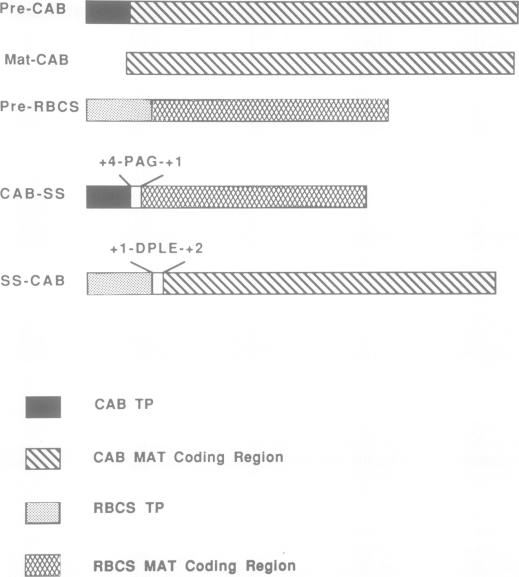
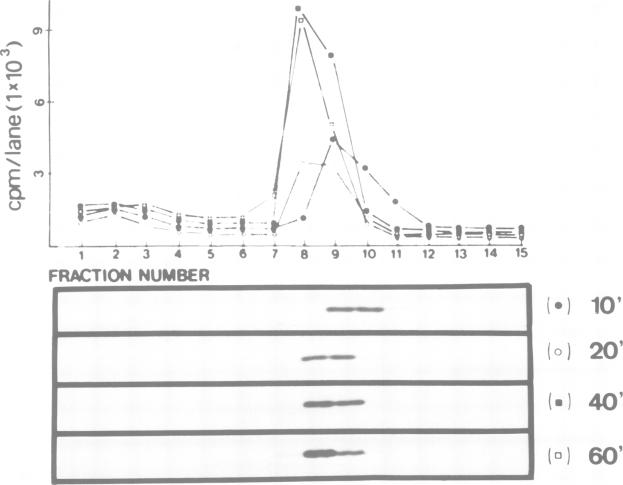
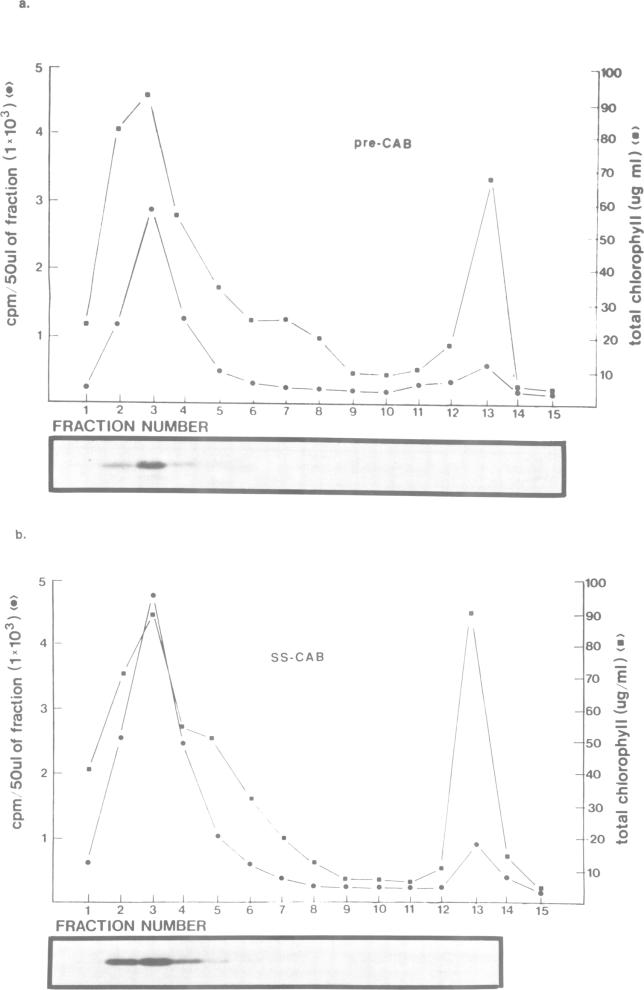
The role of transit peptides in intraorganellar targeting has been studied for a chlorophyll a/b binding (CAB) polypeptide of photosystem II (PSII) and the small subunit of ribulose-1,5-bisphosphate carboxylase (RBCS) from Pisum sativum (pea). These studies have involved in vitro import of fusion proteins into isolated pea chloroplasts. Fusion of the CAB transit peptide to RBCS mediates import to the stroma, as evidenced by assembly of RBCS with chloroplast-synthesized large subunit (RBCL) to form holoenzyme. Similarly, fusion of the RBCS transit peptide to the mature CAB polypeptide mediates import and results in integration of the processed CAB protein into the thylakoid membrane. Correct integration was indicated by association with PSII and assembly with chlorophyll to form the light-harvesting chlorophyll a/b protein complex (LHCII). We interpret these results as evidence that the CAB transit peptide is functionally equivalent to a stromal-targeting sequence and that intraorganellar sorting of the CAB protein must be determined by sequences residing within the mature protein. Our results and those of others suggest that import and integration of CAB polypeptides into the thylakoid proceeds via the stroma.
转运肽在细胞器内靶向中的作用已针对豌豆光系统II(PSII)的叶绿素a/b结合(CAB)多肽和1,5-二磷酸核酮糖羧化酶(RBCS)的小亚基进行了研究。这些研究涉及将融合蛋白体外导入分离的豌豆叶绿体。CAB转运肽与RBCS的融合介导了其向基质的导入,这一点可通过RBCS与叶绿体合成的大亚基(RBCL)组装形成全酶得到证明。同样,RBCS转运肽与成熟CAB多肽的融合介导了导入,并导致加工后的CAB蛋白整合到类囊体膜中。与PSII结合并与叶绿素组装形成捕光叶绿素a/b蛋白复合体(LHCII)表明整合正确。我们将这些结果解释为证据,即CAB转运肽在功能上等同于基质靶向序列,并且CAB蛋白在细胞器内的分选必须由成熟蛋白内的序列决定。我们的结果以及其他人的结果表明,CAB多肽向类囊体的导入和整合是通过基质进行的。