
全球温室气体排放与气候变化负担之间的不匹配。
Global mismatch between greenhouse gas emissions and the burden of climate change.
作者信息
Althor Glenn, Watson James E M, Fuller Richard A
机构信息
School of Geography, Planning and Environmental Management, University of Queensland, Queensland, 4072, Australia.
Wildlife Conservation Society, Global Conservation Program, 2300 Southern Boulevard, Bronx, NY 10460-1068, USA.
出版信息
Sci Rep. 2016 Feb 5;6:20281. doi: 10.1038/srep20281.
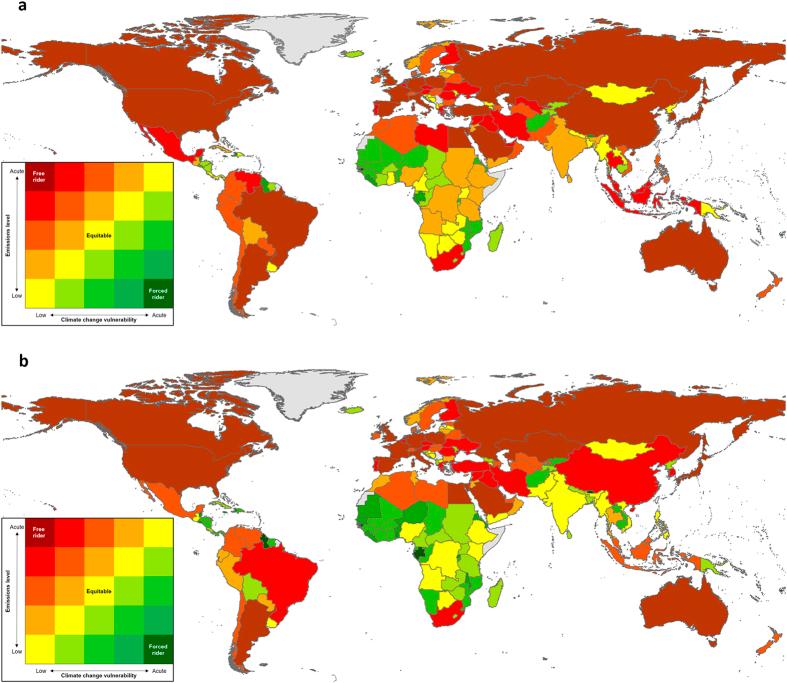
Countries export much of the harm created by their greenhouse gas (GHG) emissions because the Earth's atmosphere intermixes globally. Yet, the extent to which this leads to inequity between GHG emitters and those impacted by the resulting climate change depends on the distribution of climate vulnerability. Here, we determine empirically the relationship between countries' GHG emissions and their vulnerability to negative effects of climate change. In line with the results of other studies, we find an enormous global inequality where 20 of the 36 highest emitting countries are among the least vulnerable to negative impacts of future climate change. Conversely, 11 of the 17 countries with low or moderate GHG emissions, are acutely vulnerable to negative impacts of climate change. In 2010, only 28 (16%) countries had an equitable balance between emissions and vulnerability. Moreover, future emissions scenarios show that this inequality will significantly worsen by 2030. Many countries are manifestly free riders causing others to bear a climate change burden, which acts as a disincentive for them to mitigate their emissions. It is time that this persistent and worsening climate inequity is resolved, and for the largest emitting countries to act on their commitment of common but differentiated responsibilities.
由于地球大气在全球范围内混合,各国排放的温室气体所造成的许多危害被转嫁到其他国家。然而,温室气体排放国与受气候变化影响的国家之间的不平等程度取决于气候脆弱性的分布情况。在此,我们通过实证研究确定各国温室气体排放与其易受气候变化负面影响程度之间的关系。与其他研究结果一致,我们发现全球存在巨大的不平等:在36个温室气体排放最多的国家中,有20个国家是最不易受未来气候变化负面影响的国家。相反,在17个温室气体排放低或中等的国家中,有11个国家极易受到气候变化的负面影响。2010年,只有28个(16%)国家在排放和脆弱性之间实现了公平平衡。此外,未来排放情景表明,到2030年这种不平等将显著加剧。许多国家显然是搭便车者,让其他国家承担气候变化的负担,这不利于它们减少排放。现在是解决这种持续且不断恶化的气候不平等问题的时候了,最大排放国应履行其共同但有区别的责任承诺。

 Zotero 插件