Kim Yeong C, Zhao Linli, Zhang Hanwen, Huang Ye, Cui Jian, Xiao Fengxia, Downs Bradley, Wang San Ming
Department of Genetics, Cell Biology and Anatomy, College of Medicine, University of Nebraska Medical Center, Omaha, NE, USA.
Oncotarget. 2016 Feb 23;7(8):9600-12. doi: 10.18632/oncotarget.7144.
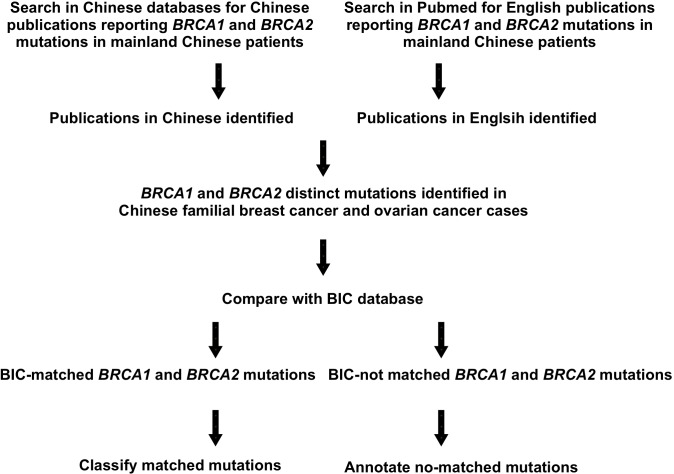
Germline mutations in BRCA1 and BRCA2 are the most penetrating genetic predispositions for breast and ovarian cancer, and their presence is largely ethnic-specific. Comprehensive information about the prevalence and spectrum of BRCA mutations has been collected in European and North American populations. However, similar information is lacking in other populations, including the mainland Chinese population despite its large size of 1.4 billion accounting for one fifth of the world's population. Herein, we performed an extensive literature analysis to collect BRCA variants identified from mainland Chinese familial breast and ovarian cancer patients. We observed 137 distinct BRCA1 variants in 409 of 3,844 and 80 distinct BRCA2 variants in 157 of 3,024 mainland Chinese patients, with an estimated prevalence of 10.6% for BRCA1 and 5.2% for BRCA2. Of these variants, only 40.3% in BRCA1 and 42.5% in BRCA2 are listed in current Breast Cancer Information Core database. We observed higher frequent variation in BRCA1 exons 11A, 11C, 11D, and 24 and BRCA2 exon 10 in Chinese patients than in the patients of other populations. The most common pathogenic variant in BRCA1 wasc.981_982delAT in exon 11A, and in BRCA2 c.3195_3198delTAAT in exon 11B and c.5576_5579delTTAA in exon 11E; the most common novel variant in BRCA1 was c.919A>G in exon 10A, and in BRCA2 c.7142delC in exon 14. None of the variants overlap with the founder mutations in other populations. Our analysis indicates that the prevalence of BRCA variation in mainland Chinese familial breast and ovarian cancer patients is at a level similar to but the spectrum is substantially different from the ones of other populations.
BRCA1和BRCA2的种系突变是乳腺癌和卵巢癌最具侵袭性的遗传易感性因素,其存在在很大程度上具有种族特异性。欧洲和北美人群已收集到有关BRCA突变患病率和谱系的全面信息。然而,包括中国大陆人群在内的其他人群缺乏类似信息,尽管中国大陆人口多达14亿,占世界人口的五分之一。在此,我们进行了广泛的文献分析,以收集来自中国大陆家族性乳腺癌和卵巢癌患者的BRCA变异。我们在3844例中国大陆患者中的409例中观察到137种不同的BRCA1变异,在3024例患者中的157例中观察到80种不同的BRCA2变异,估计BRCA1的患病率为10.6%,BRCA2的患病率为5.2%。在这些变异中,目前的乳腺癌信息核心数据库中仅列出了BRCA1变异的40.3%和BRCA2变异的42.5%。我们观察到中国患者BRCA1基因第11A、11C、11D和24外显子以及BRCA2基因第10外显子的变异频率高于其他人群的患者。BRCA1中最常见的致病变异是第11A外显子的c.981_982delAT,BRCA2中最常见的致病变异是第11B外显子的c.3195_3198delTAAT和第11E外显子的c.5576_5579delTTAA;BRCA1中最常见的新变异是第10A外显子的c.919A>G,BRCA2中最常见的新变异是第14外显子的c.7142delC。这些变异均与其他人群的始祖突变无重叠。我们的分析表明,中国大陆家族性乳腺癌和卵巢癌患者中BRCA变异的患病率与其他人群相似,但谱系存在显著差异。