Institute for Public Health Genetics, University of Washington, Seattle, Washington, United States of America.
Department of Laboratory Medicine, University of Washington, Seattle, Washington, United States of America.
PLoS One. 2023 Feb 8;18(2):e0278010. doi: 10.1371/journal.pone.0278010. eCollection 2023.
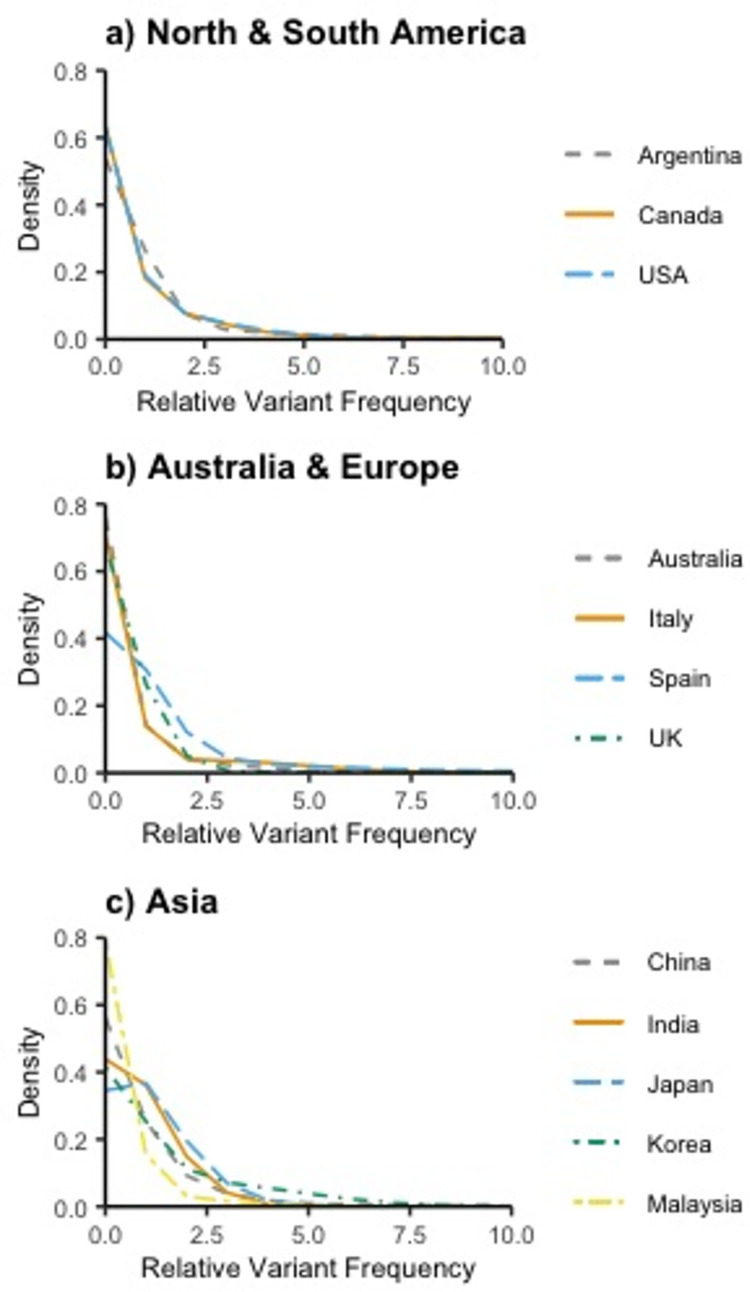
There have been many surveys of genetic variation in BRCA1 and BRCA2 to identify variant prevalence and catalogue population specific variants, yet none have evaluated the magnitude of unobserved variation. We applied species richness estimation methods from ecology to estimate "variant richness" and determine how many germline pathogenic BRCA1/2 variants have yet to be identified and the frequency of these missing variants in different populations. We also estimated the prevalence of germline pathogenic BRCA1/2 variants and identified those expected to be most common. Data was obtained from a literature search including studies conducted globally that tested the entirety of BRCA1/2 for pathogenic variation. Across countries, 45% to 88% of variants were estimated to be missing, i.e., present in the population but not observed in study data. Estimated variant frequencies in each country showed a higher proportion of rare variants compared to recurrent variants. The median prevalence estimate of BRCA1/2 pathogenic variant carriers was 0.64%. BRCA1 c.68_69del is likely the most recurrent BRCA1/2 variant globally due to its estimated prevalence in India. Modeling variant richness using ecology methods may assist in evaluating clinical targeted assays by providing a picture of what is observed with estimates of what is still unknown.
已经有许多针对 BRCA1 和 BRCA2 的遗传变异进行的调查,以确定变异的流行率并编目特定人群的变异,但没有一项研究评估未观察到的变异的程度。我们应用生态学中的物种丰富度估计方法来估计“变异丰富度”,并确定还有多少种胚系致病性 BRCA1/2 变异尚未被发现,以及这些缺失变异在不同人群中的频率。我们还估计了胚系致病性 BRCA1/2 变异的流行率,并确定了那些预计最常见的变异。数据来自文献检索,包括在全球范围内进行的研究,这些研究测试了 BRCA1/2 的全部致病性变异。在各国,估计有 45%至 88%的变异缺失,即存在于人群中但在研究数据中未观察到。每个国家的估计变异频率显示出与复发变异相比,罕见变异的比例更高。BRCA1/2 致病性变异携带者的中位数患病率估计值为 0.64%。BRCA1 c.68_69del 可能是全球最常见的 BRCA1/2 变异,因为它在印度的患病率估计较高。使用生态学方法模拟变异丰富度可以通过提供观察到的情况的估计和仍未知的情况的估计来帮助评估临床靶向检测。