Kato Aya, Sato Naoki, Sugawara Tae, Takahashi Kazue, Kito Masahiko, Makino Kenichi, Sato Toshiharu, Shimizu Dai, Shirasawa Hiromistu, Miura Hiroshi, Sato Wataru, Kumazawa Yukiyo, Sato Akira, Kumagai Jin, Terada Yukihiro
*Department of Obstetrics and Gynecology, Akita University Graduate School of Medicine †Department of Obstetrics and Gynecology, Noshiro Kosei Medical Center, Akita, Japan.
Am J Surg Pathol. 2016 Jun;40(6):770-6. doi: 10.1097/PAS.0000000000000606.
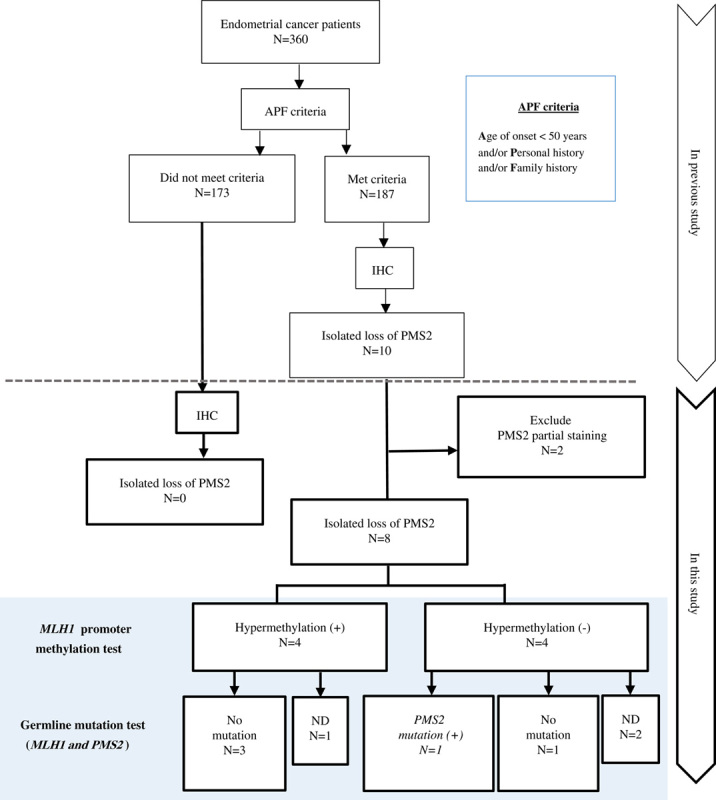
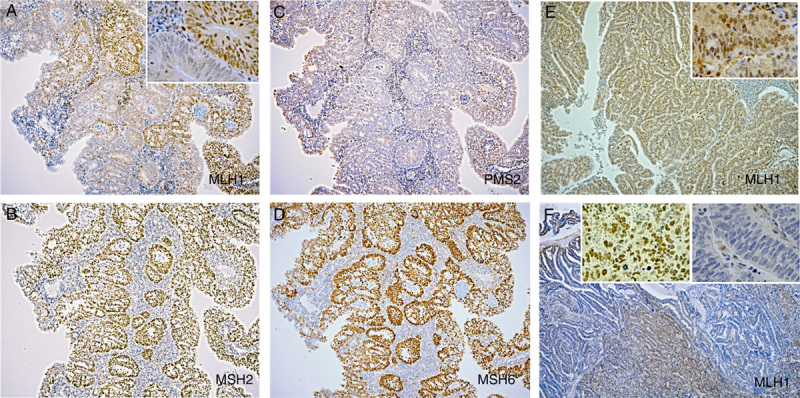
Lynch syndrome (LS) is an autosomal-dominant inherited disorder mainly caused by a germline mutation in the DNA mismatch repair (MMR) genes (MLH1, MSH2, MSH6, and PMS2) and is associated with increased risk for various cancers, particularly colorectal cancer and endometrial cancer (EC). Women with LS account for 2% to 6% of EC patients; it is clinically important to identify LS in such individuals for predicting and/or preventing additional LS-associated cancers. PMS2 germline mutation (PMS2-LS) is the rarest contribution to LS etiology among the 4 LS-associated MMR germline mutations, and its detection is complicated. Therefore, prudent screening for PMS2-LS is important as it leads to an efficient LS identification strategy. Immunohistochemistry is recommended as a screening method for LS in EC. Isolated loss of PMS2 (IL-PMS2) expression is caused not only by PMS2-LS but also by MLH1 germline mutation or MLH1 promoter hypermethylation (MLH-PHM). This study aimed to determine the association between MLH1-PHM and IL-PMS2 to avoid inappropriate genetic analysis. We performed MLH1 methylation analysis and MLH1/PMS2 germline mutation testing on the IL-PMS2 cases. By performing MMR-immunohistochemistry on 360 unselected ECs, we could select 8 (2.2%) cases as IL-PMS2. Heterogenous MLH1 staining and MLH1-PHM were detected in 4 of 8 (50%) IL-PMS2 tumors. Of the 5 IL-PMS2 patients who underwent genetic analysis, 1 had PMS2 germline mutation with normal MLH1 expression (without MLH1-PHM), and no MLH1 germline mutation was detected. We suggest that MLH1 promoter methylation analysis for IL-PMS2 EC should be performed to exclude sporadic cases before further PMS2 genetic testing.
林奇综合征(LS)是一种常染色体显性遗传性疾病,主要由DNA错配修复(MMR)基因(MLH1、MSH2、MSH6和PMS2)的种系突变引起,与多种癌症风险增加相关,尤其是结直肠癌和子宫内膜癌(EC)。患有LS的女性占EC患者的2%至6%;在这些个体中识别LS对于预测和/或预防其他与LS相关的癌症具有重要临床意义。PMS2种系突变(PMS2-LS)是4种与LS相关的MMR种系突变中对LS病因学贡献最少的,其检测较为复杂。因此,谨慎筛查PMS2-LS很重要,因为这有助于制定有效的LS识别策略。免疫组化被推荐作为EC中LS的筛查方法。PMS2表达的孤立缺失(IL-PMS2)不仅由PMS2-LS引起,还可由MLH1种系突变或MLH1启动子高甲基化(MLH-PHM)引起。本研究旨在确定MLH1-PHM与IL-PMS2之间的关联,以避免不适当的基因分析。我们对IL-PMS2病例进行了MLH1甲基化分析和MLH1/PMS2种系突变检测。通过对360例未经选择的EC进行MMR免疫组化,我们筛选出8例(2.2%)为IL-PMS2。在8例(50%)IL-PMS2肿瘤中,有4例检测到MLH1染色异质性和MLH1-PHM。在接受基因分析的5例IL-PMS2患者中,1例存在PMS2种系突变且MLH1表达正常(无MLH1-PHM),未检测到MLH1种系突变。我们建议,对于IL-PMS2 EC,应在进一步进行PMS2基因检测之前进行MLH1启动子甲基化分析,以排除散发病例。