An Dongshan, Dong Xiaoli, An Annie, Park Hyung S, Strous Marc, Voordouw Gerrit
Petroleum Microbiology Research Group, Department of Biological Sciences, University of Calgary Calgary, AB, Canada.
Department of Geosciences, University of Calgary Calgary, AB, Canada.
Front Microbiol. 2016 Jan 28;7:28. doi: 10.3389/fmicb.2016.00028. eCollection 2016.
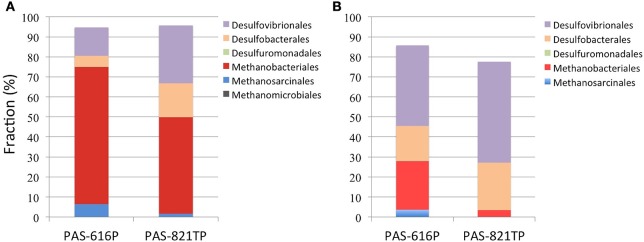
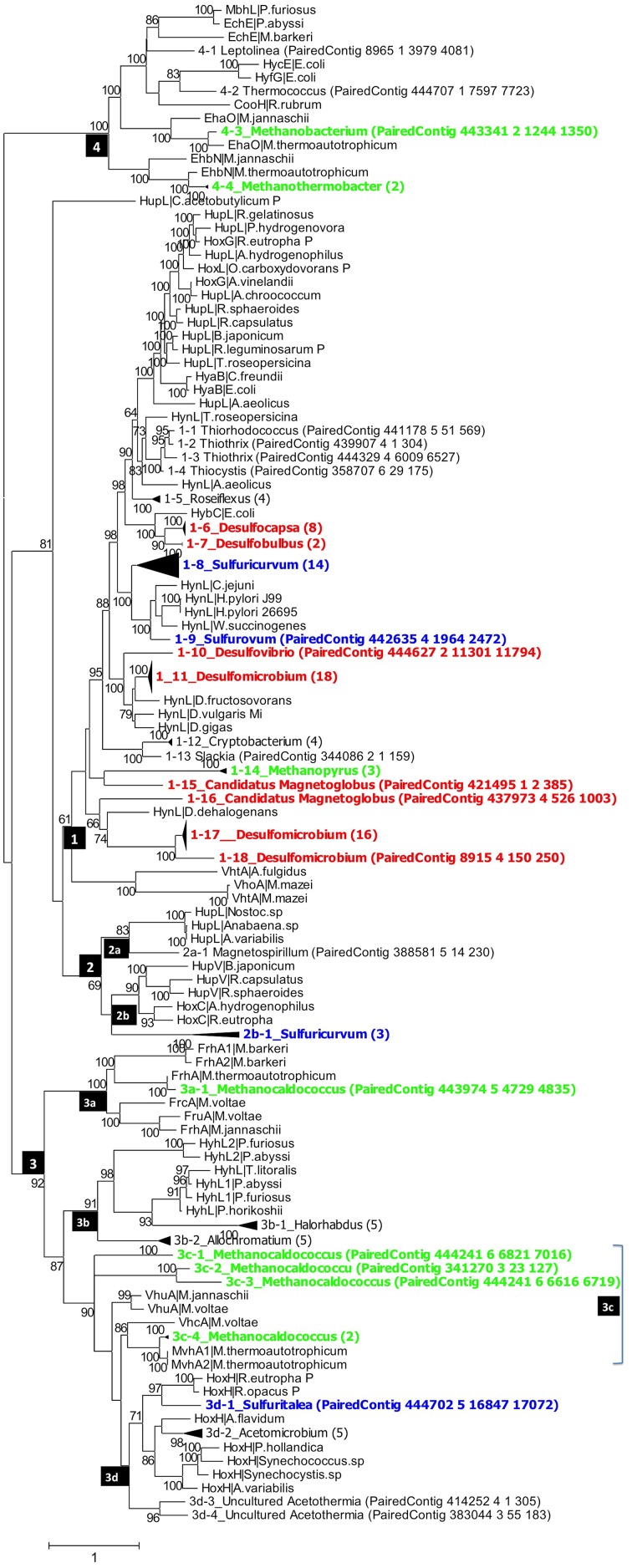
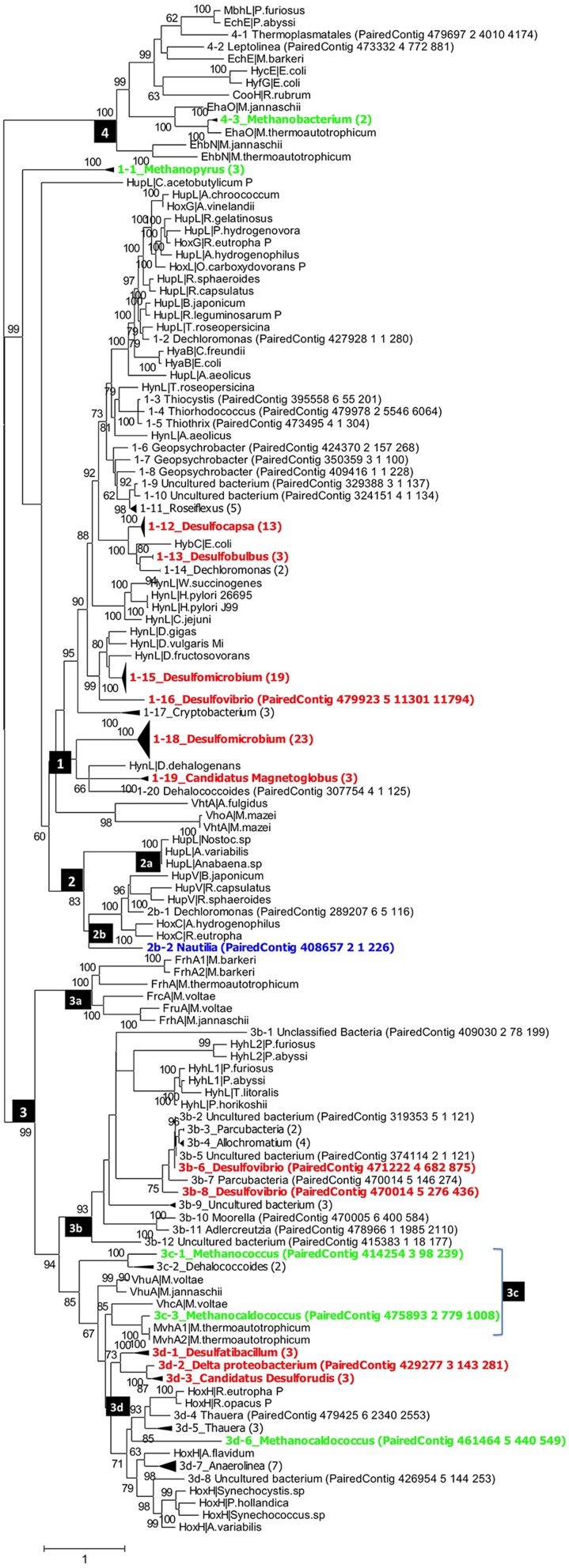
Sodium bisulfite (SBS) is used as an oxygen scavenger to decrease corrosion in pipelines transporting brackish subsurface water used in the production of bitumen by steam-assisted gravity drainage. Sequencing 16S rRNA gene amplicons has indicated that SBS addition increased the fraction of the sulfate-reducing bacteria (SRB) Desulfomicrobium, as well as of Desulfocapsa, which can also grow by disproportionating sulfite into sulfide, sulfur, and sulfate. SRB use cathodic H2, formed by reduction of aqueous protons at the iron surface, or use low potential electrons from iron and aqueous protons directly for sulfate reduction. In order to reveal the effects of SBS treatment in more detail, metagenomic analysis was performed with pipe-associated solids (PAS) scraped from a pipe section upstream (PAS-616P) and downstream (PAS-821TP) of the SBS injection point. A major SBS-induced change in microbial community composition and in affiliated hynL genes for the large subunit of [NiFe] hydrogenase was the appearance of sulfur-metabolizing Epsilonproteobacteria of the genera Sulfuricurvum and Sulfurovum. These are chemolithotrophs, which oxidize sulfide or sulfur with O2 or reduce sulfur with H2. Because O2 was absent, this class likely catalyzed reduction of sulfur (S(0)) originating from the metabolism of bisulfite with cathodic H2 (or low potential electrons and aqueous protons) originating from the corrosion of steel (Fe(0)). Overall this accelerates reaction of of S(0) and Fe(0) to form FeS, making this class a potentially powerful contributor to microbial corrosion. The PAS-821TP metagenome also had increased fractions of Deltaproteobacteria including the SRB Desulfomicrobium and Desulfocapsa. Altogether, SBS increased the fraction of hydrogen-utilizing Delta- and Epsilonproteobacteria in brackish-water-transporting pipelines, potentially stimulating anaerobic pipeline corrosion if dosed in excess of the intended oxygen scavenger function.
亚硫酸氢钠(SBS)用作除氧剂,以减少在通过蒸汽辅助重力排水生产沥青过程中输送微咸地下水的管道中的腐蚀。对16S rRNA基因扩增子进行测序表明,添加SBS增加了硫酸盐还原菌(SRB)脱硫微菌属以及脱硫荚膜菌属的比例,脱硫荚膜菌属也可以通过将亚硫酸盐歧化为硫化物、硫和硫酸盐来生长。SRB利用在铁表面还原水合质子形成的阴极H2,或直接利用来自铁和水合质子的低电位电子进行硫酸盐还原。为了更详细地揭示SBS处理的效果,对从SBS注入点上游(PAS - 616P)和下游(PAS - 821TP)的管段刮下的管道相关固体(PAS)进行了宏基因组分析。SBS引起的微生物群落组成和[NiFe]氢化酶大亚基相关hynL基因的一个主要变化是出现了硫代谢的硫化弯曲菌属和硫还原菌属的ε-变形菌。这些是化能自养菌,它们用O2氧化硫化物或硫,或用H2还原硫。由于不存在O2,这类菌可能催化了由亚硫酸氢盐代谢产生的硫(S(0))与由钢(Fe(0))腐蚀产生的阴极H2(或低电位电子和水合质子)的还原反应。总体而言,这加速了S(0)和Fe(0)反应形成FeS,使这类菌成为微生物腐蚀的潜在强大促进因素。PAS - 821TP宏基因组中δ-变形菌的比例也增加了,包括SRB脱硫微菌属和脱硫荚膜菌属。总之,SBS增加了在输送微咸水的管道中利用氢气的δ-和ε-变形菌的比例,如果剂量超过预期的除氧功能,可能会刺激厌氧管道腐蚀。