Belachew Abate Bekele, Kahsay Alemayehu Bayray, Abebe Yemane Gabremariam
School of Public Health, College of Health Sciences, Mekele University, Mekele, Ethiopia.
Arch Public Health. 2016 Feb 8;74:6. doi: 10.1186/s13690-016-0117-0. eCollection 2016.
Ethiopia is a country with low optimal breast feeding practice, and prelacteal feeding is still a norm. Introduction of prelacteal feeding is a known barrier for optimal breast feeding practices. However, knowledge on determinants of introduction of prelacteal feeding is minimal. This study aimed to identify the effects of individual and community-level factors in the introduction of prelacteal feeding in Ethiopia.
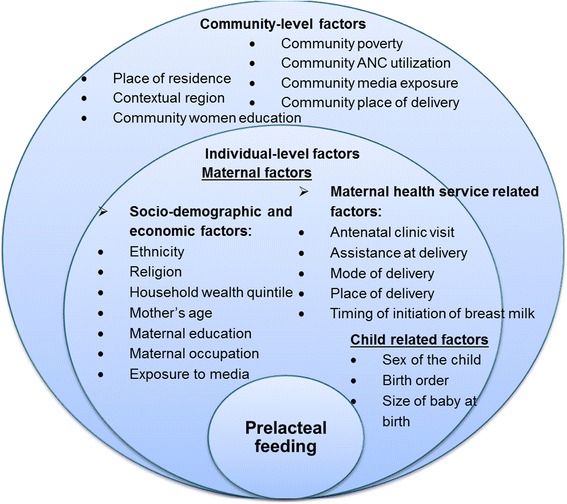
Data for this study was extracted from the nationally representative 2011 Ethiopia Demographic and Health Survey (EDHS) and focused on a sample from child data, with a sample from 576 clusters of 7692 children who were last-born in the past five years preceding the survey. The data was collected using two-stage cluster design, in which enumeration areas forming the first stage and households making the second stage. A two-level mixed effect multivariable logistic regression model was fitted to determine the individual and community-level factors associated with introduction of prelacteal feeding.
From the total sample of children 28.92 % were fed prelacteals. Butter (n = 1143), plain water (n = 395) and milk-other than breast milk (n = 323) were commonly used prelacteals. In multivariable two-level mixed effect model; caesarean mode of delivery (Adjusted odds ratio (AOR) = 1.87; 95 % CI 1.28, 2.73), and late initiation of breastfeeding (AOR = 5.32; 95 % CI 4.65, 6.09) were both positively associated with the odds of giving prelacteals. Higher economic status 28 % (AOR = 0.72; 95 % CI 0.54, 0.98), giving birth at hand of non-health personnel birth assistance (AOR = 0.68; 95 % CI 0.54, 0.87), large birth size of child (AOR = 0.80; 95 % CI 0.68, 0.95) and high community antenatal care use (AOR = 0.58; 95 % CI 0.38, 0.87) were negatively associated with the odds of giving prelacteals. Significant variation in prelacteal feeding practice was also seen among ethnic and religious groups, and across regions.
The prevalence of prelacteal feeding was high that remained a challenge for optimal breastfeeding in Ethiopia. Not only individual-level factors, but also community-level factors contribute to prelacteal feeding practice. Increasing access to health education through increasing maternal health care service coverage and community involvement is crucial.
埃塞俄比亚是一个最佳母乳喂养实践水平较低的国家,产前喂养仍是一种常态。引入产前喂养是最佳母乳喂养实践的一个已知障碍。然而,关于产前喂养引入的决定因素的知识非常有限。本研究旨在确定个体和社区层面因素对埃塞俄比亚产前喂养引入的影响。
本研究的数据取自具有全国代表性的2011年埃塞俄比亚人口与健康调查(EDHS),重点是儿童数据样本,样本来自调查前五年内最后出生的7692名儿童的576个群组。数据采用两阶段整群设计收集,其中第一阶段为枚举区域,第二阶段为家庭。采用两级混合效应多变量逻辑回归模型来确定与产前喂养引入相关的个体和社区层面因素。
在儿童总样本中,28.92%的儿童接受了产前喂养。黄油(n = 1143)、白开水(n = 395)和母乳以外的奶类(n = 323)是常用的产前喂养食物。在多变量两级混合效应模型中;剖宫产分娩方式(调整比值比(AOR)= 1.87;95%置信区间1.28,2.73)和母乳喂养开始时间较晚(AOR = 5.32;95%置信区间4.65,6.09)均与给予产前喂养的几率呈正相关。较高的经济状况28%(AOR = 0.72;95%置信区间0.54,0.98)、由非卫生人员协助分娩(AOR = 0.68;95%置信区间0.54,0.87)、孩子出生时体型较大(AOR = 0.80;95%置信区间0.68,0.95)以及社区产前保健利用率较高(AOR = 0.58;95%置信区间0.38,0.87)与给予产前喂养的几率呈负相关。在不同民族和宗教群体以及不同地区之间,产前喂养实践也存在显著差异。
产前喂养的患病率很高,这仍然是埃塞俄比亚最佳母乳喂养面临的一个挑战。不仅个体层面因素,而且社区层面因素都对产前喂养实践有影响。通过增加孕产妇保健服务覆盖范围和社区参与来增加获得健康教育的机会至关重要。