
重组人促红细胞生成素与缺血预处理对大鼠肾缺血再灌注损伤的改善作用
Ameliorative Effect of Recombinant Human Erythropoietin and Ischemic Preconditioning on Renal Ischemia Reperfusion Injury in Rats.
作者信息
Elshiekh Mohammed, Kadkhodaee Mehri, Seifi Behjat, Ranjbaran Mina, Ahghari Parisa
机构信息
Department of Physiology, Faculty of Medicine, Tehran University of Medical Sciences, International campus, Tehran, IR Iran.
Department of Physiology, Faculty of Medicine, Tehran University of Medical Sciences, Tehran, IR Iran.
出版信息
Nephrourol Mon. 2015 Nov 29;7(6):e31152. doi: 10.5812/numonthly.31152. eCollection 2015 Nov.
BACKGROUND
Ischemia-reperfusion (IR) injury is one of the most common causes of renal dysfunction. There is increasing evidence about the role of the reactive oxygen species (ROS) in these injuries and endogenous antioxidants seem to have an important role in decreasing the renal tissue injury.
OBJECTIVES
The aim of this study was to compare the effect of recombinant human erythropoietin (EPO) and ischemic preconditioning (IPC) on renal IR injury.
MATERIALS AND METHODS
Twenty four male Wistar rats were allocated into four experimental groups: sham-operated, IR, EPO + IR, and IPC + IR. Rats were underwent 50 minutes bilateral ischemia followed by 24 hours reperfusion. Erythropoietin (5000 IU/kg, i.p) was administered 30 minutes before onset of ischemia. Ischemic preconditioning was performed by three cycles of 3 minutes ischemia followed by 3 minutes reperfusion. Plasma concentrations of urea and creatinine were measured. Kidney samples were taken for reactive oxidative species (ROS) measurement including superoxide dismutase (SOD) activity, glutathione (GSH) contents, and malondialdehyde (MDA) levels.
RESULTS
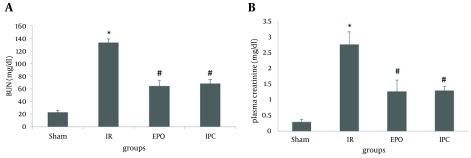
Compared to the sham group, IR led to renal dysfunction as evidenced by significantly higher plasma urea and creatinine. Treatment with EPO or IPC decreased urea, creatinine, and renal MDA levels and increased SOD activity and GSH contents in the kidney.
CONCLUSIONS
Pretreatment with EPO and application of IPC significantly ameliorated the renal injury induced by bilateral renal IR. However, both treatments attenuated renal dysfunction and oxidative stress in kidney tissues. There were no significant differences between pretreatment with EPO or application of IPC.
背景
缺血再灌注(IR)损伤是肾功能障碍最常见的原因之一。关于活性氧(ROS)在这些损伤中的作用,证据越来越多,内源性抗氧化剂似乎在减轻肾组织损伤方面发挥重要作用。
目的
本研究旨在比较重组人促红细胞生成素(EPO)和缺血预处理(IPC)对肾脏IR损伤的影响。
材料与方法
将24只雄性Wistar大鼠分为四个实验组:假手术组、IR组、EPO + IR组和IPC + IR组。大鼠接受50分钟的双侧缺血,随后进行24小时再灌注。在缺血开始前30分钟腹腔注射促红细胞生成素(5000 IU/kg)。通过三个3分钟缺血和3分钟再灌注的周期进行缺血预处理。测量血浆尿素和肌酐浓度。采集肾脏样本用于测量活性氧化物质(ROS),包括超氧化物歧化酶(SOD)活性、谷胱甘肽(GSH)含量和丙二醛(MDA)水平。
结果
与假手术组相比,IR导致肾功能障碍,血浆尿素和肌酐显著升高证明了这一点。EPO或IPC治疗降低了尿素、肌酐和肾脏MDA水平,并增加了肾脏中的SOD活性和GSH含量。
结论
EPO预处理和IPC应用显著改善了双侧肾脏IR诱导的肾损伤。然而,两种治疗都减轻了肾脏组织的功能障碍和氧化应激。EPO预处理或IPC应用之间没有显著差异。


 Zotero 插件