Elli Luca, Tomba Carolina, Branchi Federica, Roncoroni Leda, Lombardo Vincenza, Bardella Maria Teresa, Ferretti Francesca, Conte Dario, Valiante Flavio, Fini Lucia, Forti Edoardo, Cannizzaro Renato, Maiero Stefania, Londoni Claudio, Lauri Adriano, Fornaciari Giovanni, Lenoci Nicoletta, Spagnuolo Rocco, Basilisco Guido, Somalvico Francesco, Borgatta Bruno, Leandro Gioacchino, Segato Sergio, Barisani Donatella, Morreale Gaetano, Buscarini Elisabetta
Center for the Prevention and Diagnosis of Celiac Disease, Gastroenterology and Endoscopy Unit, Fondazione IRCCS Ca' Granda Ospedale Maggiore Policlinico, via Francesco Sforza 35, 20122 Milano, Italy.
Department of Medical, Surgical and Transplant Physiopathology, University of Milan, via Francesco Sforza 35, 20122 Milan, Italy.
Nutrients. 2016 Feb 8;8(2):84. doi: 10.3390/nu8020084.
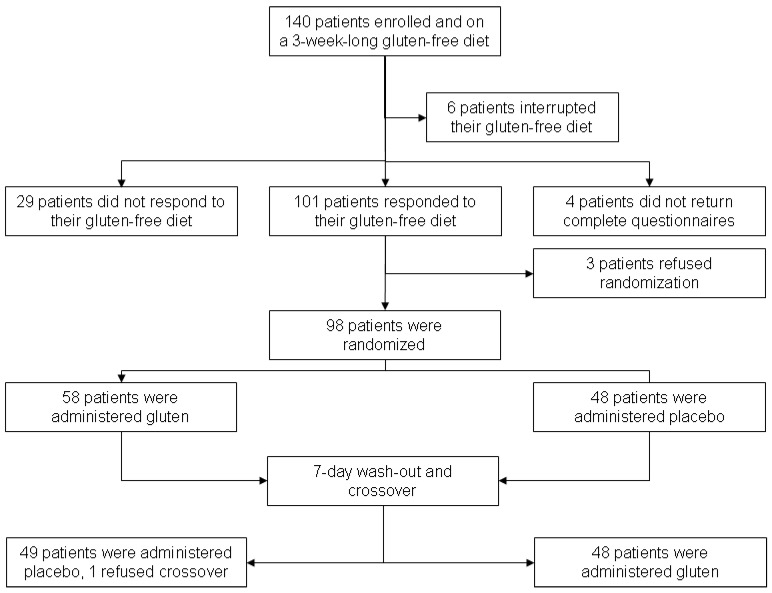
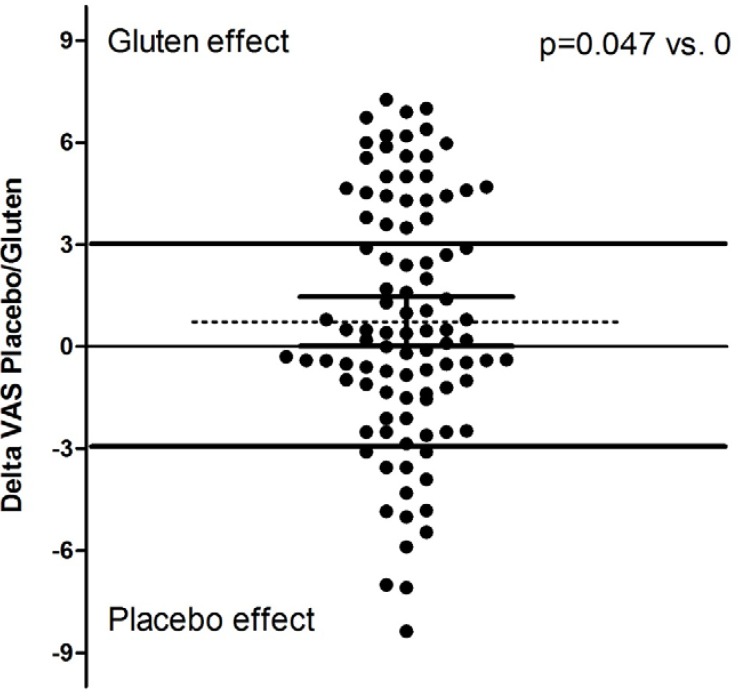
Non-celiac gluten sensitivity (NCGS) is characterized by the onset of symptoms after eating gluten-containing food. We aimed to single out NCGS subjects among subjects with functional gastrointestinal symptoms. Patients were enrolled in a multicenter double-blind placebo-controlled trial with crossover. Symptoms and quality of life were evaluated by means of 10-cm VAS and SF36. Iron parameters, transaminases and C reactive protein (CRP) were evaluated. After a three-week-long gluten-free diet (GFD), responsive patients were randomly assigned to gluten intake (5.6 g/day) or placebo for seven days, followed by crossover. The primary endpoint was the worsening of symptoms (VAS increase ≥3 cm) during gluten ingestion compared to placebo. One hundred and forty patients were enrolled and 134 (17 males, mean age 39.1 ± 11.7 years, BMI 22.4 ± 3.8) completed the first period. A total of 101 subjects (10 males, mean age 39.3 ± 11.0 years, BMI 22.3 ± 4.0) reported a symptomatic improvement (VAS score 2.3 ± 1.2 vs. 6.5 ± 2.2 before and after GFD, p = 0.001). 98 patients underwent the gluten challenge and 28 (all females, mean age 38.9 ± 12.7 years, BMI 22.0 ± 2.9) reported a symptomatic relapse and deterioration of quality of life. No parameters were found to be statistically associated with positivity to the challenge. However, 14 patients responded to the placebo ingestion. Taking into account this finding, about 14% of patients responding to gluten withdrawal showed a symptomatic relapse during the gluten challenge. This group is suspected to have NCGS.
非乳糜泻麸质敏感(NCGS)的特征是食用含麸质食物后出现症状。我们旨在从功能性胃肠道症状患者中筛选出NCGS患者。患者参加了一项多中心双盲安慰剂对照交叉试验。通过10厘米视觉模拟评分法(VAS)和SF36评估症状和生活质量。评估铁参数、转氨酶和C反应蛋白(CRP)。在进行为期三周的无麸质饮食(GFD)后,有反应的患者被随机分配接受麸质摄入(5.6克/天)或安慰剂治疗七天,然后交叉。主要终点是与安慰剂相比,麸质摄入期间症状恶化(VAS增加≥3厘米)。共招募了140名患者,134名(17名男性,平均年龄39.1±11.7岁,BMI 22.4±3.8)完成了第一阶段。共有101名受试者(10名男性,平均年龄39.3±11.0岁,BMI 22.3±4.0)报告症状改善(GFD前后VAS评分分别为2.3±1.2和6.5±2.2,p = 0.001)。98名患者接受了麸质激发试验,28名(均为女性,平均年龄38.9±12.7岁,BMI 22.0±2.9)报告症状复发且生活质量恶化。未发现任何参数与激发试验阳性有统计学关联。然而,14名患者对安慰剂摄入有反应。考虑到这一发现,约14%对麸质戒断有反应的患者在麸质激发试验期间出现症状复发。该组患者疑似患有NCGS。