Maerz Jan K, Roncoroni Lorenzo P, Goldeck David, Abruzzese Tanja, Kalbacher Hubert, Rolauffs Bernd, DeZwart Peter, Nieselt Kay, Hart Melanie L, Klein Gerd, Aicher Wilhelm K
KFO273, Department of Urology, University of Tübingen Hospital, Paul Ehrlich Str. 15, 72076, Tübingen, Germany.
Center for Medical Research, Department of Medicine II, University of Tübingen, Tübingen, Germany.
Stem Cell Res Ther. 2016 Feb 11;7:29. doi: 10.1186/s13287-015-0243-6.
Human mesenchymal stromal cells (MSCs) can be isolated from different sources including bone marrow and term placenta. These two populations display distinct patterns of proliferation and differentiation in vitro. Since proliferation and differentiation of cells are modulated by cell-matrix interactions, we investigated the attachment of MSCs to a set of peptide-coated surfaces and explored their interactions with peptides in suspension.
Human MSCs were isolated from bone marrow and term placenta and expanded. Binding of MSCs to peptides was investigated by a cell-attachment spot assay, by blocking experiments and flow cytometry. The integrin expression pattern was explored by a transcript array and corroborated by quantitative reverse transcription polymerase chain reaction and flow cytometry.
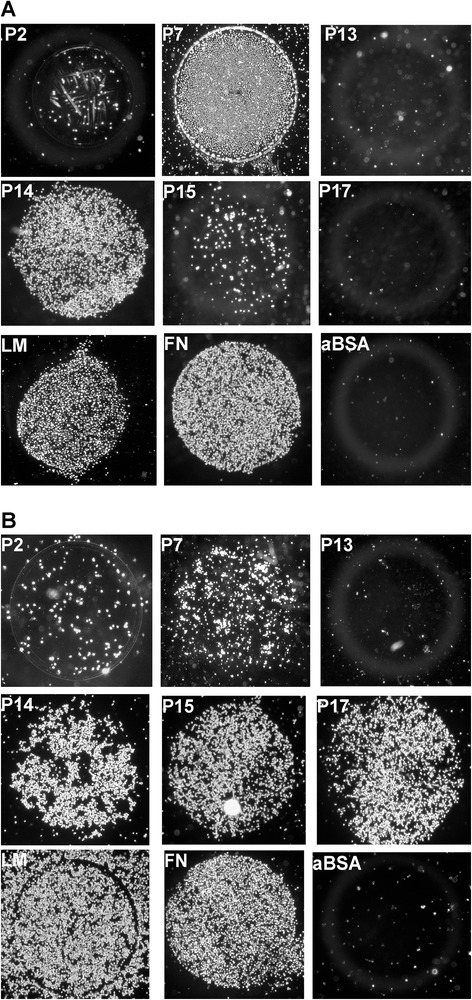
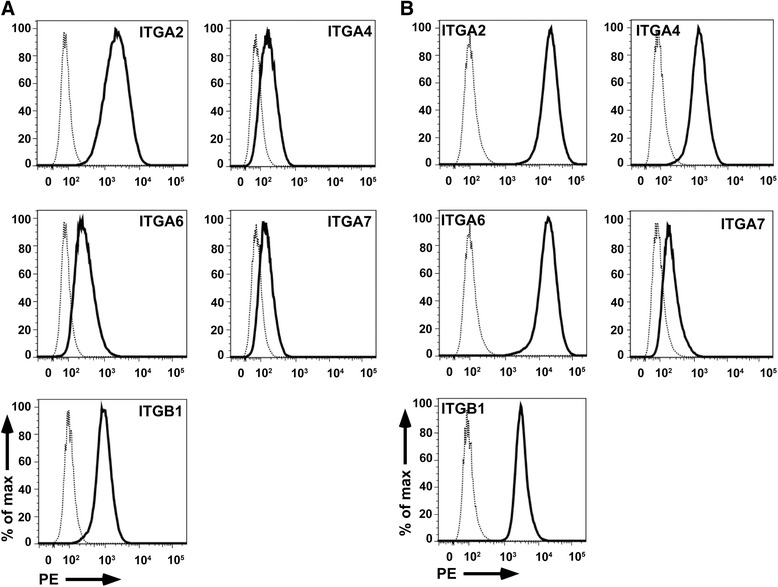
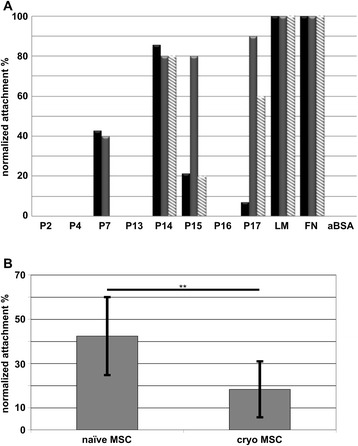
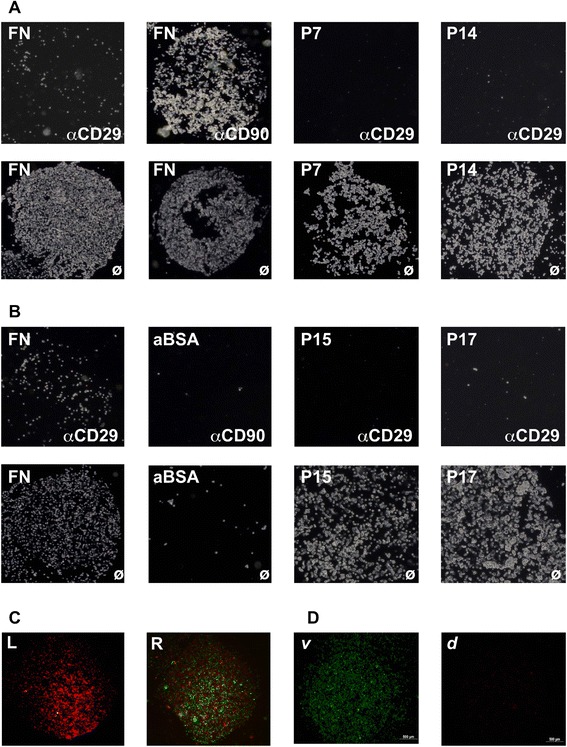
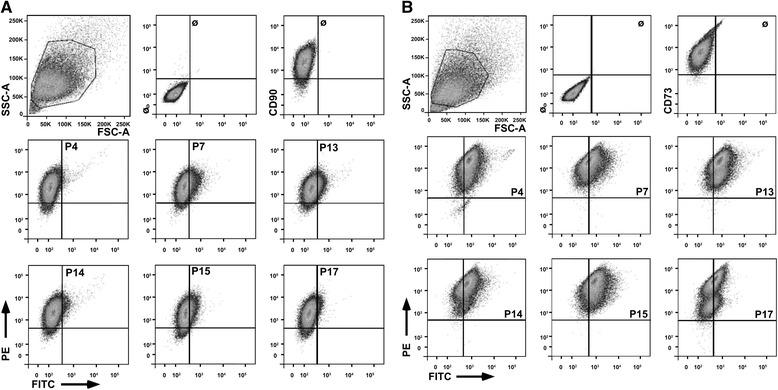
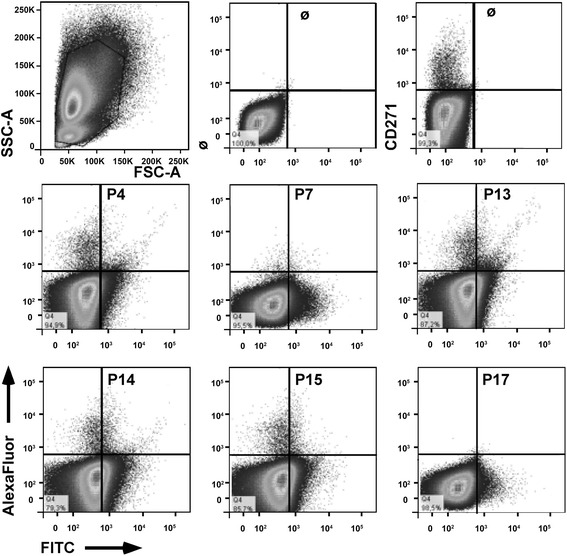
Expanded placenta-derived MSCs (pMSCs) attached well to surfaces coated with fibronectin-derived peptides P7, P15, and P17, whereas bone marrow-derived MSCs (bmMSCs) attached to P7, but barely to P15 and P17. The binding of bmMSCs and pMSCs to the peptides was mediated by β1 integrins. In suspension, expanded bmMSCs barely bind to P7, P13, P15, and less to P14 and P17. Ex vivo, bmMSCs failed to bind P7, but displayed a weak interaction with P13, P14, and P15. In suspension, expanded pMSCs displayed binding to many peptides, including P4, P7, P13, P14, P15, and P17. The differences observed in binding of bmMSCs and pMSCs to the peptides were associated with significant differences in expression of integrin α2-, α4-, and α6-chains.
Human bmMSCs and pMSCs show distinct patterns of attachment to defined peptides and maintain differences in expression of integrins in vitro. Interactions of ex vivo bmMSCs with a given peptide yield different staining patterns compared to expanded bmMSCs in suspension. Attachment of expanded MSCs to peptides on surfaces is different from interactions of expanded MSCs with peptides in suspension. Studies designed to investigate the interactions of human MSCs with peptide-augmented scaffolds or peptides in suspension must therefore regard these differences in cell-peptide interactions.
人间充质基质细胞(MSC)可从包括骨髓和足月胎盘在内的不同来源分离得到。这两种细胞群体在体外表现出不同的增殖和分化模式。由于细胞的增殖和分化受细胞 - 基质相互作用的调节,我们研究了MSC与一组肽包被表面的附着情况,并探索了它们在悬浮液中与肽的相互作用。
从骨髓和足月胎盘中分离并扩增人MSC。通过细胞附着斑点试验、阻断实验和流式细胞术研究MSC与肽的结合。通过转录本阵列探索整合素表达模式,并通过定量逆转录聚合酶链反应和流式细胞术进行验证。
扩增后的胎盘来源的MSC(pMSC)能很好地附着于包被有纤连蛋白衍生肽P7、P15和P17的表面,而骨髓来源的MSC(bmMSC)能附着于P7,但几乎不附着于P15和P17。bmMSC和pMSC与肽的结合是由β1整合素介导的。在悬浮液中,扩增后的bmMSC几乎不与P7、P13、P15结合,与P14和P17的结合较少。在体外,bmMSC不与P7结合,但与P13、P14和P15有较弱的相互作用。在悬浮液中,扩增后的pMSC能与许多肽结合,包括P4、P7、P13、P14、P15和P17。观察到的bmMSC和pMSC与肽结合的差异与整合素α2 -、α4 - 和α6 - 链表达的显著差异有关。
人bmMSC和pMSC在附着于特定肽方面表现出不同模式,并且在体外维持整合素表达的差异。与悬浮液中扩增后的bmMSC相比,体外bmMSC与给定肽的相互作用产生不同的染色模式。扩增后的MSC在表面与肽的附着不同于其在悬浮液中与肽的相互作用。因此,旨在研究人MSC与肽增强支架或悬浮液中肽相互作用的研究必须考虑这些细胞 - 肽相互作用的差异。