Zhan Jie, Gao Lei, Zhou Fuqing, Bai Lijun, Kuang Hongmei, He Laichang, Zeng Xianjun, Gong Honghan
Department of Radiology, The First Affiliated Hospital of Nanchang University , Nanchang , China.
The Key Laboratory of Biomedical Information Engineering, Department of Biomedical Engineering, School of Life Science and Technology, Ministry of Education, Xi'an Jiaotong University , Xi'an , China.
Front Hum Neurosci. 2016 Feb 1;10:27. doi: 10.3389/fnhum.2016.00027. eCollection 2016.
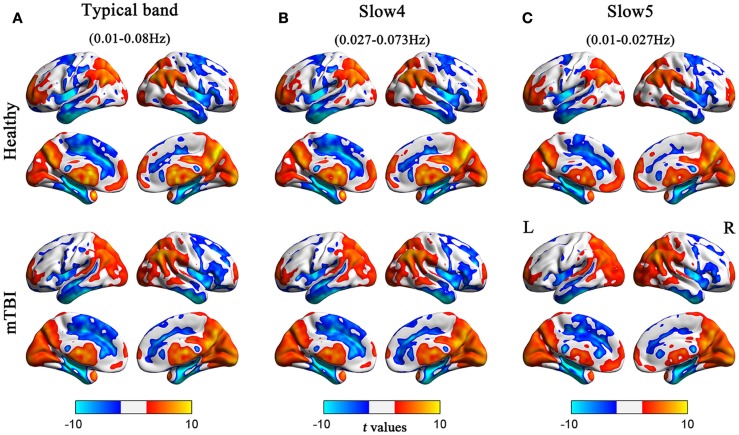
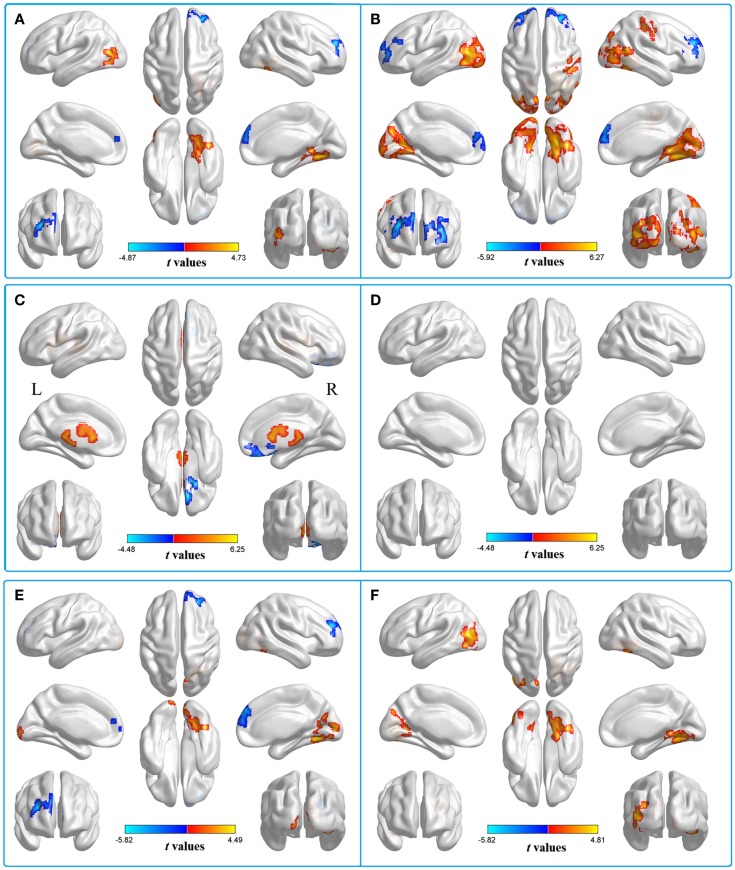
Functional disconnectivity during the resting state has been observed in mild traumatic brain injury (mTBI) patients during the acute stage. However, it remains largely unknown whether the abnormalities are related to specific frequency bands of the low-frequency oscillations (LFO). Here, we used the amplitude of low-frequency fluctuations (ALFF) to examine the amplitudes of LFO in different frequency bands (slow-5: 0.01-0.027 Hz; slow-4: 0.027-0.073 Hz; and typical: 0.01-0.08 Hz) in patients with acute mTBI. A total of 24 acute mTBI patients and 24 age-, sex-, and education-matched healthy controls participated in this study. In the typical band, acute mTBI patients showed lower standardized ALFF in the right middle frontal gyrus and higher standardized ALFF in the right lingual/fusiform gyrus and left middle occipital gyrus. Further analyses showed that the difference between groups was concentrated in a narrower (slow-4) frequency band. In the slow-5 band, mTBI patients only exhibited higher standardized ALFF in the occipital areas. No significant correlation between the mini-mental state examination score and the standardized ALFF value was found in any brain region in the three frequency bands. Finally, no significant interaction between frequency bands and groups was found in any brain region. We concluded that the abnormality of spontaneous brain activity in acute mTBI patients existed in the frontal lobe as well as in distributed brain regions associated with integrative, sensory, and emotional roles, and the abnormal spontaneous neuronal activity in different brain regions could be better detected by the slow-4 band. These findings might contribute to a better understanding of local neural psychopathology of acute mTBI. Future studies should take the frequency bands into account when measuring intrinsic brain activity of mTBI patients.
在急性期的轻度创伤性脑损伤(mTBI)患者中,静息状态下的功能连接中断已被观察到。然而,这些异常是否与低频振荡(LFO)的特定频段相关,在很大程度上仍然未知。在此,我们使用低频波动幅度(ALFF)来检查急性mTBI患者不同频段(慢波5:0.01 - 0.027Hz;慢波4:0.027 - 0.073Hz;以及典型频段:0.01 - 0.08Hz)的LFO幅度。共有24名急性mTBI患者和24名年龄、性别和教育程度相匹配的健康对照者参与了本研究。在典型频段中,急性mTBI患者右侧额中回的标准化ALFF较低,而右侧舌回/梭状回和左侧枕中回的标准化ALFF较高。进一步分析表明,组间差异集中在一个更窄的(慢波4)频段。在慢波5频段,mTBI患者仅在枕叶区域表现出较高的标准化ALFF。在三个频段的任何脑区中,简易精神状态检查评分与标准化ALFF值之间均未发现显著相关性。最后,在任何脑区中均未发现频段与组之间的显著交互作用。我们得出结论,急性mTBI患者的自发性脑活动异常存在于额叶以及与整合、感觉和情感功能相关的分布式脑区,并且慢波4频段能够更好地检测不同脑区异常的自发性神经元活动。这些发现可能有助于更好地理解急性mTBI的局部神经精神病理学。未来研究在测量mTBI患者的内在脑活动时应考虑频段因素。