Li Dongdong, Wang Changming, Yin Qin, Mao Mengchai, Zhu Chaozhe, Huang Yuxia
State Key Laboratory of Cognitive Neuroscience and Learning, IDG/McGovern Institute for Brain Research, Beijing Normal UniversityBeijing, China; Center for Collaboration and Innovation in Brain and Learning Sciences, Beijing Normal UniversityBeijing, China.
State Key Laboratory of Cognitive Neuroscience and Learning, IDG/McGovern Institute for Brain Research, Beijing Normal UniversityBeijing, China; Beijing Key Laboratory of Mental Disorders, Beijing Anding Hospital, Capital Medical UniversityBeijing, China; Beijing Institute for Brain DisordersBeijing, China.
Front Psychol. 2016 Feb 2;7:73. doi: 10.3389/fpsyg.2016.00073. eCollection 2016.
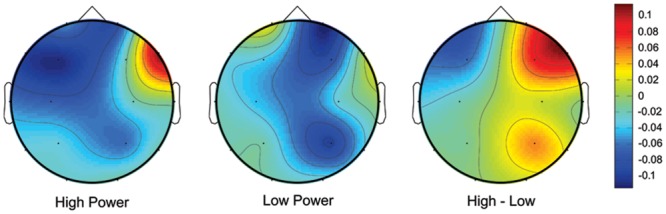
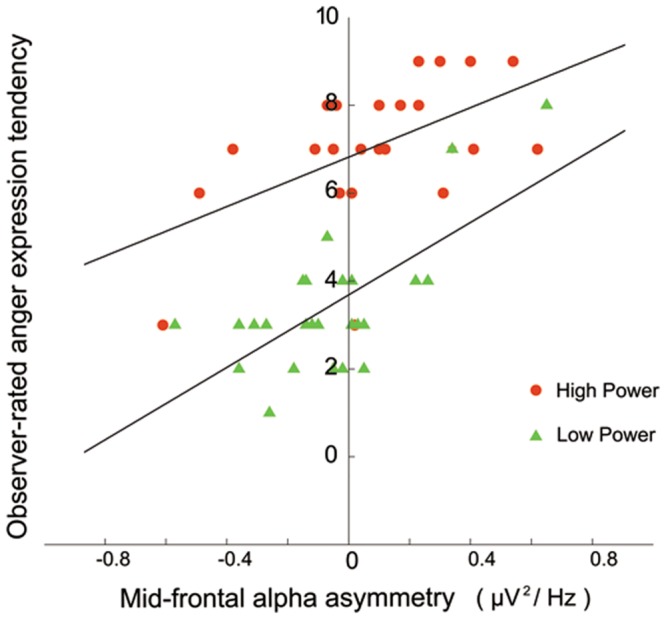
When irritated by other people, powerful people usually tend to express their anger explicitly and directly, whereas people in less powerful positions are more likely not to show their feelings freely. The neural mechanism behind power and its influence on expression tendency has been scarcely explored. This study recorded frontal EEG activity at rest and frontal EEG activation while participants were engaged in a writing task describing an anger-eliciting event, in which they were irritated by people with higher or lower social power. Participants' anger levels and expression inclination levels were self-reported on nine-point visual analog Likert scales, and also rated by independent raters based on the essays they had written. The results showed that high social power was indeed associated with greater anger expression tendency and greater left frontal activation than low social power. This is in line with the approach-inhibition theory of power. The mid-frontal asymmetric activation served as a partial mediator between social power and expression inclination. This effect may relate to the functions of the prefrontal cortex, which is in charge of information integration and evaluation and the control of motivation direction, as reported by previous studies.
当受到他人激怒时,有权势的人通常倾向于直接明确地表达愤怒,而地位较低的人则更有可能不自由地表露自己的情绪。权力背后的神经机制及其对表达倾向的影响几乎未被探索。本研究记录了参与者在休息时的额叶脑电图活动以及在进行一项描述愤怒诱发事件的写作任务时的额叶脑电图激活情况,在该事件中他们受到社会权力较高或较低的人的激怒。参与者的愤怒程度和表达倾向水平通过九点视觉模拟李克特量表进行自我报告,并且独立评分者也根据他们所写的文章进行评分。结果表明,与低社会权力相比,高社会权力确实与更大的愤怒表达倾向和更大的左额叶激活相关。这与权力的趋近 - 抑制理论一致。额中不对称激活在社会权力和表达倾向之间起到了部分中介作用。如先前研究所报道,这种效应可能与前额叶皮层的功能有关,前额叶皮层负责信息整合与评估以及动机方向的控制。