Center for Immunology and Infectious Diseases, Biosciences Division, SRI International, Harrisonburg, VA 22802, USA.
Department of Chemistry, Center for Molecular Discovery (BU-CMD), Boston University, 590 Commonwealth Avenue, Boston, MA 02215, USA.
EBioMedicine. 2015 Sep 14;2(11):1600-6. doi: 10.1016/j.ebiom.2015.09.018. eCollection 2015 Nov.
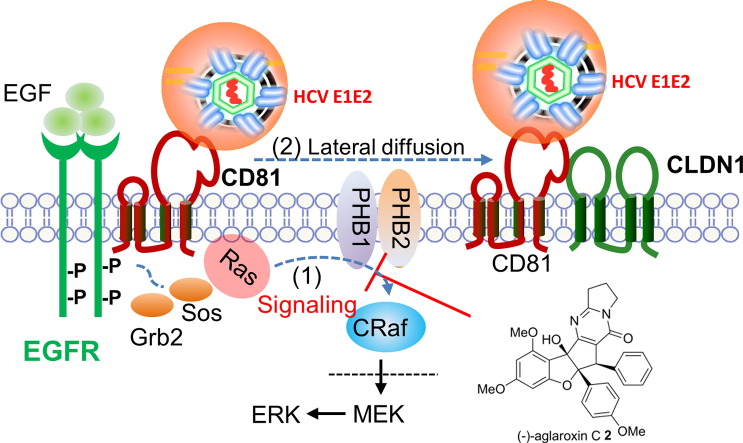
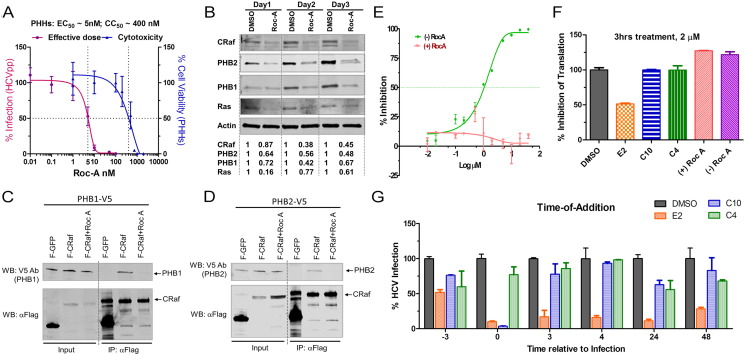
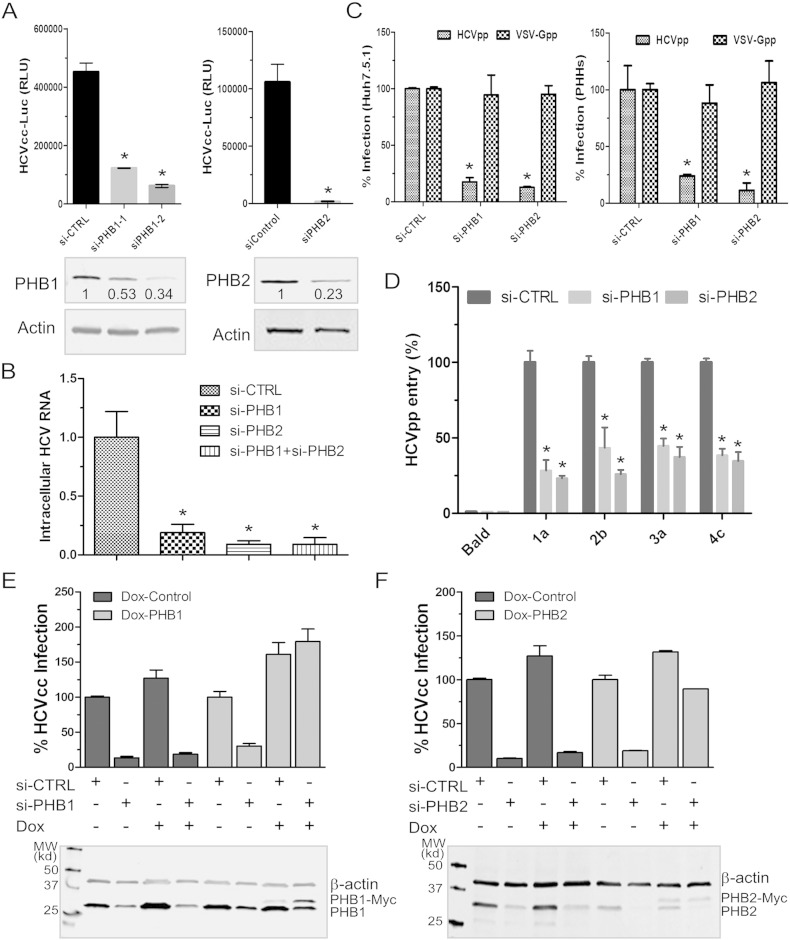
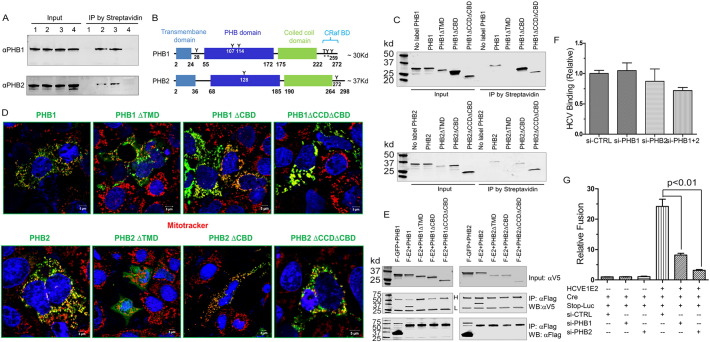
Identification of novel drug targets and affordable therapeutic agents remains a high priority in the fight against chronic hepatitis C virus (HCV) infection. Here, we report that the cellular proteins prohibitin 1 (PHB1) and 2 (PHB2) are pan-genotypic HCV entry factors functioning at a post-binding step. While predominantly found in mitochondria, PHBs localize to the plasma membrane of hepatocytes through their transmembrane domains and interact with both EGFR and CRaf. Targeting PHB by rocaglamide (Roc-A), a natural product that binds PHB1 and 2, reduced cell surface PHB1 and 2, disrupted PHB-CRaf interaction, and inhibited HCV entry at low nanomolar concentrations. A structure-activity analysis of 32 synthetic Roc-A analogs indicated that the chiral, racemic version of aglaroxin C, a natural product biosynthetically related to Roc-A, displayed improved potency and therapeutic index against HCV infection. This study reveals a new class of HCV entry inhibitors that target the PHB1/2-CRaf pathway.
鉴定新的药物靶点和负担得起的治疗药物仍然是对抗慢性丙型肝炎病毒(HCV)感染的首要任务。在这里,我们报告细胞蛋白 PHB1 和 PHB2 是泛基因型 HCV 进入因子,在结合后步骤中发挥作用。虽然 PHB 主要存在于线粒体中,但通过它们的跨膜结构域定位于肝细胞的质膜,并与 EGFR 和 CRaf 相互作用。通过 rocaglamide(Roc-A)靶向 PHB,Roc-A 是一种与 PHB1 和 2 结合的天然产物,降低了细胞表面 PHB1 和 2 的水平,破坏了 PHB-CRaf 相互作用,并以纳摩尔浓度抑制 HCV 进入。对 32 种合成 Roc-A 类似物的结构活性分析表明,与 Roc-A 在生物合成上相关的天然产物 aglaroxin C 的手性外消旋体显示出对 HCV 感染的更高活性和治疗指数。这项研究揭示了一类针对 PHB1/2-CRaf 途径的新型 HCV 进入抑制剂。