Cheng Huan-Qing, Han Li-Bo, Yang Chun-Lin, Wu Xiao-Min, Zhong Nai-Qin, Wu Jia-He, Wang Fu-Xin, Wang Hai-Yun, Xia Gui-Xian
Institute of Microbiology, Chinese Academy of Sciences, Beijing 100101, China State Key Laboratory of Plant Genomics, Beijing 100101, China University of Chinese Academy of Sciences, Beijing 100049, China.
Institute of Microbiology, Chinese Academy of Sciences, Beijing 100101, China State Key Laboratory of Plant Genomics, Beijing 100101, China.
J Exp Bot. 2016 Mar;67(6):1935-50. doi: 10.1093/jxb/erw016. Epub 2016 Feb 11.
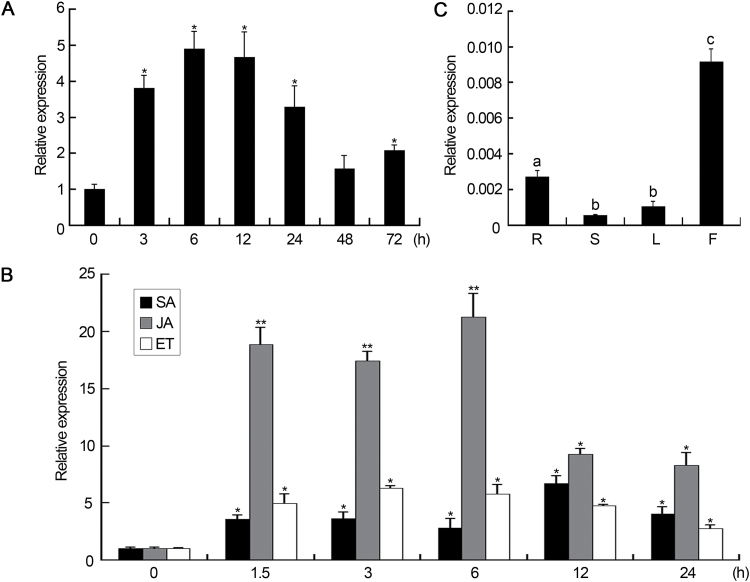
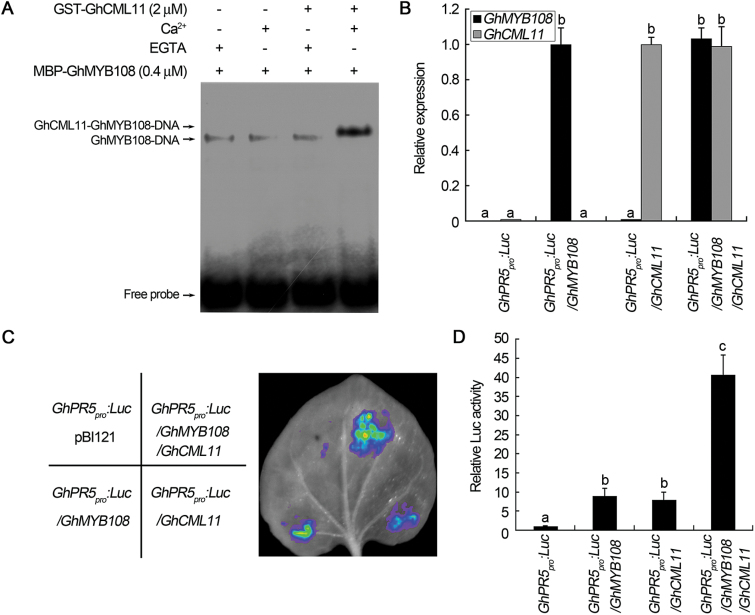
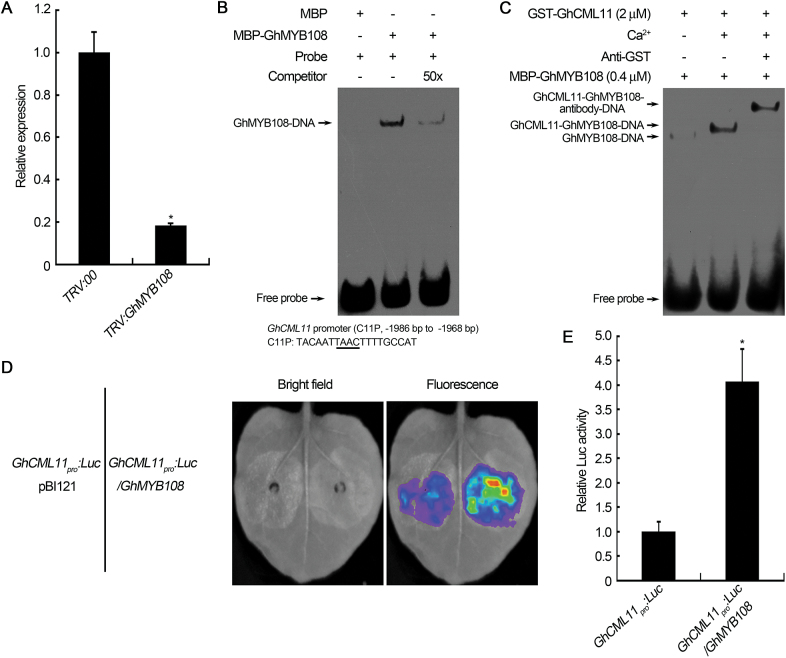
Accumulating evidence indicates that plant MYB transcription factors participate in defense against pathogen attack, but their regulatory targets and related signaling processes remain largely unknown. Here, we identified a defense-related MYB gene (GhMYB108) from upland cotton (Gossypium hirsutum) and characterized its functional mechanism. Expression of GhMYB108 in cotton plants was induced by Verticillium dahliae infection and responded to the application of defense signaling molecules, including salicylic acid, jasmonic acid, and ethylene. Knockdown of GhMYB108 expression led to increased susceptibility of cotton plants to V. dahliae, while ecotopic overexpression of GhMYB108 in Arabidopsis thaliana conferred enhanced tolerance to the pathogen. Further analysis demonstrated that GhMYB108 interacted with the calmodulin-like protein GhCML11, and the two proteins form a positive feedback loop to enhance the transcription of GhCML11 in a calcium-dependent manner. Verticillium dahliae infection stimulated Ca(2+) influx into the cytosol in cotton root cells, but this response was disrupted in both GhCML11-silenced plants and GhMYB108-silenced plants in which expression of several calcium signaling-related genes was down-regulated. Taken together, these results indicate that GhMYB108 acts as a positive regulator in defense against V. dahliae infection by interacting with GhCML11. Furthermore, the data also revealed the important roles and synergetic regulation of MYB transcription factor, Ca(2+), and calmodulin in plant immune responses.
越来越多的证据表明,植物MYB转录因子参与抵御病原体攻击,但它们的调控靶点和相关信号传导过程仍 largely未知。在此,我们从陆地棉(Gossypium hirsutum)中鉴定出一个与防御相关的MYB基因(GhMYB108),并对其功能机制进行了表征。棉花植株中GhMYB108的表达受大丽轮枝菌感染诱导,并对包括水杨酸、茉莉酸和乙烯在内的防御信号分子的施用有响应。GhMYB108表达的敲低导致棉花植株对大丽轮枝菌的易感性增加,而GhMYB108在拟南芥中的异位过表达赋予了对该病原体更强的耐受性。进一步分析表明,GhMYB108与类钙调蛋白GhCML11相互作用,这两种蛋白形成正反馈环以钙依赖的方式增强GhCML11的转录。大丽轮枝菌感染刺激棉花根细胞中Ca(2+)流入细胞质,但在GhCML11沉默植株和GhMYB108沉默植株中这种反应均被破坏,其中几个与钙信号相关的基因的表达下调。综上所述,这些结果表明GhMYB108通过与GhCML11相互作用在抵御大丽轮枝菌感染中起正调控作用。此外,数据还揭示了MYB转录因子、Ca(2+)和钙调蛋白在植物免疫反应中的重要作用和协同调控。