Center for Uterine Cancer, Research Institute and Hospital, National Cancer Center, Goyang, Korea.
Gynecologic Cancer Branch, Research Institute and Hospital, National Cancer Center, Goyang, Korea.
Cancer Res Treat. 2016 Oct;48(4):1321-1329. doi: 10.4143/crt.2015.425. Epub 2016 Feb 12.
The purpose of this study is to compare quality of life (QoL) and sexual functioning between sexually active cervical cancer survivors and healthy women.
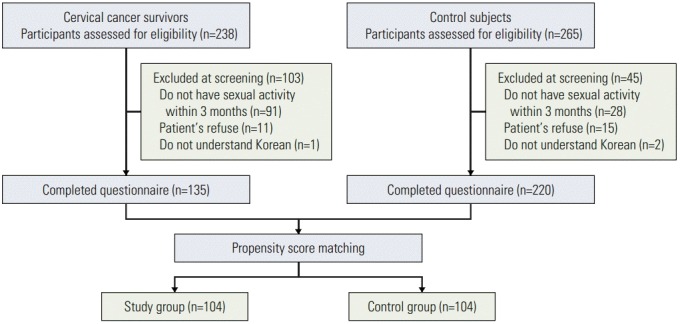
In this cross-sectional study, propensity-score-matched cervical cancer survivors (n=104) and healthy women (n=104) were compared. All women had engaged in sexual activity within the previous 3 months, and cervical cancer survivors showed no evidence of disease after primary treatment. QoL and sexual functioning were assessed using three questionnaires; the European Organization for Research and Treatment of Cancer Quality of Life Questionnaire Core 30 (EORTC QLQ-C30), Cervical Cancer Module (EORTC QLQ-CX24), and the Female Sexual Function Index (FSFI).
Significantly higher scores for lymphedema were observed in the cervical cancer survivors group compared with the healthy women group (mean, 20.2 vs. 12.2; p < 0.05). Sexuality, both in terms of sexual activity, sexual enjoyment, and sexual worry (EORTC QLQ-CX24), and in terms of desire, arousal, lubrication, orgasm, satisfaction, and pain (FSFI) were similar between the groups. When the scale of sexual/vaginal functioning in EORTC QLQ-CX24 was divided into individual questions, cervical cancer survivors reported shorter vaginal length than the control group, but without statistical significance (mean, 80.6 vs. 85.4; p=0.077).
Compared with healthy women, sexuality was not impaired in cervical cancer survivors who showed no evidence of disease after primary treatment and engaging in sexual activity. Further prospective cohort studies are warranted to confirm this finding.
本研究旨在比较活跃的宫颈癌幸存者与健康女性之间的生活质量(QoL)和性功能。
在这项横断面研究中,对倾向评分匹配的宫颈癌幸存者(n=104)和健康女性(n=104)进行了比较。所有女性在过去 3 个月内均有过性行为,且宫颈癌幸存者在初次治疗后无疾病证据。使用三个问卷评估 QoL 和性功能:欧洲癌症研究与治疗组织生活质量问卷核心 30 项(EORTC QLQ-C30)、宫颈癌模块(EORTC QLQ-CX24)和女性性功能指数(FSFI)。
与健康女性组相比,宫颈癌幸存者组的淋巴水肿评分显著更高(平均,20.2 比 12.2;p<0.05)。在性行为方面,无论是在性活动、性享受和性担忧(EORTC QLQ-CX24)方面,还是在欲望、唤起、润滑、性高潮、满意度和疼痛(FSFI)方面,两组之间均相似。当 EORTC QLQ-CX24 中的性功能/阴道功能量表分为单独问题时,宫颈癌幸存者报告的阴道长度短于对照组,但无统计学意义(平均,80.6 比 85.4;p=0.077)。
与健康女性相比,在初次治疗后无疾病证据且有性行为的宫颈癌幸存者中,其性行为并未受损。需要进一步进行前瞻性队列研究来证实这一发现。