Choi Joohee, Shin Dong Wook, Lee Seungmee, Jeon Myung Jae, Kim Sun Min, Cho Belong, Lee Seung Mi
Department of Obstetrics and Gynecology, Seoul National University College of Medicine, Seoul, Korea.
Department of Family Medicine, Seoul National University College of Medicine, Seoul, Korea. ; Health Promotion Center, Seoul National University Hospital, Seoul, Korea.
Obstet Gynecol Sci. 2015 Jul;58(4):302-8. doi: 10.5468/ogs.2015.58.4.302. Epub 2015 Jul 16.
To evaluate whether smoking is a risk factor for female sexual dysfunction (FSD) and to determine the relationship between the cumulative smoking dose and FSD in premenopausal women.
The study population consisted of sexually active premenopausal women. The frequency of FSD and female sexual function index (FSFI) total score were evaluated according to the smoking status (never/former and current smokers). Evaluation of sexual function was done using FSFI questionnaire, and women with FSFI score of ≤26.55 were considered to have FSD. In current smokers, sexual function was also evaluated according to the cumulative smoking dose and nicotine dependency.
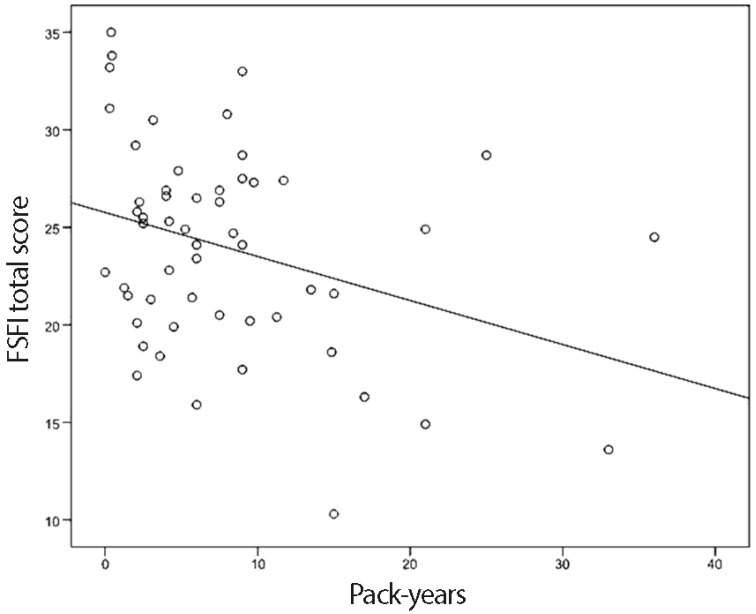
A total of 900 women were included, and the frequency of current smokers and the frequency of FSD were 62 (6.9%) and 496 (55.1%), respectively. In current smokers, the frequency of FSD was significantly higher and the median total FSFI score was significantly lower than in never/former smokers, and this difference of FSD remained significant after adjustment for confounding variables. Among current smokers, the cumulative smoking dose (pack-years) and the total FSFI score showed negative correlation, in which increased cumulative smoking dose was associated with lower total FSFI score (r=-0.278, P<0.05). In terms of nicotine dependency, the total FSFI score of moderately to heavily nicotine dependent smokers was significantly lower than that of lightly dependent smokers.
In premenopausal women, current smoking was an independent risk factor for FSD. And cumulative smoking dose and nicotine dependency were associated with higher risk of FSD.
评估吸烟是否为女性性功能障碍(FSD)的危险因素,并确定绝经前女性的累积吸烟量与FSD之间的关系。
研究人群包括性活跃的绝经前女性。根据吸烟状况(从不吸烟/曾经吸烟和当前吸烟者)评估FSD的发生率和女性性功能指数(FSFI)总分。使用FSFI问卷进行性功能评估,FSFI得分≤26.55的女性被认为患有FSD。对于当前吸烟者,还根据累积吸烟量和尼古丁依赖程度评估性功能。
共纳入900名女性,当前吸烟者的发生率和FSD的发生率分别为62例(6.9%)和496例(55.1%)。在当前吸烟者中,FSD的发生率显著更高,FSFI总分中位数显著低于从不吸烟/曾经吸烟者,在调整混杂变量后,FSD的这种差异仍然显著。在当前吸烟者中,累积吸烟量(包年)与FSFI总分呈负相关,其中累积吸烟量增加与FSFI总分降低相关(r=-0.278,P<0.05)。就尼古丁依赖而言,中度至重度尼古丁依赖吸烟者的FSFI总分显著低于轻度依赖吸烟者。
在绝经前女性中,当前吸烟是FSD的独立危险因素。累积吸烟量和尼古丁依赖与FSD的较高风险相关。