Gwak Eunji, Oh Mi-Hwa, Park Beom-Young, Lee Heeyoung, Lee Soomin, Ha Jimyeong, Lee Jeeyeon, Kim Sejeong, Choi Kyoung-Hee, Yoon Yohan
Department of Food and Nutrition, Sookmyung Women's University, Seoul 04310, Korea.
National Institute of Animal Science, RDA, Wanju 55365, Korea.
Korean J Food Sci Anim Resour. 2015;35(6):815-23. doi: 10.5851/kosfa.2015.35.6.815. Epub 2015 Dec 31.
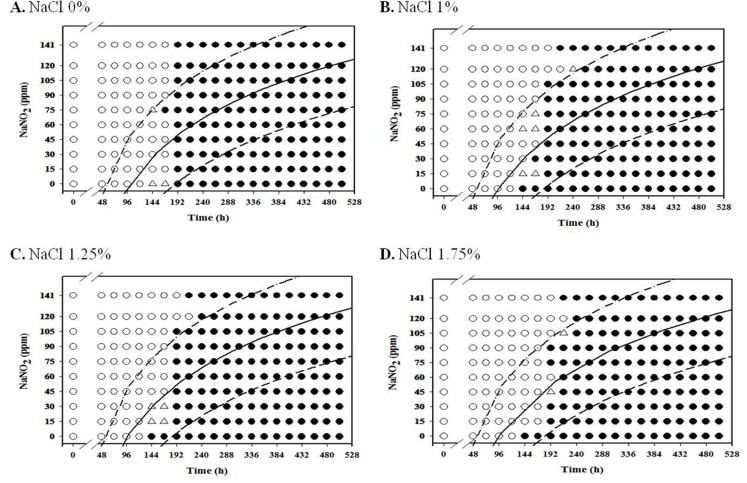
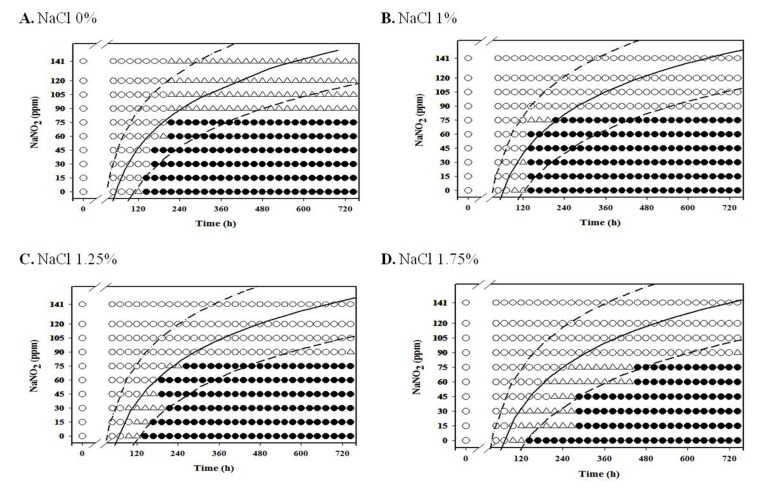
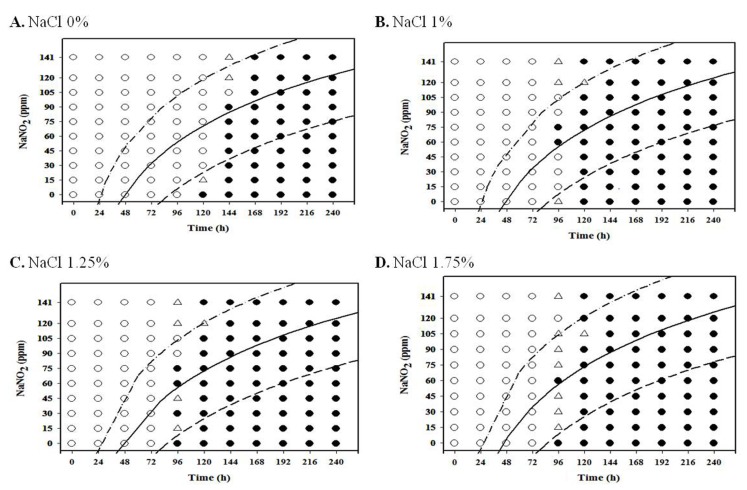
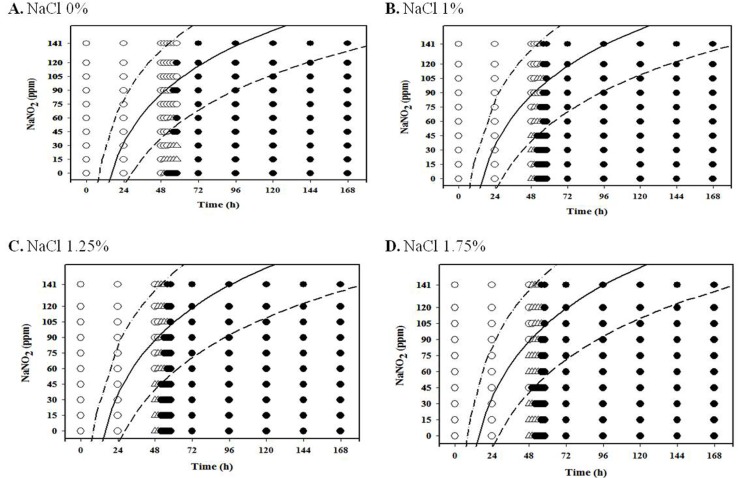
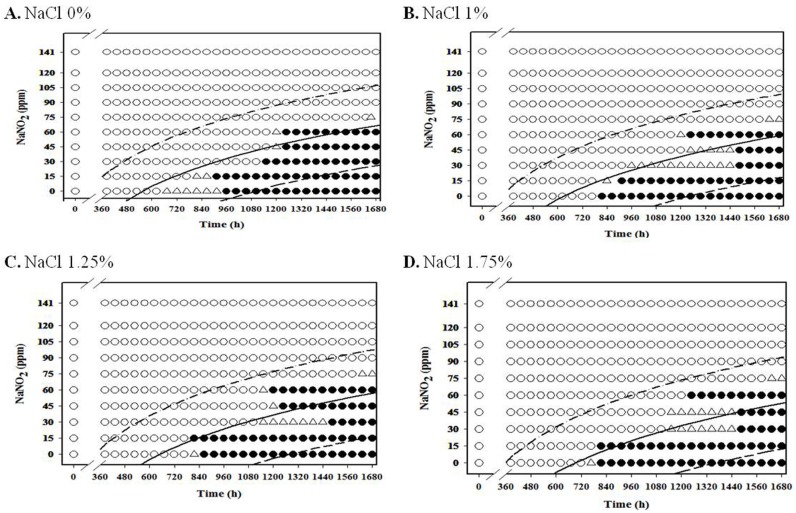
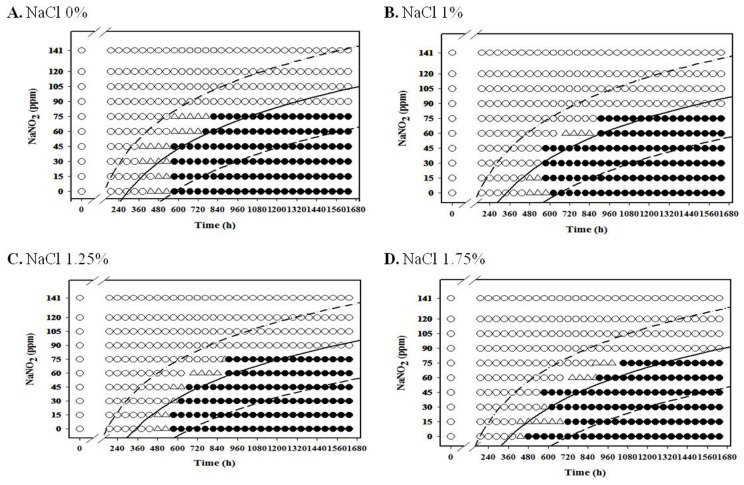
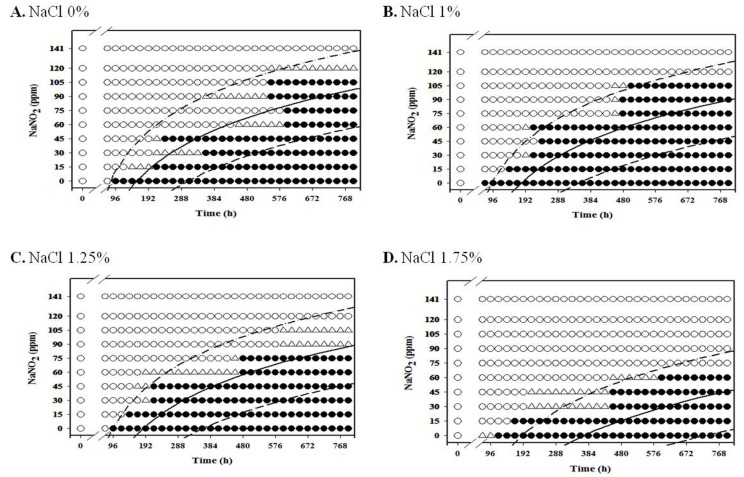
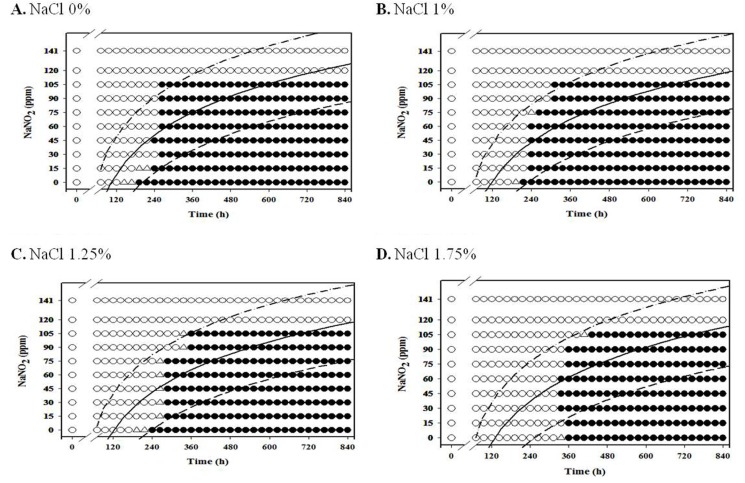
This study developed probabilistic models to describe Listeria monocytogenes growth responses in meat products with low concentrations of NaNO2 and NaCl. A five-strain mixture of L. monocytogenes was inoculated in NBYE (nutrient broth plus 0.6% yeast extract) supplemented with NaNO2 (0-141 ppm) and NaCl (0-1.75%). The inoculated samples were then stored under aerobic and anaerobic conditions at 4, 7, 10, 12, and 15℃ for up to 60 d. Growth response data [growth (1) or no growth (0)] for each combination were determined by turbidity. The growth response data were analyzed using logistic regression to predict the growth probability of L. monocytogenes as a function of NaNO2 and NaCl. The model performance was validated with the observed growth responses. The effect of an obvious NaNO2 and NaCl combination was not observed under aerobic storage condition, but the antimicrobial effect of NaNO2 on the inhibition of L. monocytogenes growth generally increased as NaCl concentration increased under anaerobic condition, especially at 7-10℃. A single application of NaNO2 or NaCl significantly (p<0.05) inhibited L. monocytogenes growth at 4-15℃, but the combination of NaNO2 or NaCl more effectively (p<0.05) inhibited L. monocytogenes growth than single application of either compound under anaerobic condition. Validation results showed 92% agreement between predicted and observed growth response data. These results indicate that the developed model is useful in predicting L. monocytogenes growth response at low concentrations of NaNO2 and NaCl, and the antilisterial effect of NaNO2 increased by NaCl under anaerobic condition.
本研究建立了概率模型,以描述低浓度亚硝酸钠(NaNO₂)和氯化钠(NaCl)存在时,单核细胞增生李斯特菌在肉类产品中的生长反应。将单核细胞增生李斯特菌的五菌株混合物接种于添加了NaNO₂(0 - 141 ppm)和NaCl(0 - 1.75%)的NBYE(营养肉汤加0.6%酵母提取物)中。然后将接种后的样品在需氧和厌氧条件下于4、7、10、12和15℃储存长达60天。通过浊度法确定每种组合的生长反应数据[生长(1)或不生长(0)]。使用逻辑回归分析生长反应数据,以预测单核细胞增生李斯特菌的生长概率作为NaNO₂和NaCl的函数。通过观察到的生长反应验证模型性能。在需氧储存条件下未观察到明显的NaNO₂和NaCl组合效应,但在厌氧条件下,随着NaCl浓度增加,NaNO₂对单核细胞增生李斯特菌生长的抑菌作用总体上增强,尤其是在7 - 10℃时。单独使用NaNO₂或NaCl在4 - 15℃时显著(p<0.05)抑制单核细胞增生李斯特菌生长,但在厌氧条件下,NaNO₂和NaCl的组合比单独使用任何一种化合物更有效地(p<0.05)抑制单核细胞增生李斯特菌生长。验证结果表明预测的和观察到的生长反应数据之间有92%的一致性。这些结果表明,所建立的模型可用于预测低浓度NaNO₂和NaCl时单核细胞增生李斯特菌的生长反应,并且在厌氧条件下NaCl可增强NaNO₂的抗李斯特菌作用。