Freemantle Nick, Chou Engels, Frois Christian, Zhuo Daisy, Lehmacher Walter, Vlajnic Aleksandra, Wang Hongwei, Chung Hsing-Wen, Zhang Quanwu, Wu Eric, Gerrits Charles
Department of Primary Care and Population Health, University College London, London, UK.
Global Evidence & Value Development/Health Economics & Outcomes Research, Sanofi, Bridgewater, New Jersey, USA.
BMJ Open. 2016 Feb 15;6(2):e009421. doi: 10.1136/bmjopen-2015-009421.
To compare the efficacy and safety of a concentrated formulation of insulin glargine (Gla-300) with other basal insulin therapies in patients with type 2 diabetes mellitus (T2DM).
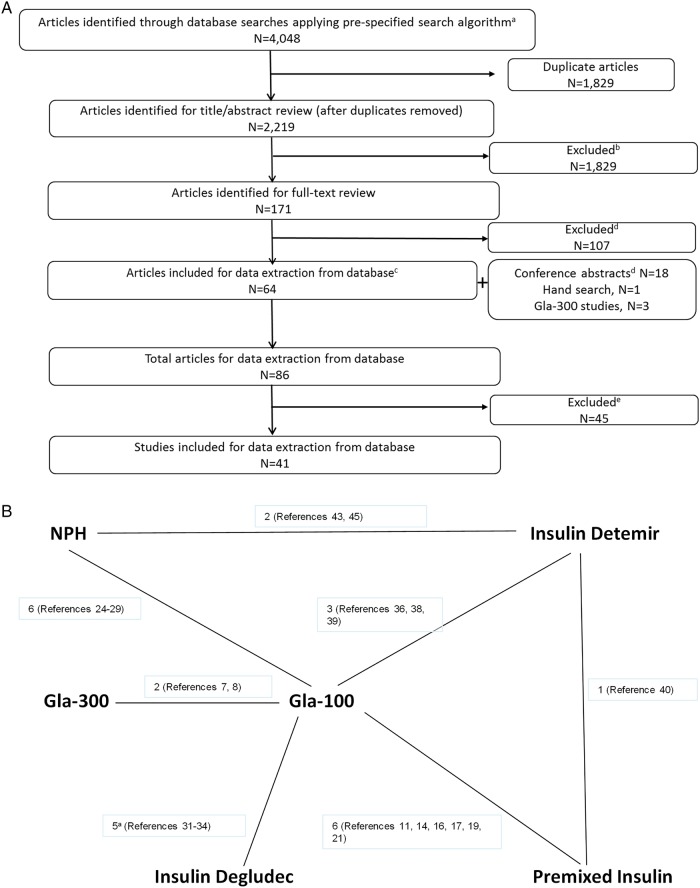
This was a network meta-analysis (NMA) of randomised clinical trials of basal insulin therapy in T2DM identified via a systematic literature review of Cochrane library databases, MEDLINE and MEDLINE In-Process, EMBASE and PsycINFO.
Changes in HbA1c (%) and body weight, and rates of nocturnal and documented symptomatic hypoglycaemia were assessed.
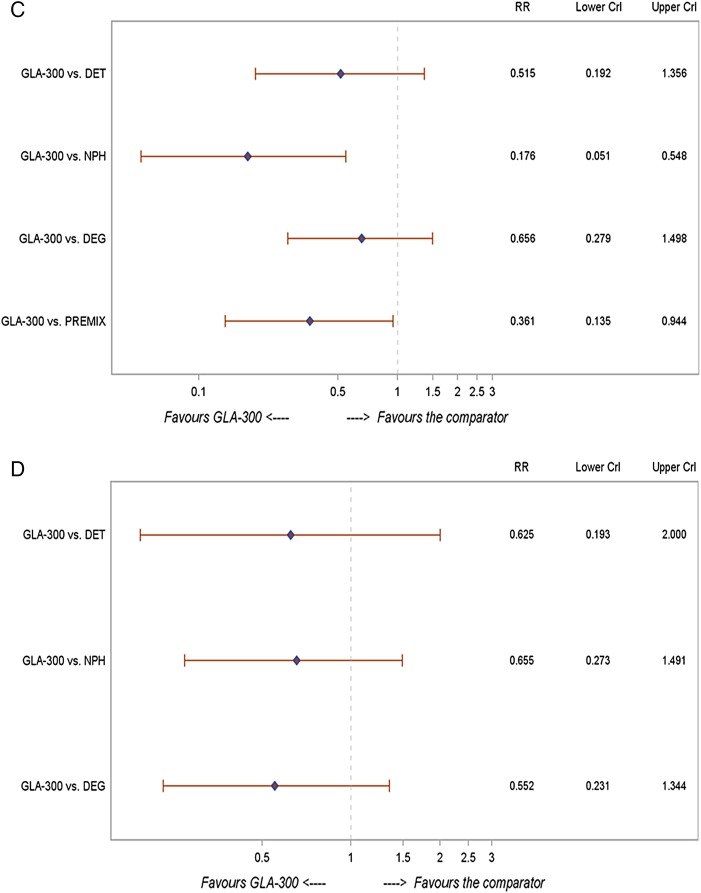
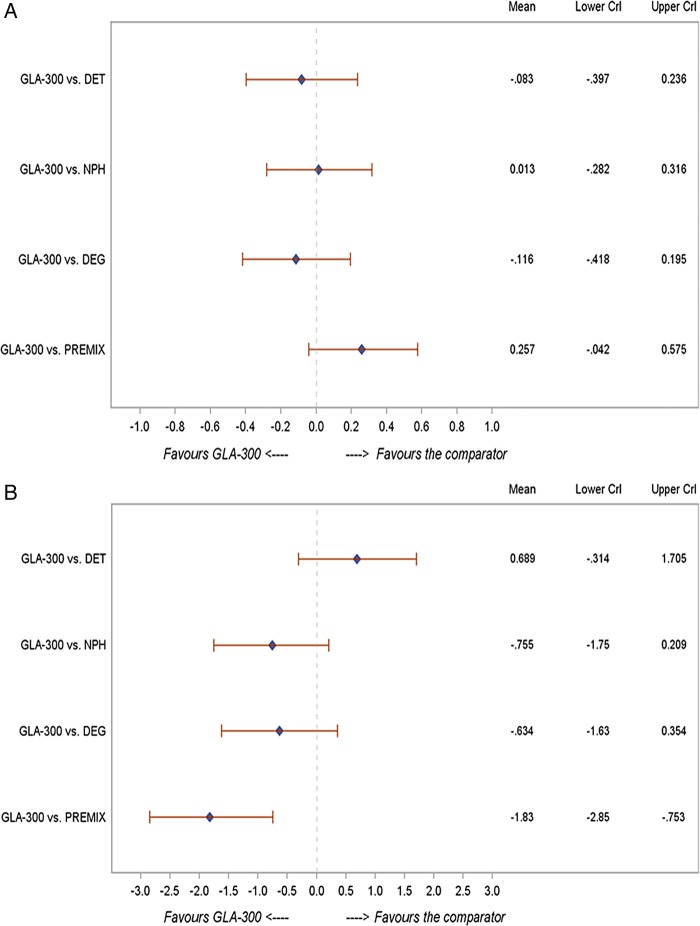
41 studies were included; 25 studies comprised the main analysis population: patients on basal insulin-supported oral therapy (BOT). Change in glycated haemoglobin (HbA1c) was comparable between Gla-300 and detemir (difference: -0.08; 95% credible interval (CrI): -0.40 to 0.24), neutral protamine Hagedorn (NPH; 0.01; -0.28 to 0.32), degludec (-0.12; -0.42 to 0.20) and premixed insulin (0.26; -0.04 to 0.58). Change in body weight was comparable between Gla-300 and detemir (0.69; -0.31 to 1.71), NPH (-0.76; -1.75 to 0.21) and degludec (-0.63; -1.63 to 0.35), but significantly lower compared with premixed insulin (-1.83; -2.85 to -0.75). Gla-300 was associated with a significantly lower nocturnal hypoglycaemia rate versus NPH (risk ratio: 0.18; 95% CrI: 0.05 to 0.55) and premixed insulin (0.36; 0.14 to 0.94); no significant differences were noted in Gla-300 versus detemir (0.52; 0.19 to 1.36) and degludec (0.66; 0.28 to 1.50). Differences in documented symptomatic hypoglycaemia rates of Gla-300 versus detemir (0.63; 0.19 to 2.00), NPH (0.66; 0.27 to 1.49) and degludec (0.55; 0.23 to 1.34) were not significant. Extensive sensitivity analyses supported the robustness of these findings.
NMA comparisons are useful in the absence of direct randomised controlled data. This NMA suggests that Gla-300 is also associated with a significantly lower risk of nocturnal hypoglycaemia compared with NPH and premixed insulin, with glycaemic control comparable to available basal insulin comparators.
比较甘精胰岛素浓缩制剂(Gla-300)与其他基础胰岛素疗法在2型糖尿病(T2DM)患者中的疗效和安全性。
这是一项通过对Cochrane图书馆数据库、MEDLINE及MEDLINE在研数据库、EMBASE和PsycINFO进行系统文献回顾所确定的T2DM基础胰岛素疗法随机临床试验的网状Meta分析(NMA)。
评估糖化血红蛋白(HbA1c)(%)和体重的变化,以及夜间和有记录的症状性低血糖发生率。
纳入41项研究;25项研究构成主要分析人群:接受基础胰岛素支持口服治疗(BOT)的患者。甘精胰岛素(Gla-300)与地特胰岛素相比糖化血红蛋白(HbA1c)变化相当(差异:-0.08;95%可信区间(CrI):-0.40至0.24),与中性鱼精蛋白锌胰岛素(NPH;0.01;-0.28至0.32)、德谷胰岛素(-0.12;-0.42至0.20)和预混胰岛素(0.26;-0.04至0.58)相比也相当。Gla-300与地特胰岛素相比体重变化相当(0.69;-0.31至1.71),与NPH(-0.76;-1.75至0.21)和德谷胰岛素(-0.63;-1.63至0.35)相比也相当,但与预混胰岛素相比显著更低(-1.83;-2.85至-0.75)。与NPH(风险比:0.18;95%CrI:0.05至0.55)和预混胰岛素(0.36;0.14至0.94)相比,Gla-300的夜间低血糖发生率显著更低;Gla-300与地特胰岛素(0.52;0.19至1.36)和德谷胰岛素(0.66;0.28至1.50)相比无显著差异。Gla-300与地特胰岛素(0.63;0.19至2.00)、NPH(0.66;0.27至1.49)和德谷胰岛素(0.55;0.23至1.34)相比,有记录的症状性低血糖发生率差异不显著。广泛的敏感性分析支持了这些发现的稳健性。
在缺乏直接随机对照数据的情况下,NMA比较很有用。这项NMA表明,与NPH和预混胰岛素相比,Gla-300的夜间低血糖风险也显著更低,血糖控制与现有的基础胰岛素对照药物相当。