Fu Zhongjun, Li Weihua, Xing Xiaolong, Xu Mengmeng, Liu Xiaoyang, Li Haochuan, Xue Yadong, Liu Zonghua, Tang Jihua
Key Laboratory of Wheat and Maize Crops Science, Collaborative Innovation Center of Henan Grain Crops, College of Agronomy, Henan Agricultural University, Zhengzhou 450002, China.
Maize Research Institute, Chongqing Academy of Agricultural Sciences, Chongqing 401329, China.
Sci Rep. 2016 Feb 16;6:21292. doi: 10.1038/srep21292.
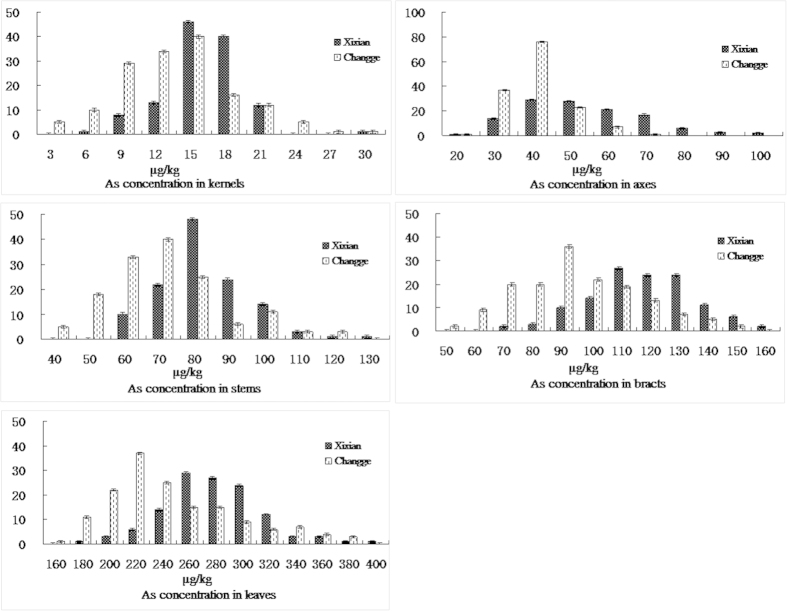
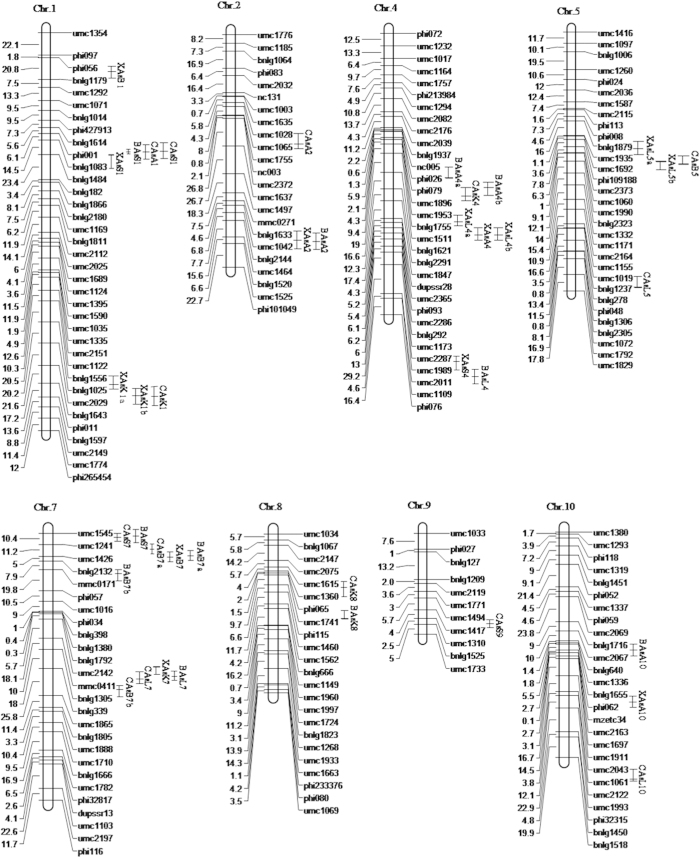
Arsenic (As) is a toxic heavy metal that can accumulate in crops and poses a threat to human health. The genetic mechanism of As accumulation is unclear. Herein, we used quantitative trait locus (QTL) mapping to unravel the genetic basis of As accumulation in a maize recombinant inbred line population derived from the Chinese crossbred variety Yuyu22. The kernels had the lowest As content among the different maize tissues, followed by the axes, stems, bracts and leaves. Fourteen QTLs were identified at each location. Some of these QTLs were identified in different environments and were also detected by joint analysis. Compared with the B73 RefGen v2 reference genome, the distributions and effects of some QTLs were closely linked to those of QTLs detected in a previous study; the QTLs were likely in strong linkage disequilibrium. Our findings could be used to help maintain maize production to satisfy the demand for edible corn and to decrease the As content in As-contaminated soil through the selection and breeding of As pollution-safe cultivars.
砷(As)是一种有毒重金属,可在作物中积累并对人类健康构成威胁。砷积累的遗传机制尚不清楚。在此,我们利用数量性状位点(QTL)定位来揭示源自中国杂交品种豫玉22的玉米重组自交系群体中砷积累的遗传基础。在不同的玉米组织中,籽粒的砷含量最低,其次是轴、茎、苞叶和叶片。在每个位置鉴定出14个QTL。其中一些QTL在不同环境中被鉴定出来,并且也通过联合分析检测到。与B73 RefGen v2参考基因组相比,一些QTL的分布和效应与先前研究中检测到的QTL紧密相关;这些QTL可能处于强连锁不平衡状态。我们的研究结果可用于帮助维持玉米产量,以满足对食用玉米的需求,并通过选择和培育对砷污染安全的品种来降低砷污染土壤中的砷含量。