Ohara Koji, Mitsui Akio, Mori Masahiro, Onodera Yohei, Shiotani Shinya, Koyama Yukinori, Orikasa Yuki, Murakami Miwa, Shimoda Keiji, Mori Kazuhiro, Fukunaga Toshiharu, Arai Hajime, Uchimoto Yoshiharu, Ogumi Zempachi
Office of Society-Academia Collaboration for Innovation, Kyoto University, Gokasho, Uji, Kyoto 611-0011, Japan.
Material Analysis Department, Material Development Division, TOYOTA MOTOR CORPORATION, 1, Toyota-cho, Toyota, Aichi 471-8572, Japan.
Sci Rep. 2016 Feb 19;6:21302. doi: 10.1038/srep21302.
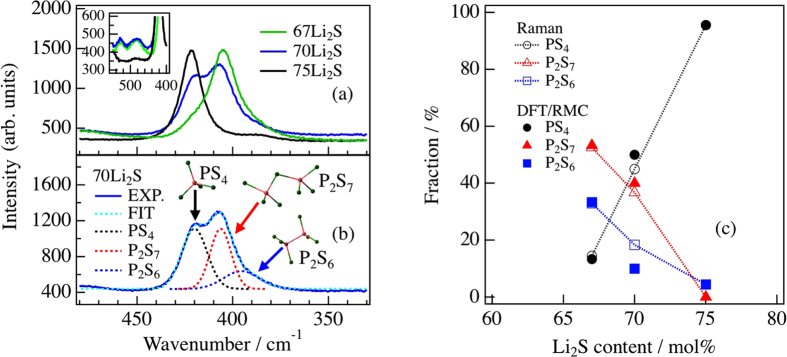
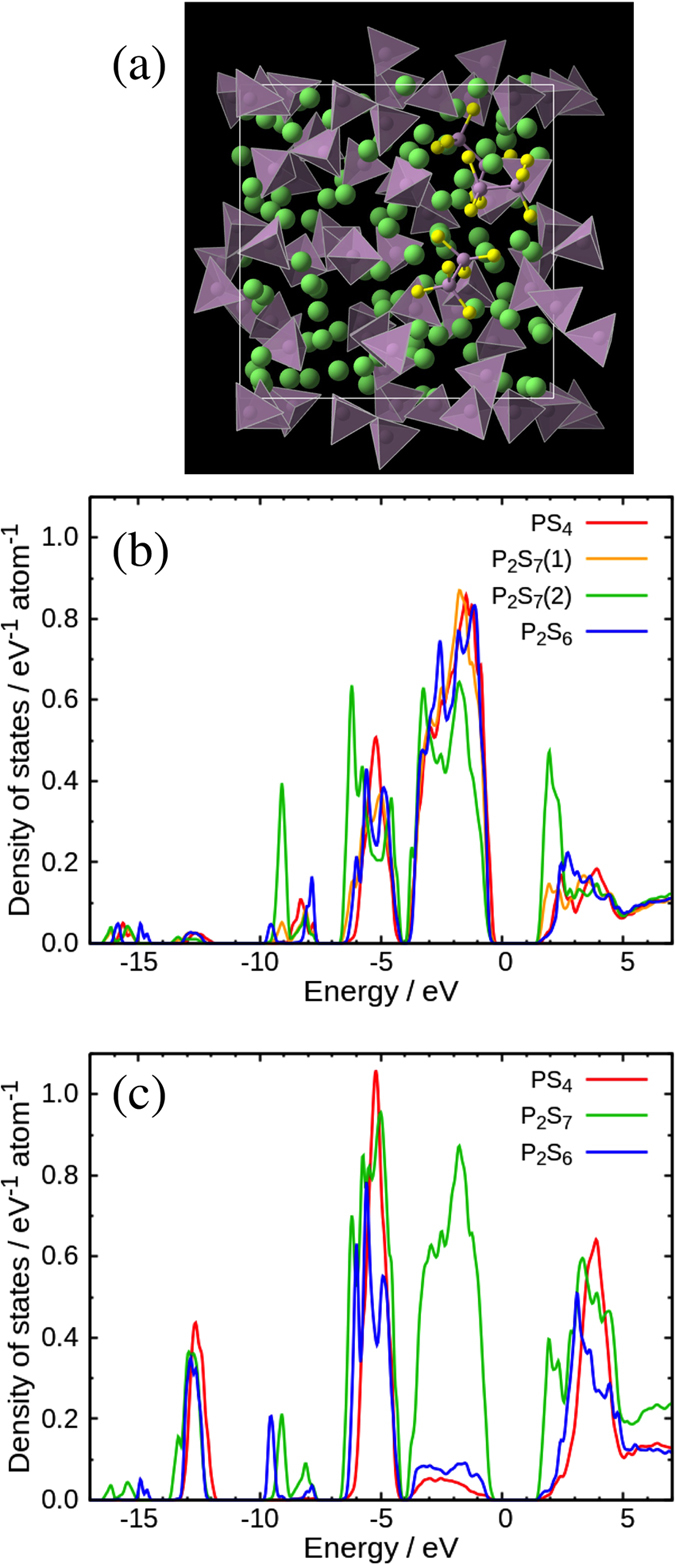
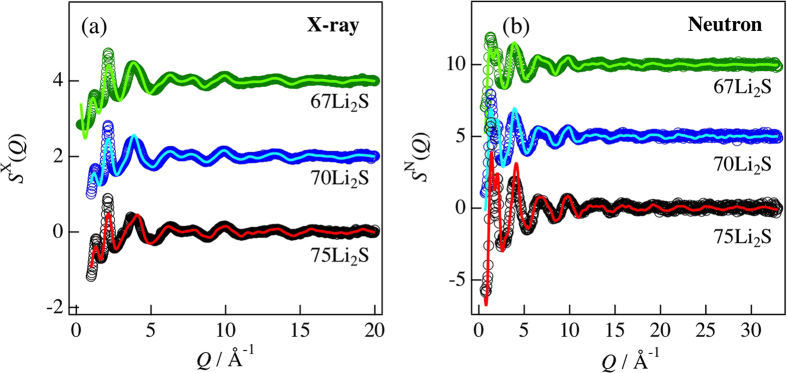
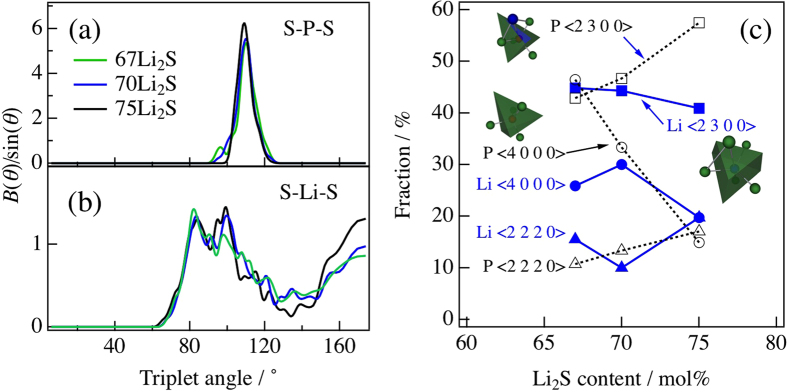
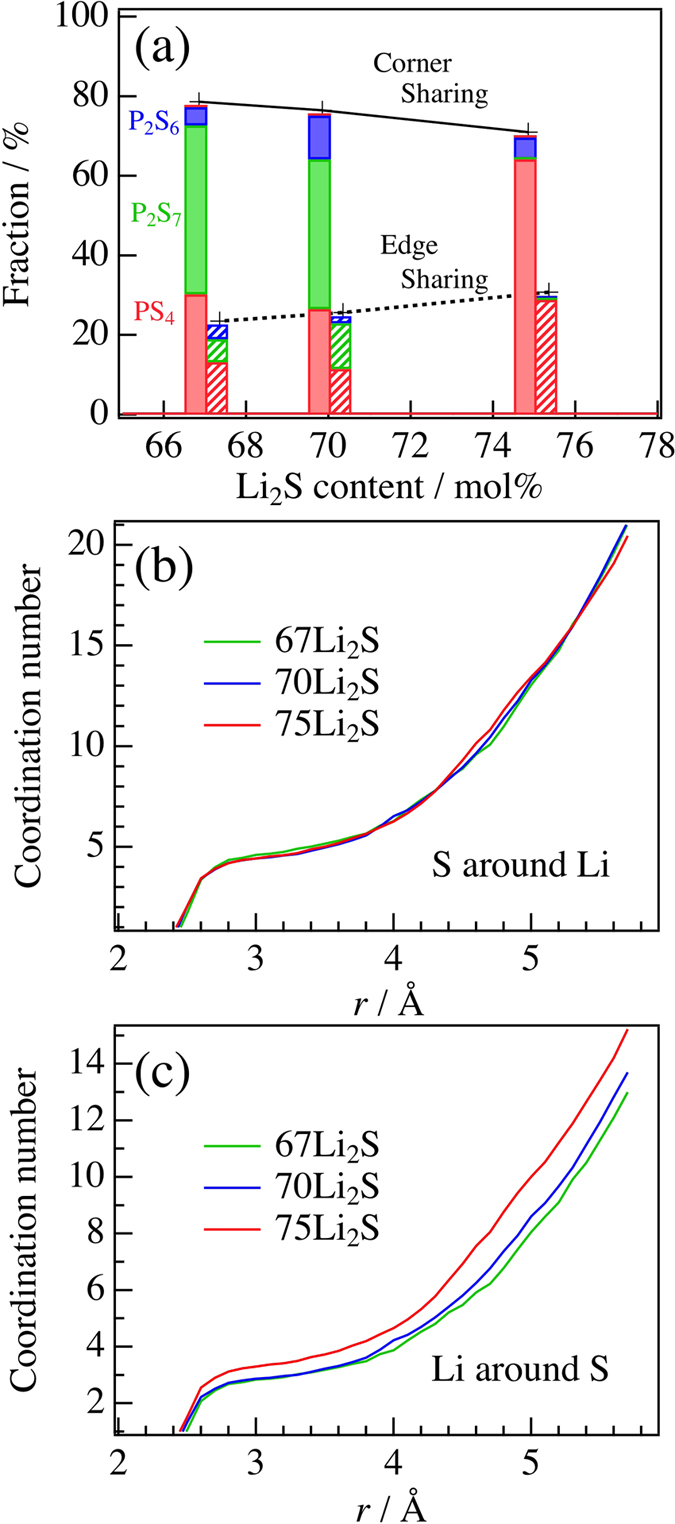
The atomic and electronic structures of binary Li2S-P2S5 glasses used as solid electrolytes are modeled by a combination of density functional theory (DFT) and reverse Monte Carlo (RMC) simulation using synchrotron X-ray diffraction, neutron diffraction, and Raman spectroscopy data. The ratio of PSx polyhedral anions based on the Raman spectroscopic results is reflected in the glassy structures of the 67Li2S-33P2S5, 70Li2S-30P2S5, and 75Li2S-25P2S5 glasses, and the plausible structures represent the lithium ion distributions around them. It is found that the edge sharing between PSx and LiSy polyhedra increases at a high Li2S content, and the free volume around PSx polyhedra decreases. It is conjectured that Li(+) ions around the face of PSx polyhedra are clearly affected by the polarization of anions. The electronic structure of the DFT/RMC model suggests that the electron transfer between the P ion and the bridging sulfur (BS) ion weakens the positive charge of the P ion in the P2S7 anions. The P2S7 anions of the weak electrostatic repulsion would causes it to more strongly attract Li(+) ions than the PS4 and P2S6 anions, and suppress the lithium ionic conduction. Thus, the control of the edge sharing between PSx and LiSy polyhedra without the electron transfer between the P ion and the BS ion is expected to facilitate lithium ionic conduction in the above solid electrolytes.
用作固体电解质的二元Li2S - P2S5玻璃的原子和电子结构,通过结合密度泛函理论(DFT)和使用同步加速器X射线衍射、中子衍射及拉曼光谱数据的逆蒙特卡罗(RMC)模拟进行建模。基于拉曼光谱结果的PSx多面体阴离子比例,反映在67Li2S - 33P2S5、70Li2S - 30P2S5和75Li2S - 25P2S5玻璃的玻璃结构中,且合理的结构表示了它们周围的锂离子分布。研究发现,在高Li2S含量下,PSx和LiSy多面体之间的边共享增加,PSx多面体周围的自由体积减小。推测PSx多面体表面周围的Li(+)离子明显受到阴离子极化的影响。DFT/RMC模型的电子结构表明,P离子与桥连硫(BS)离子之间的电子转移削弱了P2S7阴离子中P离子的正电荷。弱静电排斥的P2S7阴离子比PS4和P2S6阴离子更强烈地吸引Li(+)离子,并抑制锂离子传导。因此,在不发生P离子与BS离子之间电子转移的情况下控制PSx和LiSy多面体之间的边共享,有望促进上述固体电解质中的锂离子传导。