Rao Deepa P, Orpana Heather, Krewski Daniel
Interdisciplinary School of Health Sciences, University of Ottawa, Ottawa, ON, Canada.
School of Psychology, University of Ottawa, Ottawa, ON, Canada.
Int J Behav Nutr Phys Act. 2016 Feb 19;13:26. doi: 10.1186/s12966-016-0350-5.
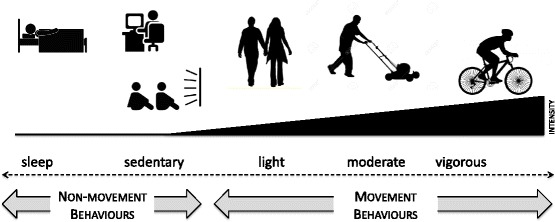
Metabolic syndrome (MetS) is a prevalent risk condition associated with a higher risk of chronic conditions, including diabetes and cardiovascular diseases. Physical activity and non-movement behaviours (NMB), including sleep, screen time and sedentary activity, have been associated with MetS. In light of the increasing prevalence of NMBs, and the moderate rates of physical activity guideline adherence in Canada, this analysis examines the independent and combined associations of NMB and physical activity with MetS.
Data on Canadians 18 years and older from the Canadian Health Measures Survey (n = 2901) were used to examine the moderating effect of moderate-to-vigorous physical activity (MVPA) guideline adherence (150 minutes or more of MVPA/week, based on accelerometer) on the association of NMBs (sleep based on self-report, screen time based on self-report, and sedentary time based on accelerometer) with MetS. Logistic regression analyses were conducted and sampling weights were applied to represent the Canadian adult population.
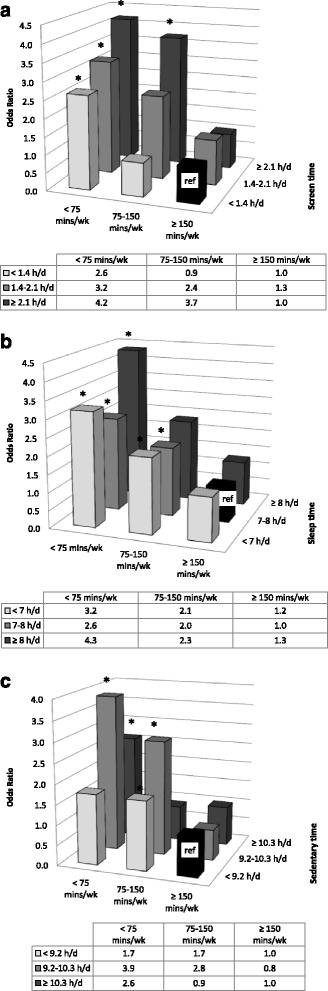
A graded association between PA and MetS was observed, with those achieving less MVPA than guidelines having a higher odds of MetS (OR 2.9, 95 % CI: 1.9-4.5 for < 75 mins/week of MVPA, and OR 1.8, 95 % CI: 1.2-2.8 for 75-150 mins/week, as compared to those accumulating 150 mins/week or more). When examining the moderating effect of PA on the association between NMBs and MetS, we found that (1) for participants who met guidelines, no level of any NMB was significantly associated with MetS and (2) for those who did not achieve guidelines, there was an increased odds of MetS based on excess NMB time(OR 3.2, 95 % CI: 1.5-6.8 for 1.4-2.1 h/day and OR 4.4, 95 % CI: 2.5-7.9 for ≥2.1 h/day of screen time and 75-150 mins/week of MVPA, OR 1.7, 95 % CI: 1.1-2.5 for ≥8 h/day of sleep time and <75 mins/week of MVPA, and OR 2.2, 95 % CI: 1.3-3.8 for 9.2-10.3 h/day of sedentary time and <75 mins/week of MVPA).
Adhering to physical activity guidelines may mitigate the associations of NMBs with MetS. Given the novel findings that associations between NMBs and MetS were not significant among Canadians meeting PA guidelines, these results suggest the beneficial role of physical activity to prevent chronic disease risk.
代谢综合征(MetS)是一种普遍存在的风险状况,与包括糖尿病和心血管疾病在内的慢性病风险较高相关。身体活动和非运动行为(NMB),包括睡眠、屏幕时间和久坐活动,都与代谢综合征有关。鉴于非运动行为的患病率不断上升,以及加拿大遵循身体活动指南的比例适中,本分析探讨了非运动行为和身体活动与代谢综合征的独立及联合关联。
使用来自加拿大健康措施调查的18岁及以上加拿大人的数据(n = 2901),来检验适度至剧烈身体活动(MVPA)指南遵循情况(基于加速度计,每周150分钟或更多MVPA)对非运动行为(基于自我报告的睡眠、基于自我报告的屏幕时间和基于加速度计的久坐时间)与代谢综合征关联的调节作用。进行了逻辑回归分析,并应用抽样权重来代表加拿大成年人口。
观察到身体活动与代谢综合征之间存在分级关联,未达到指南规定的MVPA量的人患代谢综合征的几率更高(每周MVPA < 75分钟时,OR为2.9,95%CI:1.9 - 4.5;每周MVPA为75 - 150分钟时,OR为1.8,95%CI:1.2 - 2.8,与每周累积150分钟或更多的人相比)。在检验身体活动对非运动行为与代谢综合征之间关联的调节作用时,我们发现:(1)对于符合指南的参与者,任何非运动行为水平与代谢综合征均无显著关联;(2)对于未达到指南要求的人,基于非运动行为时间过长,患代谢综合征的几率增加(屏幕时间为每天1.4 - 2.1小时且每周MVPA为75 - 150分钟时,OR为3.2,95%CI:1.5 - 6.8;屏幕时间≥2.1小时且每周MVPA为75 - 150分钟时,OR为4.4,95%CI:2.5 - 7.9;睡眠时间≥8小时且每周MVPA < 75分钟时,OR为1.7,95%CI:1.1 - 2.5;久坐时间为每天9.2 - 10.3小时且每周MVPA < 75分钟时,OR为2.2,95%CI:1.3 - 3.8)。
遵循身体活动指南可能会减轻非运动行为与代谢综合征之间的关联。鉴于在符合身体活动指南的加拿大人中,非运动行为与代谢综合征之间的关联不显著这一新颖发现,这些结果表明身体活动在预防慢性病风险方面的有益作用。