Valdes-Donoso Pablo, Jarvis Lovell S, Wright Dave, Alvarez Julio, Perez Andres M
Department of Veterinary Population Medicine, College of Veterinary Medicine, University of Minnesota, Saint Paul, MN, United States of America.
Department of Agriculture and Resource Economics, University of California Davis, Davis, CA, United States of America.
PLoS One. 2016 Feb 19;11(2):e0149498. doi: 10.1371/journal.pone.0149498. eCollection 2016.
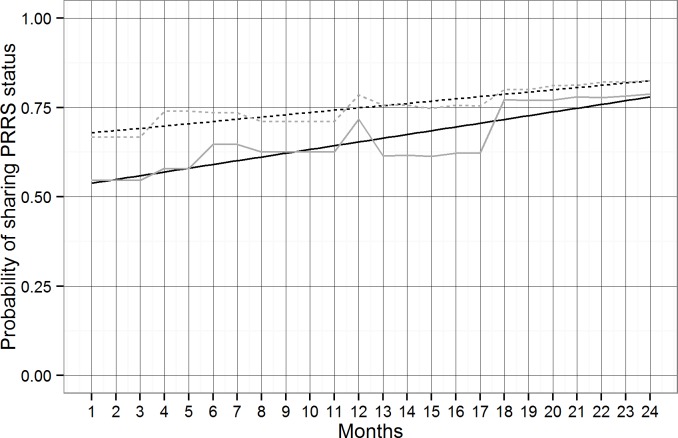
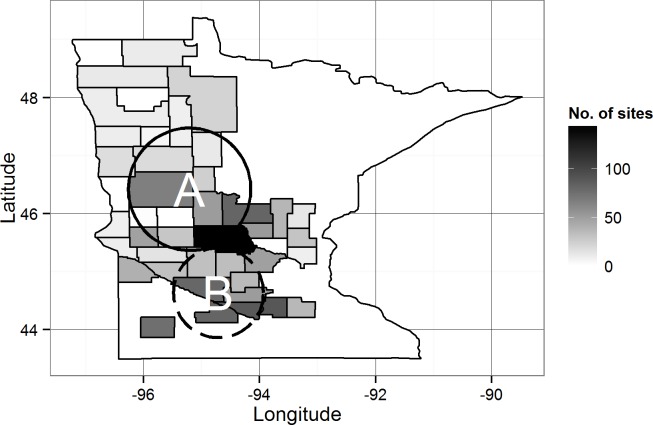
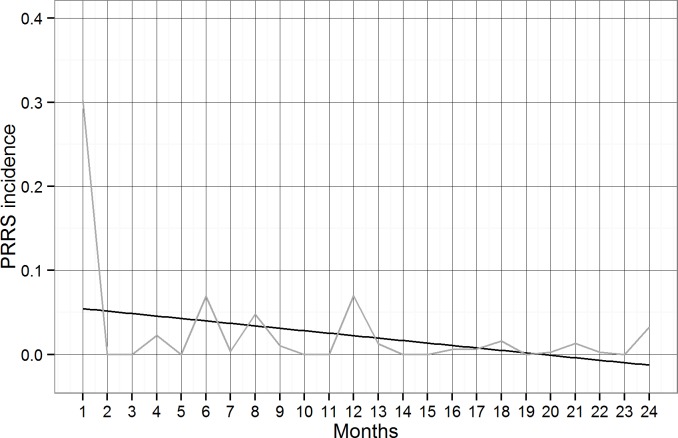
Due to the highly transmissible nature of porcine reproductive and respiratory syndrome (PRRS), implementation of regional programs to control the disease may be critical. Because PRRS is not reported in the US, numerous voluntary regional control projects (RCPs) have been established. However, the effect of RCPs on PRRS control has not been assessed yet. This study aims to quantify the extent to which RCPs contribute to PRRS control by proposing a methodological framework to evaluate the progress of RCPs. Information collected between July 2012 and June 2015 from the Minnesota Voluntary Regional PRRS Elimination Project (RCP-N212) was used. Demography of premises (e.g. composition of farms with sows = SS and without sows = NSS) was assessed by a repeated analysis of variance. By using general linear mixed-effects models, active participation of farms enrolled in the RCP-N212, defined as the decision to share (or not to share) PRRS status, was evaluated and used as a predictor, along with other variables, to assess the PRRS trend over time. Additionally, spatial and temporal patterns of farmers' participation and the disease dynamics were investigated. The number of farms enrolled in RCP-N212 and its geographical coverage increased, but the proportion of SS and NSS did not vary significantly over time. A significant increasing (p<0.001) trend in farmers' decision to share PRRS status was observed, but with NSS producers less willing to report and a large variability between counties. The incidence of PRRS significantly (p<0.001) decreased, showing a negative correlation between degree of participation and occurrence of PRRS (p<0.001) and a positive correlation with farm density at the county level (p = 0.02). Despite a noted decrease in PRRS, significant spatio-temporal patterns of incidence of the disease over 3-weeks and 3-kms during the entire study period were identified. This study established a systematic approach to quantify the effect of RCPs on PRRS control. Despite an increase in number of farms enrolled in the RCP-N212, active participation is not ensured. By evaluating the effect of participation on the occurrence of PRRS, the value of sharing information among producers may be demonstrated, in turn justifying the existence of RCPs.
由于猪繁殖与呼吸综合征(PRRS)具有高度传染性,实施区域疾病控制计划可能至关重要。因为美国未报告PRRS病例,所以已经建立了许多自愿性区域控制项目(RCP)。然而,RCP对PRRS控制的效果尚未得到评估。本研究旨在通过提出一个评估RCP进展的方法框架,来量化RCP对PRRS控制的贡献程度。使用了2012年7月至2015年6月期间从明尼苏达州自愿性区域PRRS根除项目(RCP-N212)收集的信息。通过重复方差分析评估猪场的人口统计学特征(例如,有母猪的农场=SS,无母猪的农场=NSS)。通过使用一般线性混合效应模型,评估了参与RCP-N212的猪场的积极参与情况(定义为分享(或不分享)PRRS状态的决定),并将其作为预测因子,与其他变量一起,来评估PRRS随时间的趋势。此外,还调查了农民参与的时空模式和疾病动态。参与RCP-N212的猪场数量及其地理覆盖范围有所增加,但SS和NSS的比例随时间没有显著变化。观察到农民分享PRRS状态的决定有显著增加趋势(p<0.001),但NSS生产者报告意愿较低,且各县之间差异很大。PRRS的发病率显著下降(p<0.001),显示参与程度与PRRS发生之间呈负相关(p<0.001),与县级农场密度呈正相关(p = 0.02)。尽管PRRS有所下降,但在整个研究期间,仍确定了该疾病在3周和3公里范围内发病率的显著时空模式。本研究建立了一种系统方法来量化RCP对PRRS控制的效果。尽管参与RCP-N212的猪场数量有所增加,但并不能确保积极参与。通过评估参与对PRRS发生的影响,可以证明生产者之间分享信息的价值,进而证明RCP存在的合理性。