Valdes-Donoso Pablo, Alvarez Julio, Jarvis Lovell S, Morrison Robert B, Perez Andres M
Department of Agricultural and Resource Economics, University of California Davis, Davis, CA, United States.
Department of Veterinary Population Medicine, College of Veterinary Medicine, University of Minnesota, Saint Paul, MN, United States.
Front Vet Sci. 2018 May 16;5:102. doi: 10.3389/fvets.2018.00102. eCollection 2018.
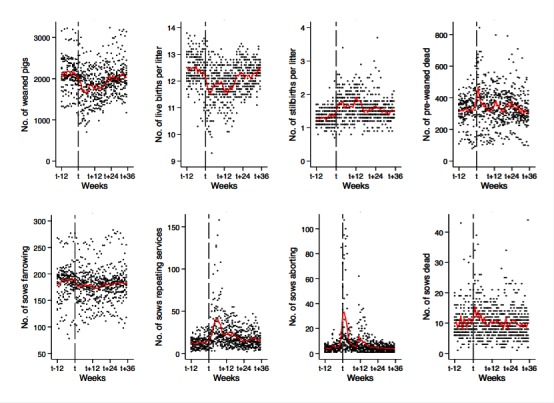
Porcine reproductive and respiratory syndrome (PRRS) is an endemic disease causing important economic losses to the US swine industry. The complex epidemiology of the disease, along with the diverse clinical outputs observed in different types of infected farms, have hampered efforts to quantify PRRS' impact on production over time. We measured the impact of PRRS on the production of weaned pigs using a log-linear fixed effects model to evaluate longitudinal data collected from 16 sow farms belonging to a specific firm. We measured seven additional indicators of farm performance to gain insight into disease dynamics. We used pre-outbreak longitudinal data to establish a baseline that was then used to estimate the decrease in production. A significant rise of abortions in the week before the outbreak was reported was the strongest signal of PRRSV activity. In addition, production declined slightly one week before the outbreak and then fell markedly until weeks 5 and 6 post-outbreak. Recovery was not monotonic, cycling gently around a rising trend. At the end of the study period (35 weeks post-outbreak), neither the production of weaned pigs nor any of the performance indicators had fully recovered to baseline levels. This result suggests PRSS outbreaks may last longer than has been found in most other studies. We assessed PRRS' effect on farm efficiency as measured by changes in sow production of weaned pigs per year. We translated production losses into revenue losses assuming an average market price of $45.2/weaned pig. We estimate that the average PRSS outbreak reduced production by approximately 7.4%, relative to annual output in the absence of an outbreak. PRRS reduced production by 1.92 weaned pigs per sow when adjusted to an annual basis. This decrease is substantially larger than the 1.44 decrease of weaned pigs per sow/year reported elsewhere.
猪繁殖与呼吸综合征(PRRS)是一种地方性疾病,给美国养猪业造成了重大经济损失。该疾病复杂的流行病学,以及在不同类型感染猪场观察到的多样临床结果,阻碍了量化PRRS随时间对生产影响的努力。我们使用对数线性固定效应模型来评估从属于某特定公司的16个母猪场收集的纵向数据,以衡量PRRS对断奶仔猪生产的影响。我们还测量了另外七个猪场生产性能指标,以深入了解疾病动态。我们利用疫情爆发前的纵向数据建立了一个基线,然后用它来估计产量的下降。报告显示,疫情爆发前一周流产率显著上升是PRRS病毒活动的最强信号。此外,产量在疫情爆发前一周略有下降,然后在疫情爆发后第5周和第6周显著下降。恢复并非单调的,而是围绕上升趋势轻微波动。在研究期结束时(疫情爆发后35周),断奶仔猪的产量以及任何生产性能指标都没有完全恢复到基线水平。这一结果表明,PRSS疫情可能比大多数其他研究发现的持续时间更长。我们通过每年每头母猪断奶仔猪产量的变化来评估PRRS对猪场效率的影响。假设每头断奶仔猪的平均市场价格为45.2美元,我们将生产损失转化为收入损失。我们估计,相对于没有疫情爆发时的年产量,PRSS疫情爆发平均使产量降低了约7.4%。按年度调整后,PRRS使每头母猪的断奶仔猪产量减少了1.92头。这一降幅明显大于其他地方报道的每头母猪每年断奶仔猪产量下降1.44头的幅度。