Munier Mathilde, Grouleff Julie, Gourdin Louis, Fauchard Mathilde, Chantreau Vanessa, Henrion Daniel, Coutant Régis, Schiøtt Birgit, Chabbert Marie, Rodien Patrice
MITOVASC Institute, Angers, France.
Environ Health Perspect. 2016 Jul;124(7):991-9. doi: 10.1289/ehp.1510006. Epub 2016 Feb 19.
1-chloro-4-[2,2,2-trichloro-1-(4-chlorophenyl)ethyl]benzene (p,p'-DDT) is a persistent environmental endocrine disruptor (ED). Several studies have shown an association between p,p'-DDT exposure and reproductive abnormalities.
To investigate the putative effects of p,p'-DDT on the human follitropin receptor (FSHR) function.
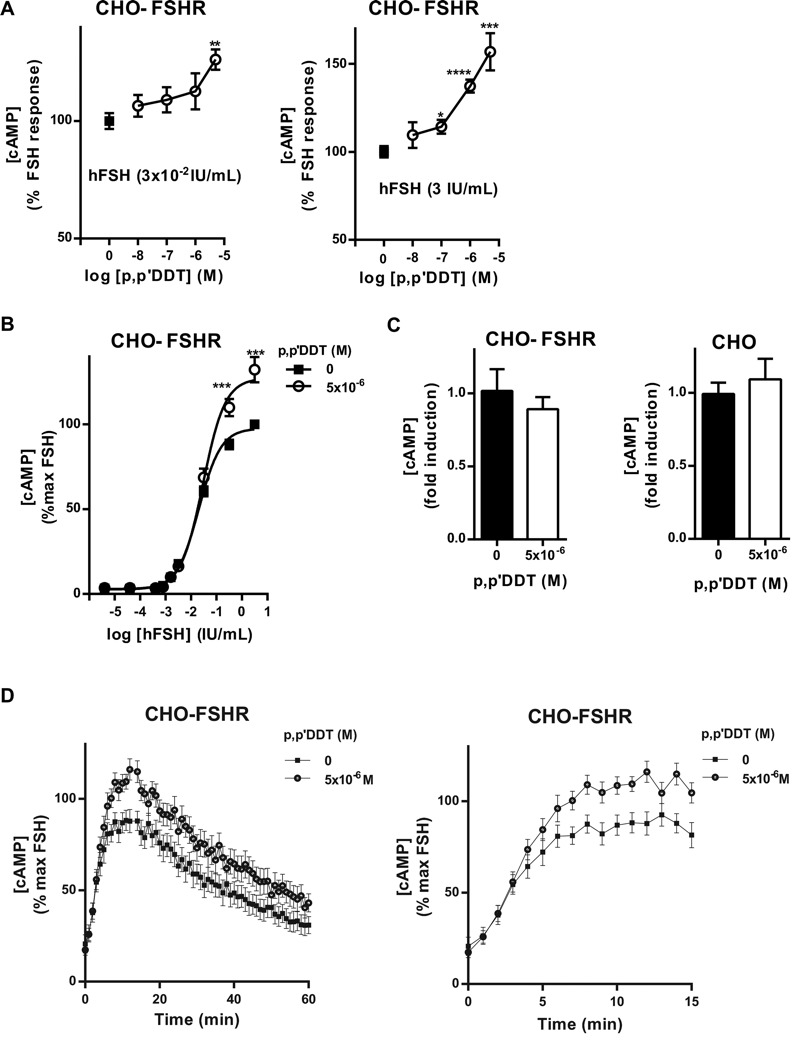
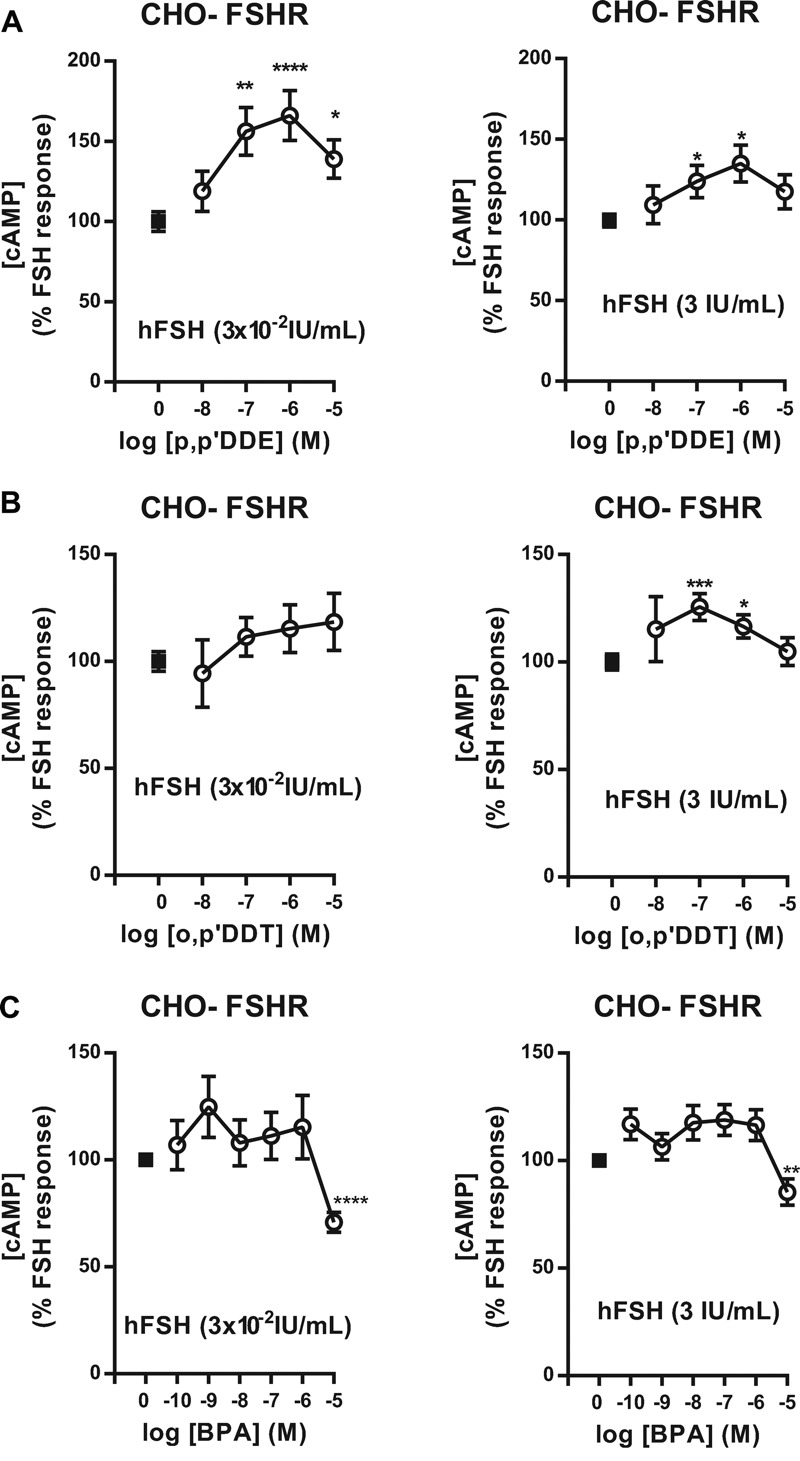
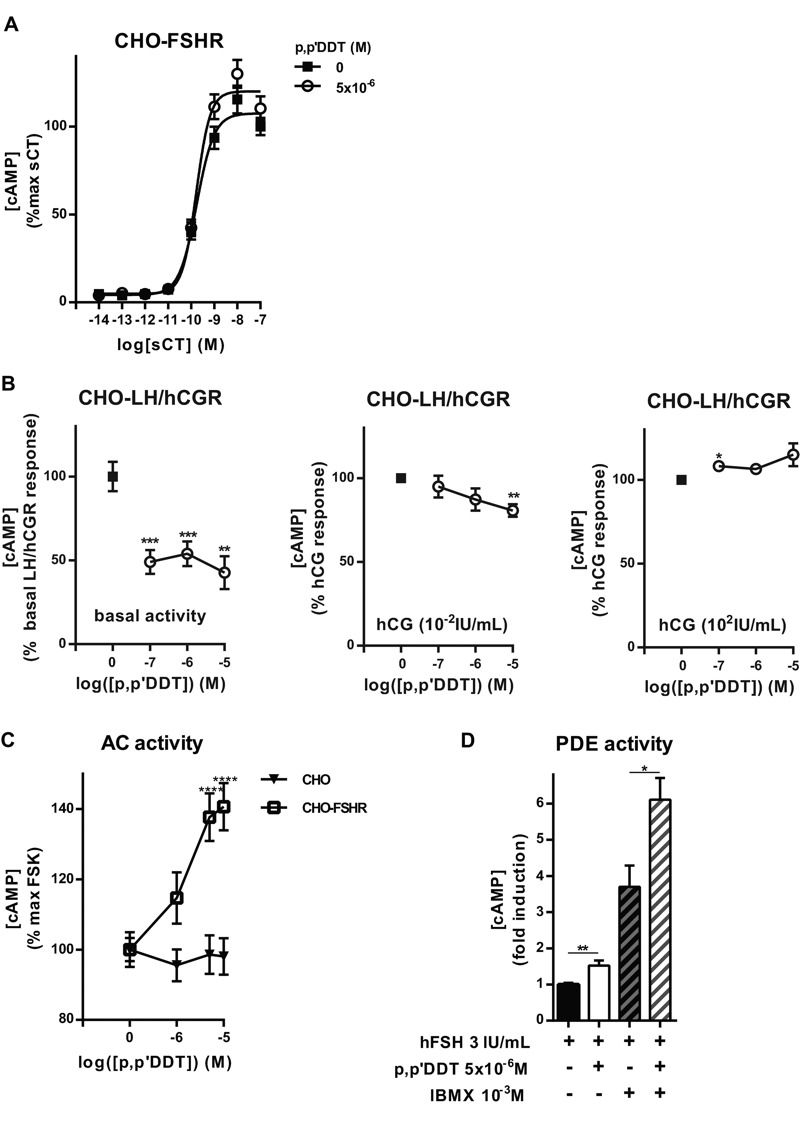
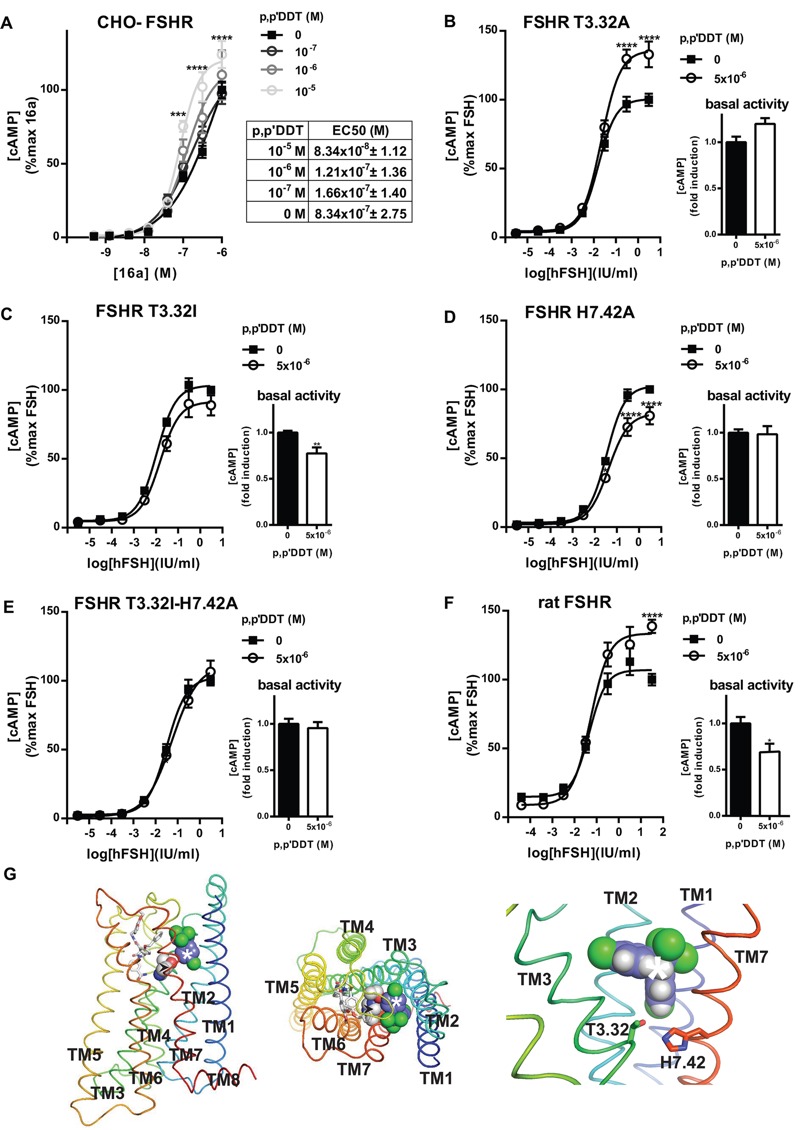
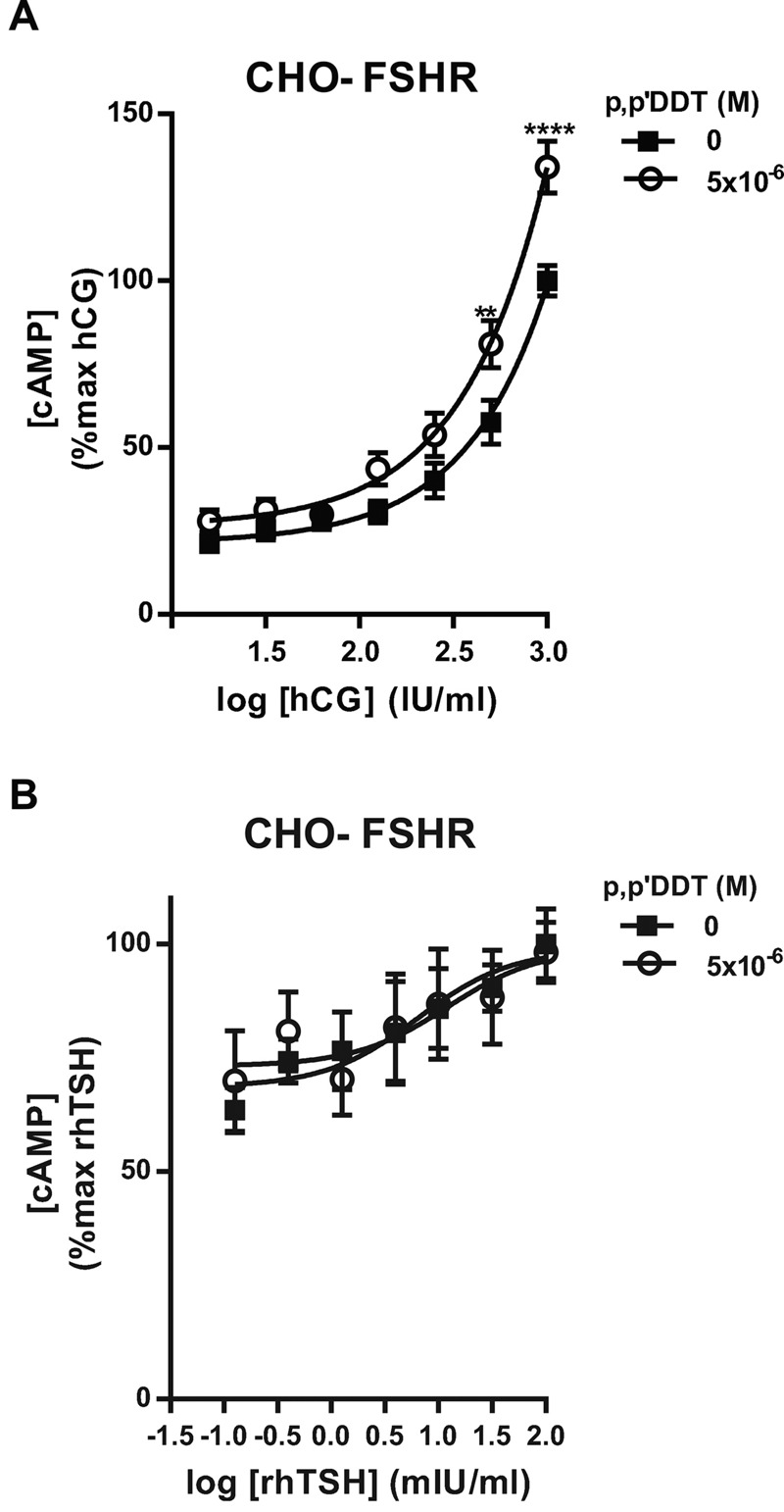
We used Chinese hamster ovary (CHO) cells stably expressing human FSHR to investigate the impact of p,p'-DDT on FSHR activity and its interaction with the receptor. At a concentration of 5 μM p,p'-DDT increased the maximum response of the FSHR to follitropin by 32 ± 7.45%. However, 5 μM p,p'-DDT decreased the basal activity and did not influence the maximal response of the closely related LH/hCG receptor to human chorionic gonadotropin (hCG). The potentiating effect of p,p'-DDT was specific for the FSHR. Moreover, in cells that did not express FSHR, p,p'-DDT had no effect on cAMP response. Thus, the potentiating effect of p,p'-DDT was dependent on the FSHR. In addition, p,p'-DDT increased the sensitivity of FSHR to hCG and to a low molecular weight agonist of the FSHR, 3-((5methyl)-2-(4-benzyloxy-phenyl)-5-{[2-[3-ethoxy-4-methoxy-phenyl)-ethylcarbamoyl]-methyl}-4-oxo-thiazolidin-3-yl)-benzamide (16a). Basal activity in response to p,p'-DDT and potentiation of the FSHR response to FSH by p,p'-DDT varied among FSHR mutants with altered transmembrane domains (TMDs), consistent with an effect of p,p'-DDT via TMD binding. This finding was corroborated by the results of simultaneously docking p,p'-DDT and 16a into the FSHR transmembrane bundle.
p,p'-DDT acted as a positive allosteric modulator of the FSHR in our experimental model. These findings suggest that G protein-coupled receptors are additional targets of endocrine disruptors.
Munier M, Grouleff J, Gourdin L, Fauchard M, Chantreau V, Henrion D, Coutant R, Schiøtt B, Chabbert M, Rodien P. 2016. In vitro effects of the endocrine disruptor p,p'-DDT on human follitropin receptor. Environ Health Perspect 124:991-999; http://dx.doi.org/10.1289/ehp.1510006.
1-氯-4-[2,2,2-三氯-1-(4-氯苯基)乙基]苯(p,p'-滴滴涕)是一种持久性环境内分泌干扰物(ED)。多项研究表明,接触p,p'-滴滴涕与生殖异常之间存在关联。
研究p,p'-滴滴涕对人促卵泡激素受体(FSHR)功能的假定影响。
我们使用稳定表达人FSHR的中国仓鼠卵巢(CHO)细胞,研究p,p'-滴滴涕对FSHR活性及其与该受体相互作用的影响。在5 μM的浓度下,p,p'-滴滴涕使FSHR对促卵泡激素的最大反应增加了32±7.45%。然而,5 μM的p,p'-滴滴涕降低了基础活性,并且不影响密切相关的促黄体生成素/人绒毛膜促性腺激素受体(LH/hCG受体)对人绒毛膜促性腺激素(hCG)的最大反应。p,p'-滴滴涕的增强作用对FSHR具有特异性。此外,在不表达FSHR的细胞中,p,p'-滴滴涕对环磷酸腺苷(cAMP)反应没有影响。因此,p,p'-滴滴涕的增强作用依赖于FSHR。此外,p,p'-滴滴涕增加了FSHR对hCG以及对FSHR的一种低分子量激动剂3-((5-甲基)-2-(4-苄氧基-苯基)-5-{[2-[3-乙氧基-4-甲氧基-苯基)-乙基氨基甲酰基]-甲基}-4-氧代-噻唑烷-3-基)-苯甲酰胺(16a)的敏感性。对p,p'-滴滴涕的基础反应以及p,p'-滴滴涕对FSHR对FSH反应的增强作用在跨膜结构域(TMD)改变的FSHR突变体之间有所不同,这与p,p'-滴滴涕通过TMD结合产生的效应一致。p,p'-滴滴涕和16a同时对接至FSHR跨膜束的结果证实了这一发现。
在我们的实验模型中,p,p'-滴滴涕作为FSHR的正变构调节剂发挥作用。这些发现表明,G蛋白偶联受体是内分泌干扰物的额外靶点。
Munier M, Grouleff J, Gourdin L, Fauchard M, Chantreau V, Henrion D, Coutant R, Schiøtt B, Chabbert M, Rodien P. 2016. 内分泌干扰物p,p'-滴滴涕对人促卵泡激素受体的体外效应。《环境健康展望》124:991 - 999;http://dx.doi.org/10.1289/ehp.1510006 。