Gavande Navnath S, VanderVere-Carozza Pamela S, Hinshaw Hilary D, Jalal Shadia I, Sears Catherine R, Pawelczak Katherine S, Turchi John J
Department of Medicine, Indiana University School of Medicine, Indianapolis, IN 46202, United States.
Department of Obstetrics and Gynecology, Indiana University School of Medicine, Indianapolis, IN 46202, United States.
Pharmacol Ther. 2016 Apr;160:65-83. doi: 10.1016/j.pharmthera.2016.02.003. Epub 2016 Feb 16.
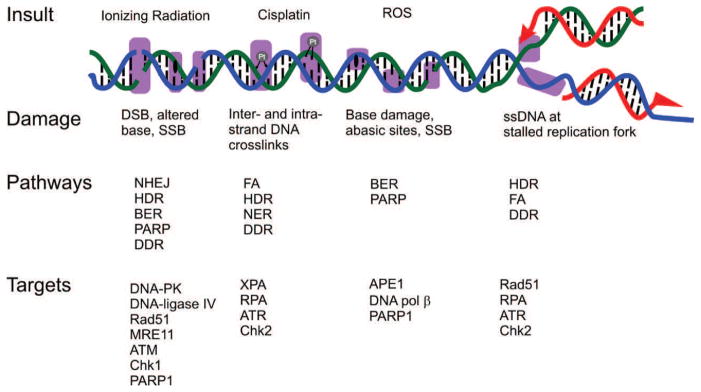
The repair of DNA damage is a complex process that relies on particular pathways to remedy specific types of damage to DNA. The range of insults to DNA includes small, modest changes in structure including mismatched bases and simple methylation events to oxidized bases, intra- and interstrand DNA crosslinks, DNA double strand breaks and protein-DNA adducts. Pathways required for the repair of these lesions include mismatch repair, base excision repair, nucleotide excision repair, and the homology directed repair/Fanconi anemia pathway. Each of these pathways contributes to genetic stability, and mutations in genes encoding proteins involved in these pathways have been demonstrated to promote genetic instability and cancer. In fact, it has been suggested that all cancers display defects in DNA repair. It has also been demonstrated that the ability of cancer cells to repair therapeutically induced DNA damage impacts therapeutic efficacy. This has led to targeting DNA repair pathways and proteins to develop anti-cancer agents that will increase sensitivity to traditional chemotherapeutics. While initial studies languished and were plagued by a lack of specificity and a defined mechanism of action, more recent approaches to exploit synthetic lethal interaction and develop high affinity chemical inhibitors have proven considerably more effective. In this review we will highlight recent advances and discuss previous failures in targeting DNA repair to pave the way for future DNA repair targeted agents and their use in cancer therapy.
DNA损伤的修复是一个复杂的过程,它依赖于特定的途径来修复DNA的特定类型损伤。对DNA的损伤范围包括结构上的微小、适度变化,包括碱基错配、简单的甲基化事件、氧化碱基、链内和链间DNA交联、DNA双链断裂以及蛋白质-DNA加合物。修复这些损伤所需的途径包括错配修复、碱基切除修复、核苷酸切除修复以及同源定向修复/范可尼贫血途径。这些途径中的每一个都有助于遗传稳定性,并且已经证明参与这些途径的蛋白质编码基因中的突变会促进遗传不稳定性和癌症。事实上,有人提出所有癌症在DNA修复方面都存在缺陷。还已经证明癌细胞修复治疗诱导的DNA损伤的能力会影响治疗效果。这导致了针对DNA修复途径和蛋白质来开发抗癌药物,这些药物将增加对传统化疗的敏感性。虽然最初的研究进展缓慢且受到缺乏特异性和明确作用机制的困扰,但最近利用合成致死相互作用和开发高亲和力化学抑制剂的方法已被证明要有效得多。在这篇综述中,我们将重点介绍最近的进展,并讨论以前在靶向DNA修复方面的失败,以为未来靶向DNA修复的药物及其在癌症治疗中的应用铺平道路。