Ricaño-Ponce Isis, Zhernakova Daria V, Deelen Patrick, Luo Oscar, Li Xingwang, Isaacs Aaron, Karjalainen Juha, Di Tommaso Jennifer, Borek Zuzanna Agnieszka, Zorro Maria M, Gutierrez-Achury Javier, Uitterlinden Andre G, Hofman Albert, van Meurs Joyce, Netea Mihai G, Jonkers Iris H, Withoff Sebo, van Duijn Cornelia M, Li Yang, Ruan Yijun, Franke Lude, Wijmenga Cisca, Kumar Vinod
University of Groningen, University Medical Centre Groningen, Department of Genetics, Groningen, 9700 RB, The Netherlands.
University of Groningen, University Medical Centre Groningen, Department of Genetics, Groningen, 9700 RB, The Netherlands; University of Groningen, University Medical Centre Groningen, Genomics Coordination Centre, Groningen, 9700 RB, The Netherlands.
J Autoimmun. 2016 Apr;68:62-74. doi: 10.1016/j.jaut.2016.01.002. Epub 2016 Feb 18.
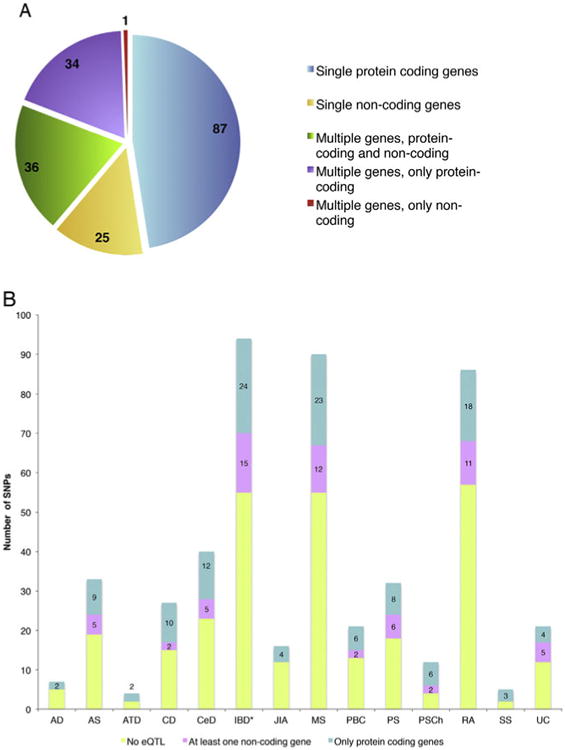
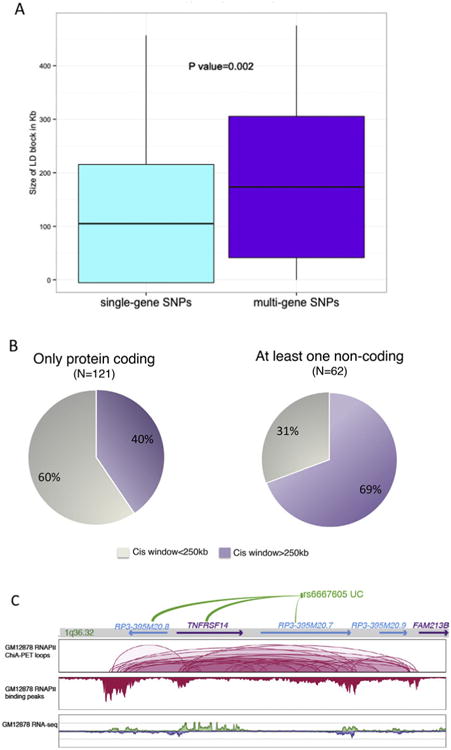
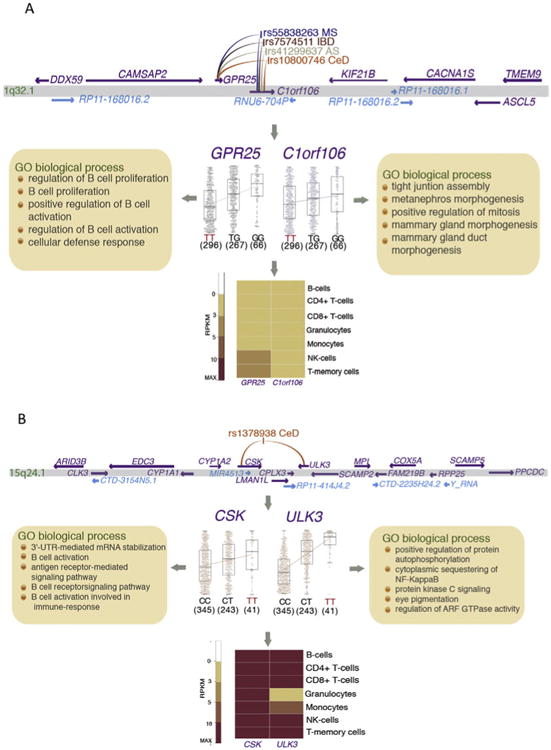
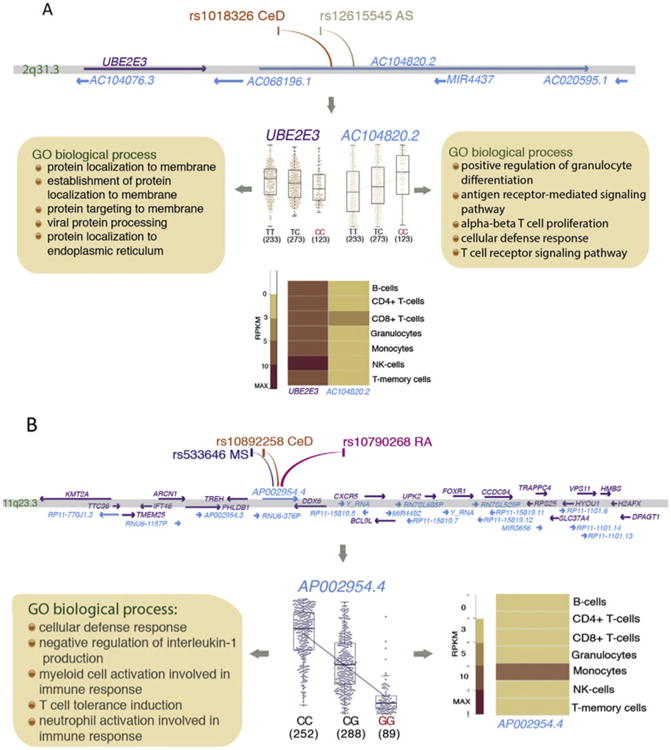
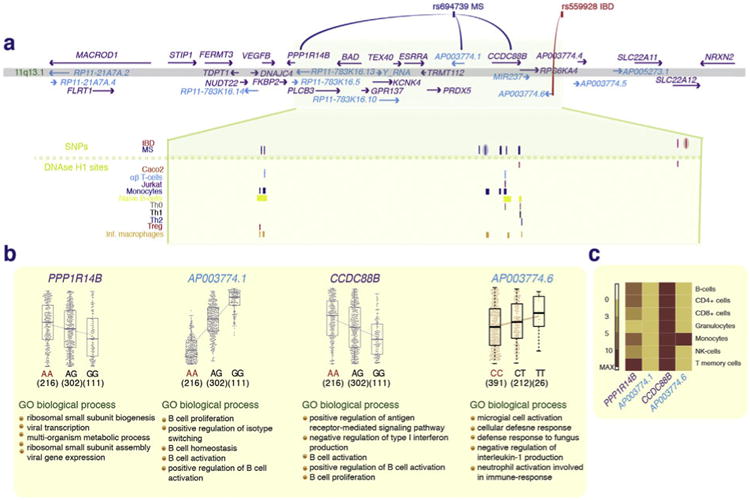
Genome-wide association and fine-mapping studies in 14 autoimmune diseases (AID) have implicated more than 250 loci in one or more of these diseases. As more than 90% of AID-associated SNPs are intergenic or intronic, pinpointing the causal genes is challenging. We performed a systematic analysis to link 460 SNPs that are associated with 14 AID to causal genes using transcriptomic data from 629 blood samples. We were able to link 71 (39%) of the AID-SNPs to two or more nearby genes, providing evidence that for part of the AID loci multiple causal genes exist. While 54 of the AID loci are shared by one or more AID, 17% of them do not share candidate causal genes. In addition to finding novel genes such as ULK3, we also implicate novel disease mechanisms and pathways like autophagy in celiac disease pathogenesis. Furthermore, 42 of the AID SNPs specifically affected the expression of 53 non-coding RNA genes. To further understand how the non-coding genome contributes to AID, the SNPs were linked to functional regulatory elements, which suggest a model where AID genes are regulated by network of chromatin looping/non-coding RNAs interactions. The looping model also explains how a causal candidate gene is not necessarily the gene closest to the AID SNP, which was the case in nearly 50% of cases.
对14种自身免疫性疾病(AID)开展的全基因组关联研究和精细定位研究表明,超过250个基因座与其中一种或多种疾病相关。由于超过90%的与AID相关的单核苷酸多态性(SNP)位于基因间或内含子区域,确定致病基因具有挑战性。我们利用来自629份血液样本的转录组数据进行了一项系统分析,将与14种AID相关的460个SNP与致病基因联系起来。我们能够将71个(39%)AID-SNP与两个或更多附近基因联系起来,这表明部分AID基因座存在多个致病基因。虽然54个AID基因座为一种或多种AID所共有,但其中17%没有共享候选致病基因。除了发现ULK3等新基因外,我们还发现了新的疾病机制和途径,如乳糜泻发病机制中的自噬。此外,42个AID SNP特异性影响了53个非编码RNA基因的表达。为了进一步了解非编码基因组如何导致AID,这些SNP与功能调控元件相关联,这提示了一种模型,即AID基因由染色质环化/非编码RNA相互作用网络调控。这种环化模型还解释了为什么致病候选基因不一定是最靠近AID SNP的基因,近50%的情况都是如此。