Hamanishi Junzo, Mandai Masaki, Matsumura Noriomi, Abiko Kaoru, Baba Tsukasa, Konishi Ikuo
Department of Gynecology and Obstetrics, Kyoto University Graduate School of Medicine, 54 Kawahara-cho, Shogoin, Sakyo-ku, Kyoto, Kyoto, 606-8507, Japan.
Department of Obstetrics and Gynecology, Kinki University Faculty of Medicine, Osaka, Japan.
Int J Clin Oncol. 2016 Jun;21(3):462-73. doi: 10.1007/s10147-016-0959-z. Epub 2016 Feb 22.
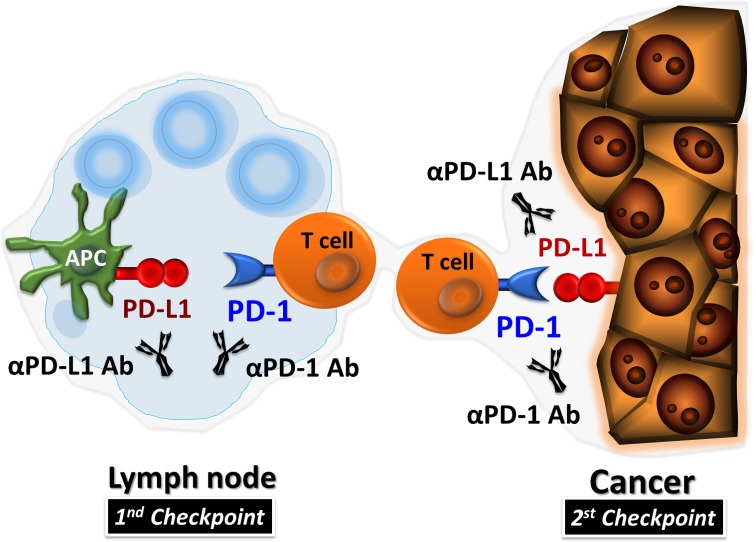
Recent studies showed that tumor cells 'edit' host immunity in several ways to evade immune defenses in the tumor microenvironment. This phenomenon is called "cancer immune escape." One of the most important components in this system is an immunosuppressive co-signal (immune checkpoint) mediated by the PD-1 receptor and its ligand, PD-L1. PD-1 is mainly expressed on activated T cells, whereas PD-L1 is expressed on several types of tumor cells. Preclinical studies have shown that inhibition of the interaction between PD-1 and PD-L1 enhances the T-cell response and mediates antitumor activity. Several clinical trials of PD-1/PD-L1 signal-blockade agents have exhibited dramatic antitumor efficacy in patients with certain types of solid or hematological malignancies. In this review, we highlight recent clinical trials using anti-PD-1 or anti-PD-L1 antibodies against several types of malignancies, including a trial conducted in our department, and describe the clinical perspectives and issues regarding the PD-1/PD-L1 blockade in cancer treatment.
最近的研究表明,肿瘤细胞通过多种方式“编辑”宿主免疫,以逃避肿瘤微环境中的免疫防御。这种现象被称为“癌症免疫逃逸”。该系统中最重要的组成部分之一是由PD-1受体及其配体PD-L1介导的免疫抑制共信号(免疫检查点)。PD-1主要表达于活化的T细胞上,而PD-L1则表达于多种类型的肿瘤细胞上。临床前研究表明,抑制PD-1与PD-L1之间的相互作用可增强T细胞反应并介导抗肿瘤活性。几项PD-1/PD-L1信号阻断剂的临床试验在某些类型的实体或血液恶性肿瘤患者中显示出显著的抗肿瘤疗效。在这篇综述中,我们重点介绍了使用抗PD-1或抗PD-L1抗体治疗几种类型恶性肿瘤的近期临床试验,包括我们科室进行的一项试验,并描述了癌症治疗中PD-1/PD-L1阻断的临床前景和问题。