Lee Ji Yun, Lim Sung Hee, Lee Min-Young, Kim Hae Su, Ahn Jin Seok, Im Young-Hyuck, Park Yeon Hee
Department of Medicine, Samsung Medical Center, Sungkyunkwan University School of Medicine, Seoul, Korea.
PLoS One. 2016 Feb 22;11(2):e0149432. doi: 10.1371/journal.pone.0149432. eCollection 2016.
Metastatic breast cancer (MBC) remains a devastating and incurable disease. Over the past decade, the implementation of clinical trials both with and without molecular targeted therapeutics has impacted the daily clinical treatment of patients with MBC. In this study, we determine whether including MBC patients in clinical trials affects clinical outcomes.
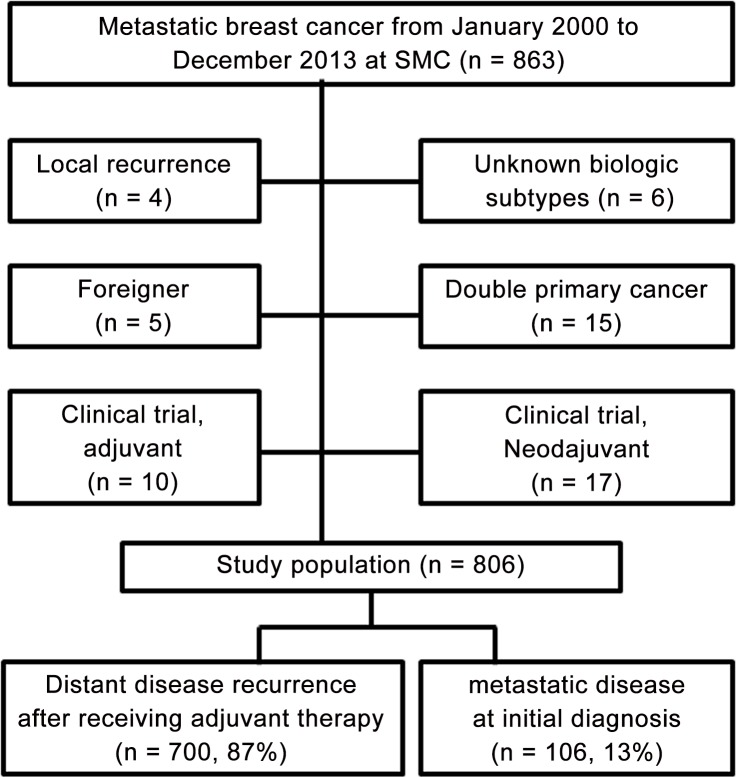
We retrospectively reviewed data for a total of 863 patients diagnosed with initial or recurrent (after receiving adjuvant systemic treatments following surgery) metastatic disease between January 2000 and December 2013. Data were obtained from the breast cancer database of Samsung Medical Center.
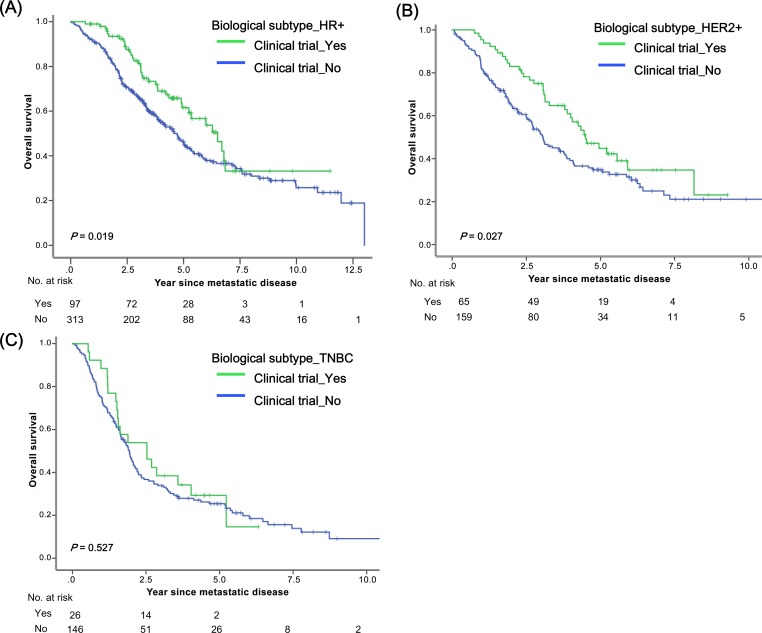
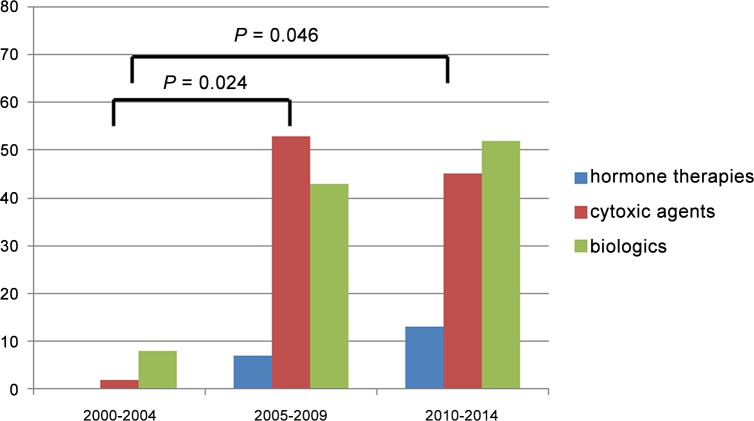
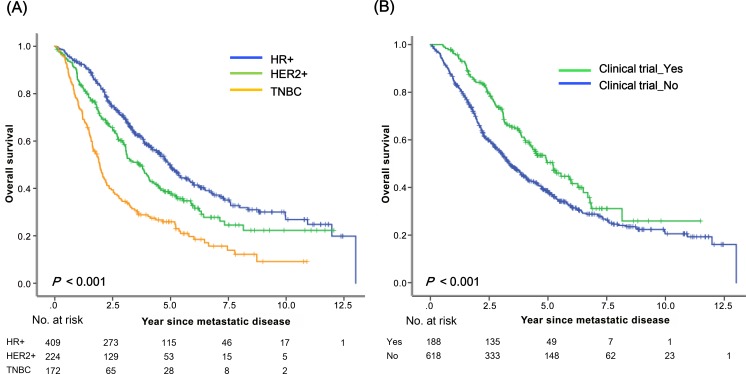
Among the 806 patients selected for inclusion, 188 (23%) had participated in clinical trials. A total of 185 clinical trials were conducted from 2000 to 2014. When compared with earlier periods (n = 10 for 2000-2004), clinical trial enrollment significantly increased over time (n = 103 for 2005-2009, P = 0.024; n = 110 for 2010-2014, P = 0.046). Multivariate analyses revealed that biologic subtype, distant recurrence free interval (DRFI), and clinical trial enrollment were independent predictors of overall survival. Patients who participated in clinical trials showed improved survival, with a hazard ratio of 0.75 (95% CI, 0.59-0.95), which was associated with a 25% reduction in the risk of death. However, subgroup analysis showed that this improved survival benefit was not maintained in patients with triple negative breast cancer (TNBC).
Although not conclusive, we could speculate that there were differences in the use of newer agents or regimens over time, and these differences appear to be associated with improved survival.
转移性乳腺癌(MBC)仍然是一种具有毁灭性且无法治愈的疾病。在过去十年中,包含或不包含分子靶向治疗的临床试验的开展对MBC患者的日常临床治疗产生了影响。在本研究中,我们确定将MBC患者纳入临床试验是否会影响临床结局。
我们回顾性分析了2000年1月至2013年12月期间共863例被诊断为初始或复发性(手术后接受辅助全身治疗后)转移性疾病患者的数据。数据来自三星医疗中心的乳腺癌数据库。
在入选的806例患者中,188例(23%)参与了临床试验。2000年至2014年共进行了185项临床试验。与早期(2000 - 2004年,n = 10)相比,随着时间推移,临床试验入组人数显著增加(2005 - 2009年,n = 103,P = 0.024;2010 - 2014年,n = 110,P = 0.046)。多因素分析显示,生物学亚型、无远处复发生存期(DRFI)和临床试验入组是总生存的独立预测因素。参与临床试验的患者生存率提高,风险比为0.75(95%CI,0.59 - 0.95),这与死亡风险降低25%相关。然而,亚组分析显示,三阴性乳腺癌(TNBC)患者并未维持这种生存获益的改善。
尽管尚无定论,但我们可以推测,随着时间推移,新型药物或方案的使用存在差异,且这些差异似乎与生存改善相关。