Al-Mutairi Aymer, Meyer Ashley N D, Thomas Eric J, Etchegaray Jason M, Roy Kevin M, Davalos Maria Caridad, Sheikh Shazia, Singh Hardeep
Houston Veterans Affairs Center for Innovations in Quality, Effectiveness and Safety, Michael E. DeBakey Veterans Affairs Medical Center and Baylor College of Medicine, 2002 Holcombe Boulevard 152, Houston, TX, 77030, USA.
Department of Family & Community Medicine, Baylor College of Medicine, Houston, TX, USA.
J Gen Intern Med. 2016 Jun;31(6):602-8. doi: 10.1007/s11606-016-3601-x. Epub 2016 Feb 22.
Diagnostic errors are common and harmful, but difficult to define and measure. Measurement of diagnostic errors often depends on retrospective medical record reviews, frequently resulting in reviewer disagreement.
We aimed to test the accuracy of an instrument to help detect presence or absence of diagnostic error through record reviews.
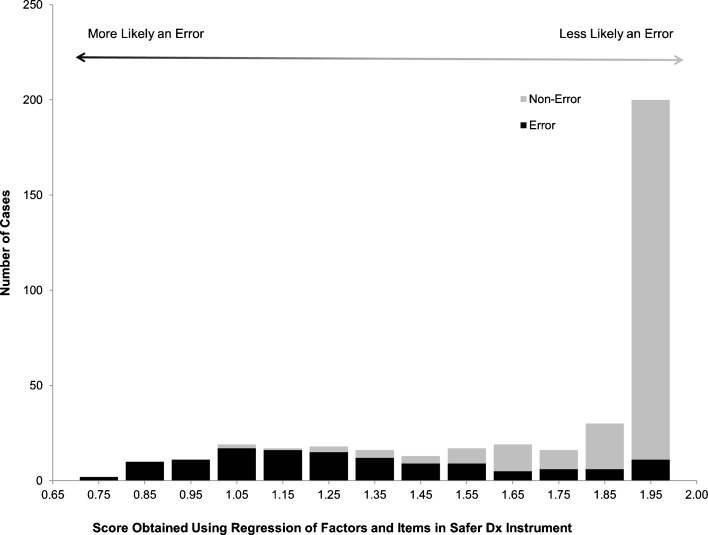
We gathered questions from several previously used instruments for diagnostic error measurement, then developed and refined our instrument. We tested the accuracy of the instrument against a sample of patient records (n = 389), with and without previously identified diagnostic errors (n = 129 and n = 260, respectively).
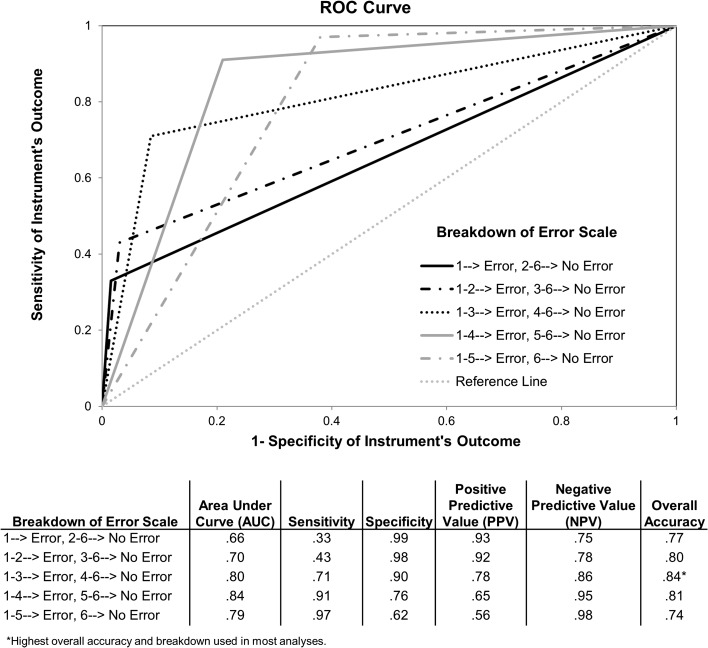
The final version of our instrument (titled Safer Dx Instrument) consisted of 11 questions assessing diagnostic processes in the patient-provider encounter and a main outcome question to determine diagnostic error. In comparison with the previous sample, the instrument yielded an overall accuracy of 84 %, sensitivity of 71 %, specificity of 90 %, negative predictive value of 86 %, and positive predictive value of 78 %. All 11 items correlated significantly with the instrument's error outcome question (all p values ≤ 0.01). Using factor analysis, the 11 questions clustered into two domains with high internal consistency (initial diagnostic assessment, and performance and interpretation of diagnostic tests) and a patient factor domain with low internal consistency (Cronbach's alpha coefficients 0.93, 0.92, and 0.38, respectively).
The Safer Dx Instrument helps quantify the likelihood of diagnostic error in primary care visits, achieving a high degree of accuracy for measuring their presence or absence. This instrument could be useful to identify high-risk cases for further study and quality improvement.
诊断错误很常见且有害,但难以定义和衡量。诊断错误的衡量通常依赖于回顾性病历审查,这常常导致审查者之间存在分歧。
我们旨在测试一种工具通过病历审查来帮助检测诊断错误是否存在的准确性。
我们从先前用于诊断错误衡量的几种工具中收集问题,然后开发并完善我们的工具。我们针对一组患者病历样本(n = 389)测试了该工具的准确性,这些病历样本中有和没有先前确定的诊断错误(分别为n = 129和n = 260)。
我们工具的最终版本(名为更安全诊断工具)由11个评估患者与医疗服务提供者诊疗过程中诊断流程的问题以及一个用于确定诊断错误的主要结果问题组成。与先前的样本相比,该工具的总体准确率为84%,灵敏度为71%,特异性为90%,阴性预测值为86%,阳性预测值为78%。所有11个项目均与该工具的错误结果问题显著相关(所有p值≤0.01)。通过因子分析,这11个问题聚为两个具有高内部一致性的领域(初始诊断评估以及诊断测试的执行和解读)和一个具有低内部一致性的患者因素领域(克朗巴哈系数分别为0.93、0.92和0.38)。
更安全诊断工具有助于量化初级保健就诊中诊断错误的可能性,在测量诊断错误是否存在方面达到了高度准确性。该工具可用于识别高风险病例以便进一步研究和改进质量。