Huang Xiaoli, Borgström Björn, Kempengren Sebastian, Persson Lo, Hegardt Cecilia, Strand Daniel, Oredsson Stina
Department of Biology, Lund University, Lund, Sweden.
Department of Chemistry, Center for Analysis and Synthesis, Lund University, Lund, Sweden.
BMC Cancer. 2016 Feb 23;16:145. doi: 10.1186/s12885-016-2142-3.
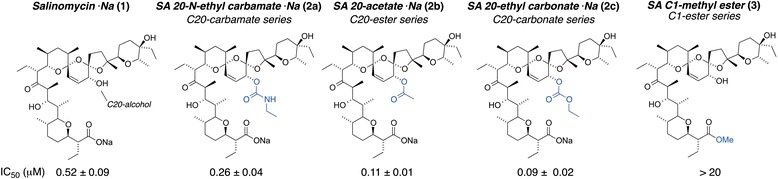
Cancer stem cells (CSCs) have been invoked in resistance, recurrence and metastasis of cancer. Consequently, curative cancer treatments may be contingent on CSC selective approaches. Of particular interest in this respect is the ionophore salinomycin, a natural product shown to be 100-fold more active against CSCs than clinically used paclitaxel. We have previously reported that synthetic salinomycin derivatives display increased activity against breast cancer cell lines. Herein we specifically investigate the CSC selectivity of the most active member in each class of C20-O-acylated analogs as well as a C1-methyl ester analog incapable of charge-neutral metal ion transport.
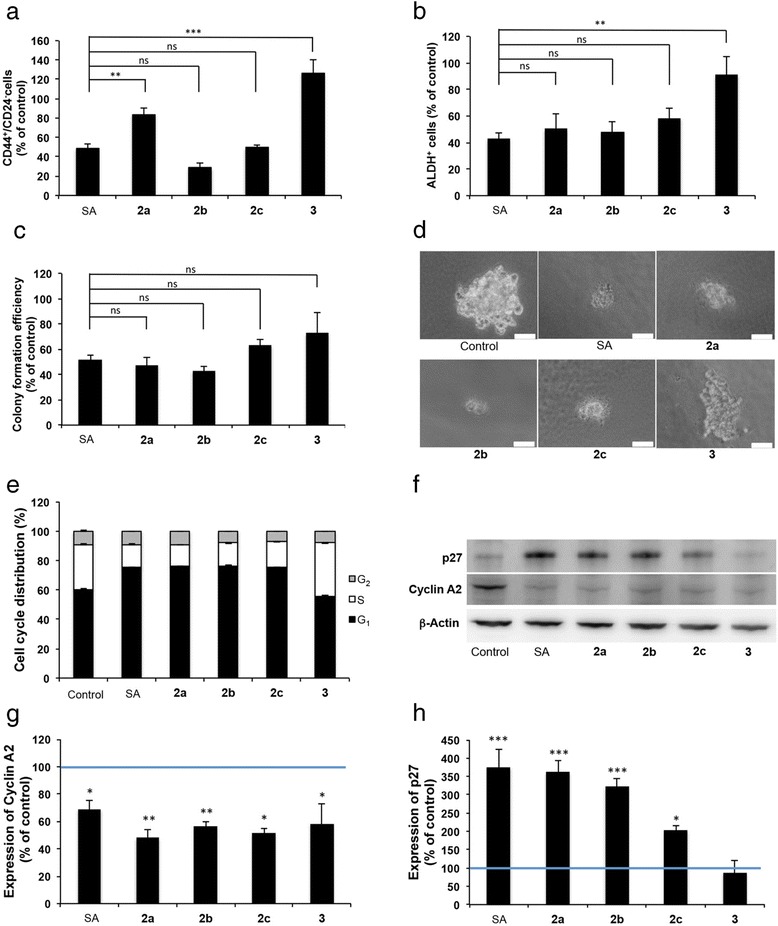
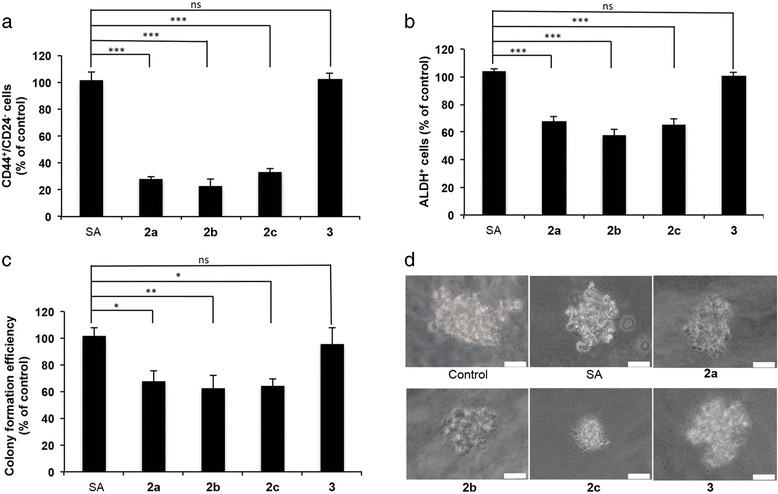
JIMT-1 breast cancer cells were treated with three C20-O-acylated analogs, the C1-methyl ester of salinomycin, and salinomycin. The effects of treatment on the CSC-related CD44(+)/CD24(-) and the aldehyde dehydrogenase positive (ALDH(+)) populations were determined using flow cytometry. The survival ability of CSCs after treatment was investigated with a colony formation assay under serum free conditions. The effect of the compounds on cell migration was evaluated using wound-healing and Boyden chamber assays. The expression of vimentin, related to mesenchymal traits and expression of E-cadherin and β-catenin, related to the epithelial traits, were investigated using immunofluorescence microscopy.
Treatment with each of the three C20-acylated analogs efficiently decreased the putative CSC population as reflected by reduction of the CD44(+)/CD24(-) and ALDH(+) populations already at a 50 nM concentration. In addition, colony forming efficiency and cell migration were reduced, and the expression of the epithelial markers E-cadherin and β-catenin at the cell surface were increased. In contrast, salinomycin used at the same concentration did not significantly influence the CSC population and the C1-methyl ester was inactive even at a 20 μM concentration.
Synthetic structural analogs of salinomycin, previously shown to exhibit increased activity against cancer cells, also exhibited improved activity against CSCs across several assays even at nanomolar concentrations where salinomycin was found inactive. The methyl ester analog of salinomycin, incapable of charge-neutral metal ion transport, did not show activity in CSC assays, lending experimental support to ionophoric stress as the molecular initiating event for the CSC effects of salinomycin and related structures.
癌症干细胞(CSCs)与癌症的耐药性、复发和转移有关。因此,治愈性癌症治疗可能取决于针对CSCs的选择性方法。在这方面特别值得关注的是离子载体盐霉素,一种天然产物,其对CSCs的活性比临床使用的紫杉醇高100倍。我们之前报道过合成的盐霉素衍生物对乳腺癌细胞系显示出更高的活性。在此,我们具体研究了每类C20 - O - 酰化类似物中活性最高的成员以及一种无法进行电荷中性金属离子转运的C1 - 甲酯类似物对CSCs的选择性。
用三种C20 - O - 酰化类似物、盐霉素的C1 - 甲酯和盐霉素处理JIMT - 1乳腺癌细胞。使用流式细胞术测定处理对与CSCs相关的CD44(+)/CD24(-)和醛脱氢酶阳性(ALDH(+))细胞群的影响。在无血清条件下通过集落形成试验研究处理后CSCs的存活能力。使用伤口愈合试验和博伊登小室试验评估化合物对细胞迁移的影响。使用免疫荧光显微镜研究与间充质特征相关的波形蛋白的表达以及与上皮特征相关的E - 钙黏蛋白和β - 连环蛋白的表达。
三种C20 - 酰化类似物中的每一种处理均有效降低了假定的CSC群体,这通过在50 nM浓度时CD44(+)/CD24(-)和ALDH(+)群体的减少得以体现。此外,集落形成效率和细胞迁移降低,并且细胞表面上皮标志物E - 钙黏蛋白和β - 连环蛋白的表达增加。相比之下,相同浓度的盐霉素对CSC群体没有显著影响,并且C1 - 甲酯即使在20 μM浓度下也无活性。
盐霉素的合成结构类似物,之前已显示出对癌细胞活性增加,在多项试验中即使在盐霉素无活性的纳摩尔浓度下对CSCs也表现出增强的活性。盐霉素的甲酯类似物,无法进行电荷中性金属离子转运,在CSC试验中未显示活性,为离子载体应激作为盐霉素及相关结构对CSCs作用的分子起始事件提供了实验支持。