Liu Shuang, Yin Feng, Zhao Mingming, Zhou Chunhui, Ren Junlin, Huang Qiming, Zhao Zhongming, Mitra Ramkrishna, Fan Wenhong, Fan Ming
Department of Neurosurgery, Navy General Hospital, PLA, Beijing 100048, China.
Department of Brain Protection & Plasticity Research, Beijing Institute of Basic Medical Sciences, Beijing 100850, China.
Oncotarget. 2016 Apr 5;7(14):17920-31. doi: 10.18632/oncotarget.7472.
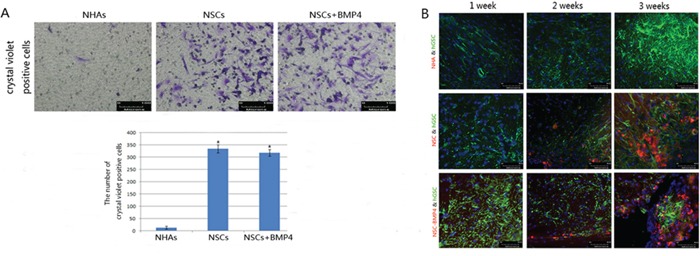
Malignant gliomas patients have a poor survival rate, partially due to the inability in delivering therapeutic agents to the tumors, especially to the metastasis of human glioma stem cells (hGSCs). To explore whether the human neural stem cells (hNSCs) with an over-expression of BMP4 (hNSCs-BMP4) can trace and inhibit hGSCs, in this study, we examined the migration of hNSCs to hGSCs using transwell assay in vitro and performed the fluorescent tracer experiment in vivo. We examined the proliferation, differentiation, apoptosis and migration of hGSCs after co-culturing with hNSCs-BMP4 in vitro and tested the tropism and antitumor effects of hNSCs-BMP4 in the established brain xenograft models of hGSCs. We found that hNSCs-BMP4 could secrete BMP4 and trace hGSCs both in vitro and in vivo. When compared to the normal human astrocytes (NHAs) and hNSCs, hNSCs-BMP4 could significantly inhibit the invasive growth of hGSCs, promote their differentiation and apoptosis by activating Smad1/5/8 signaling, and prolong the survival time of the tumor-bearing nude mice. Collectively, this study suggested that hNSCs-BMP4 may help in developing therapeutic approaches for the treatment of human malignant gliomas.
恶性胶质瘤患者的生存率较低,部分原因是无法将治疗药物输送到肿瘤部位,尤其是无法输送到人类胶质瘤干细胞(hGSCs)的转移灶。为了探究过表达骨形态发生蛋白4(BMP4)的人类神经干细胞(hNSCs-BMP4)是否能够追踪并抑制hGSCs,在本研究中,我们使用体外Transwell实验检测了hNSCs向hGSCs的迁移情况,并在体内进行了荧光示踪实验。我们检测了hNSCs-BMP4与hGSCs体外共培养后hGSCs的增殖、分化、凋亡及迁移情况,并在已建立的hGSCs脑异种移植模型中测试了hNSCs-BMP4的趋向性和抗肿瘤作用。我们发现hNSCs-BMP4在体外和体内均可分泌BMP4并追踪hGSCs。与正常人星形胶质细胞(NHAs)和hNSCs相比,hNSCs-BMP4可通过激活Smad1/5/8信号通路显著抑制hGSCs的侵袭性生长,促进其分化和凋亡,并延长荷瘤裸鼠的生存时间。总体而言,本研究表明hNSCs-BMP4可能有助于开发治疗人类恶性胶质瘤的方法。