Chan Pei-Ying S, Cheng Chia-Hsiung, Jhu Ya-Jhih, Chen Chia-Ling, von Leupoldt Andreas
Department of Occupational Therapy, College of Medicine, and Healthy Ageing Research Center, Chang Gung UniversityTaoyuan, Taiwan; Department of Psychiatry, Chang Gung Memorial Hospital at LinkouTaoyuan, Taiwan.
Department of Occupational Therapy, College of Medicine, and Healthy Ageing Research Center, Chang Gung UniversityTaoyuan, Taiwan; Division of Psychiatry, Taipei Veterans General Hospital at Yuan ShanYilan County, Taiwan.
Front Physiol. 2016 Feb 16;7:19. doi: 10.3389/fphys.2016.00019. eCollection 2016.
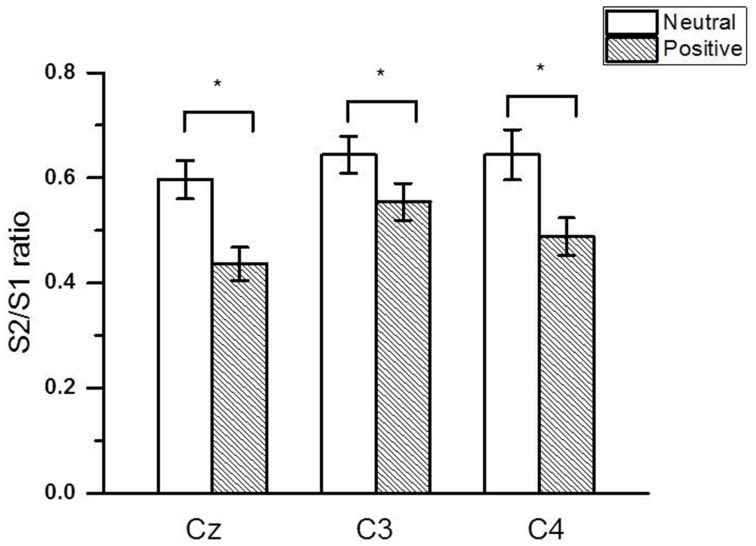
Respiratory sensory gating function has been found decreased by induced negative emotion in healthy adults. The increased ratio of the respiratory-related evoked potential (RREP) N1 peak amplitude for the second occlusion (S2) vs. the first occlusion (S1), S2/S1, is indicative of such decreased respiratory sensory gating. In this study, we tested the hypothesis that a positive emotional context would enhance respiratory sensory gating function in healthy individuals. In addition, we tested the modulating role of individual anxiety levels. We compared respiratory sensory gating in 40 healthy individuals by the paired inspiratory occlusion paradigm in a positive and neutral emotional context induced by emotional picture viewing. The results showed that the group averaged RREP N1 peak amplitudes S2/S1 ratios were significantly smaller in the positive compared to neutral context (0.49 vs. 0.64; p < 0.01). Further, analysis showed that the ratio decrease was due to a reduced response to the S2 and an enhanced response to S1 in the positive emotional context (p < 0.05). The subgroup analyses showed that in the positive emotional context, both individuals with low-moderate anxiety levels and those with no anxiety demonstrated a significant decrease of their S2/S1 ratio, but only those with low-moderate anxiety levels showed reduced S2 amplitudes compared to the neutral context (p < 0.01). In conclusion, our results suggest that a positive emotional context is related to better brain inhibitory mechanisms by filtering out repetitive respiratory stimuli in healthy individuals, especially in the presence of low-moderate anxiety levels. Further, investigation on how positive emotional contexts might contribute to improved respiratory sensory gating ability in clinical populations is necessary.
已有研究发现,在健康成年人中,诱发的负面情绪会降低呼吸感觉门控功能。呼吸相关诱发电位(RREP)第二次阻断(S2)与第一次阻断(S1)的N1峰振幅之比(S2/S1)增加,表明呼吸感觉门控功能降低。在本研究中,我们检验了这样一个假设:积极的情绪背景会增强健康个体的呼吸感觉门控功能。此外,我们还检验了个体焦虑水平的调节作用。我们通过配对吸气阻断范式,在观看情绪图片诱发的积极和中性情绪背景下,比较了40名健康个体的呼吸感觉门控。结果显示:与中性背景相比,积极背景下的组平均RREP N1峰振幅S2/S1比值显著更小(0.49对0.64;p<0.01)。此外,分析表明,比值降低是由于在积极情绪背景下对S2的反应减弱以及对S1的反应增强所致(p<0.05)。亚组分析表明,在积极情绪背景下,低中度焦虑水平个体和无焦虑个体的S2/S1比值均显著降低,但只有低中度焦虑水平个体与中性背景相比S2振幅降低(p<0.01)。总之,我们的结果表明,积极的情绪背景与更好的大脑抑制机制有关,即通过过滤健康个体中的重复性呼吸刺激,尤其是在存在低中度焦虑水平时。此外,有必要进一步研究积极情绪背景如何有助于改善临床人群的呼吸感觉门控能力。