Kawaguchiya M, Urushibara N, Aung M S, Morimoto S, Ito M, Kudo K, Sumi A, Kobayashi N
Department of Hygiene, Sapporo Medical University School of Medicine, Japan.
Sapporo Clinical Laboratory Inc., Sapporo, Hokkaido, Japan.
New Microbes New Infect. 2015 Nov 11;9:66-72. doi: 10.1016/j.nmni.2015.11.001. eCollection 2016 Jan.
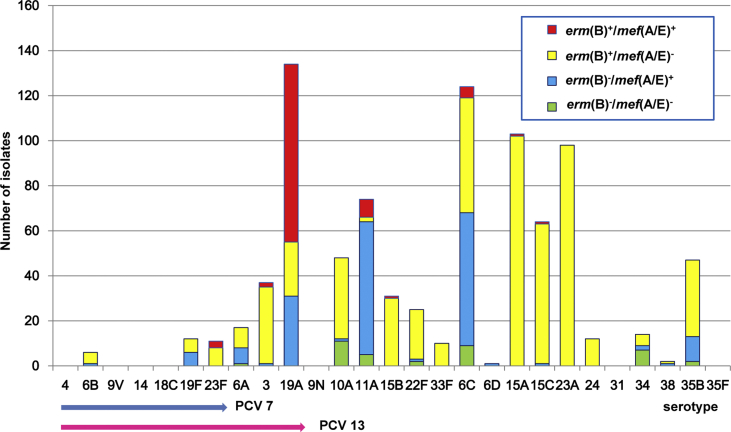
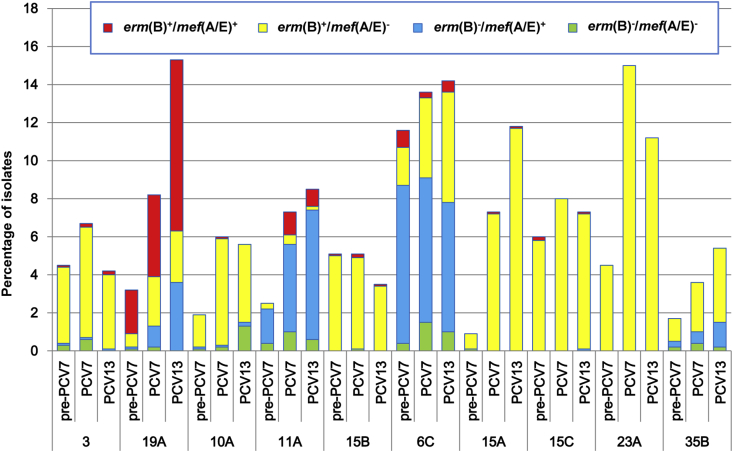
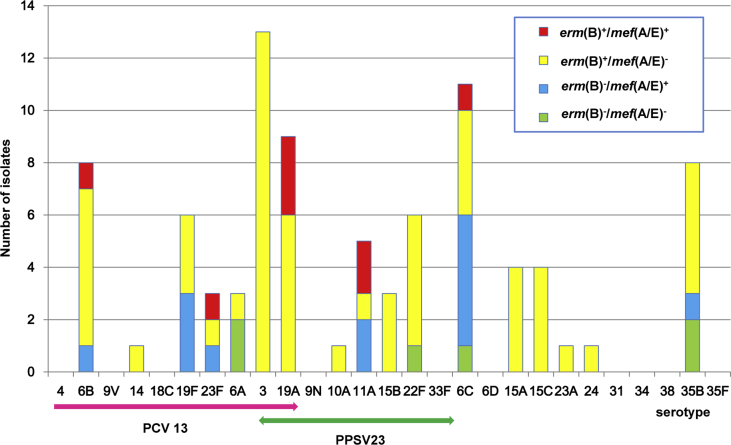
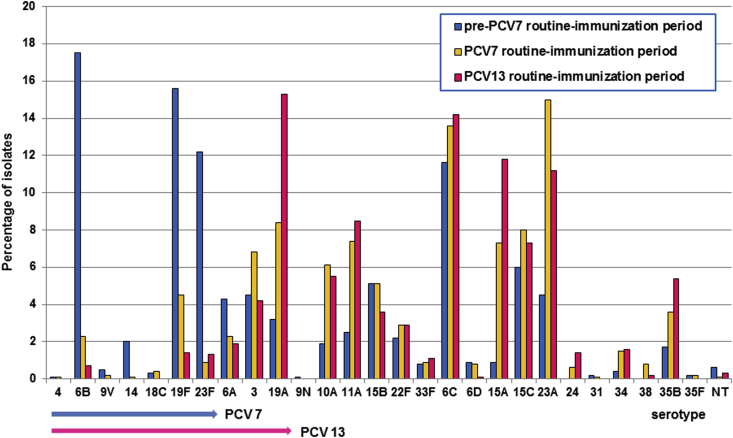
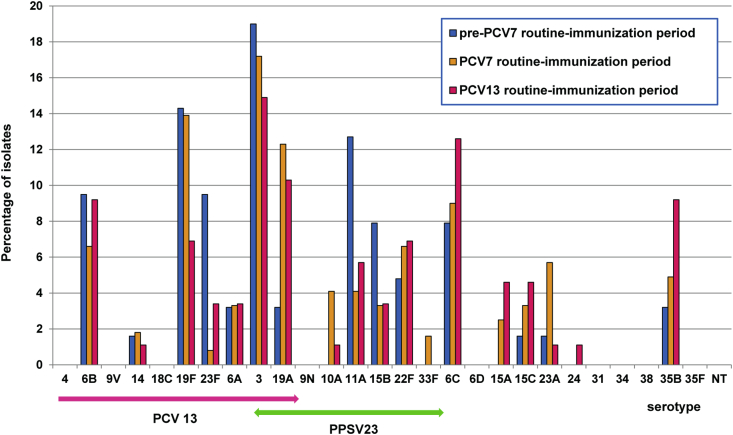
In Japan, the 7-valent pneumococcal conjugate vaccine (PCV7) was introduced to the nation's routine immunization program in April 2013 and was replaced by the 13-valent pneumococcal conjugate vaccine (PCV13) in November 2013. Distribution of serotypes and macrolide resistance genotypes was investigated for a total of 1097 (975 children, 122 adults) and 960 (873 children, 87 adults) clinical isolates of Streptococcus pneumoniae from noninvasive infections in Hokkaido (northern main island of Japan) in the routine immunization periods for PCV7 and PCV13 (April-October 2013 and November 2013-November 2014, respectively). Serotype was determined by sequential multiplex PCR and additional genetic analyses. Macrolide resistance genes erm(B) and mef(A/E) were detected by multiplex PCR. Although the most prevalent serotypes in children were 23A and 6C in the PCV7 period, after replacement with PCV13, 19A became the most common, followed by 6C, 15A and 23A. Among adults, serotype 3 was consistently the most frequent throughout the study periods. Compared with values from the pre-PCV7 routine immunization period, PCV7 serotypes decreased from 48.3 to 3.3% in the PCV13 period among children, while the rates of non-PCV13 serotypes (particularly 15A, 23A, 11A, 10A and 35B) increased from 39.7 to 75.1% (p < 0.001). In the PCV13 period, erm(B), mef(A/E) and both of these genes were detected in 75.8, 31.6 and 11.3% of all isolates, respectively. Serotype 19A accounted for 76.9% of the isolates with both the macrolide resistance genes, and emerging non-PCV13 serotypes 15A, 15C and 23A mostly harboured erm(B).
在日本,7价肺炎球菌结合疫苗(PCV7)于2013年4月被纳入国家常规免疫计划,并于2013年11月被13价肺炎球菌结合疫苗(PCV13)取代。对北海道(日本北部主岛)在PCV7和PCV13常规免疫期间(分别为2013年4月至10月和2013年11月至2014年11月)从非侵袭性感染中分离出的总共1097株(975名儿童,122名成人)和960株(873名儿童,87名成人)肺炎链球菌临床分离株的血清型分布和大环内酯类耐药基因型进行了调查。通过连续多重PCR和额外的基因分析确定血清型。通过多重PCR检测大环内酯类耐药基因erm(B)和mef(A/E)。在PCV7时期,儿童中最常见的血清型是23A和6C,但在更换为PCV13后,19A成为最常见的血清型,其次是6C、15A和23A。在成人中,血清型3在整个研究期间一直是最常见的。与PCV7之前的常规免疫时期的值相比,PCV13时期儿童中PCV7血清型从48.3%降至3.3%,而非PCV13血清型(特别是15A、23A、11A、10A和35B)的比例从39.7%增加到75.1%(p<0.001)。在PCV13时期,分别在所有分离株的75.8%、31.6%和11.3%中检测到erm(B)、mef(A/E)以及这两个基因。血清型19A在同时携带大环内酯类耐药基因的分离株中占76.9%,新出现的非PCV13血清型15A、15C和23A大多携带erm(B)。