Kraehenmann Rainer, Schmidt André, Friston Karl, Preller Katrin H, Seifritz Erich, Vollenweider Franz X
Department of Psychiatry, Psychotherapy and Psychosomatics, Psychiatric Hospital, University of Zurich, Zürich 8032, Switzerland; Neuropsychopharmacology and Brain Imaging, Department of Psychiatry, Psychotherapy and Psychosomatics, Psychiatric Hospital, University of Zurich, Zürich 8032, Switzerland.
Department of Psychiatry (UPK), University of Basel, Basel 4012, Switzerland; Department of Psychosis Studies, Institute of Psychiatry, Psychology and Neuroscience, King's College London, London SE5 AF, United Kingdom.
Neuroimage Clin. 2015 Aug 22;11:53-60. doi: 10.1016/j.nicl.2015.08.009. eCollection 2016.
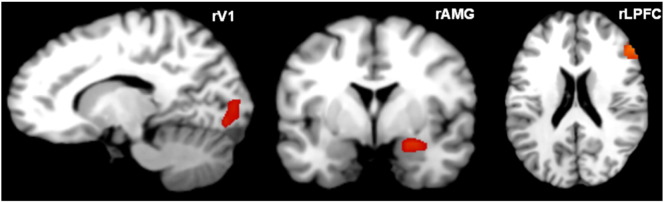
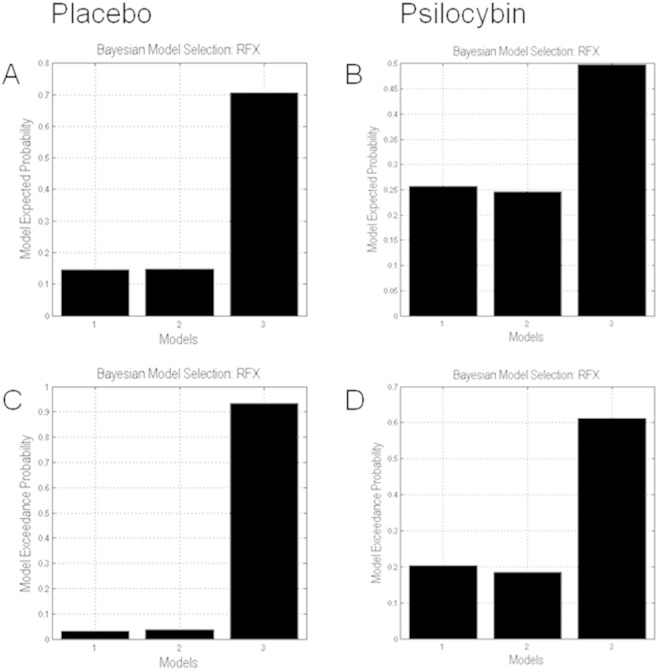
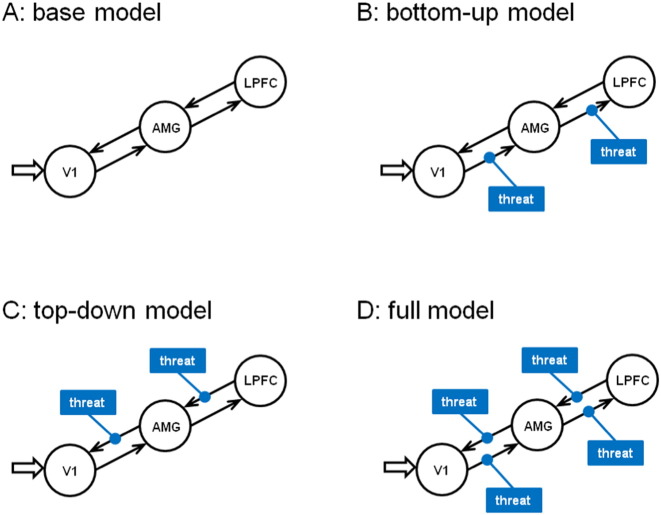
Stimulation of serotonergic neurotransmission by psilocybin has been shown to shift emotional biases away from negative towards positive stimuli. We have recently shown that reduced amygdala activity during threat processing might underlie psilocybin's effect on emotional processing. However, it is still not known whether psilocybin modulates bottom-up or top-down connectivity within the visual-limbic-prefrontal network underlying threat processing. We therefore analyzed our previous fMRI data using dynamic causal modeling and used Bayesian model selection to infer how psilocybin modulated effective connectivity within the visual-limbic-prefrontal network during threat processing. First, both placebo and psilocybin data were best explained by a model in which threat affect modulated bidirectional connections between the primary visual cortex, amygdala, and lateral prefrontal cortex. Second, psilocybin decreased the threat-induced modulation of top-down connectivity from the amygdala to primary visual cortex, speaking to a neural mechanism that might underlie putative shifts towards positive affect states after psilocybin administration. These findings may have important implications for the treatment of mood and anxiety disorders.
裸盖菇素对血清素能神经传递的刺激已被证明能将情绪偏向从负面刺激转向正面刺激。我们最近发现,在威胁处理过程中杏仁核活动的减少可能是裸盖菇素对情绪处理产生影响的基础。然而,尚不清楚裸盖菇素是否会调节威胁处理背后的视觉-边缘-前额叶网络内的自下而上或自上而下的连接。因此,我们使用动态因果模型分析了之前的功能磁共振成像数据,并使用贝叶斯模型选择来推断裸盖菇素在威胁处理过程中如何调节视觉-边缘-前额叶网络内的有效连接。首先,安慰剂和裸盖菇素数据都最好由一个模型来解释,在该模型中,威胁影响调节了初级视觉皮层、杏仁核和外侧前额叶皮层之间的双向连接。其次,裸盖菇素降低了从杏仁核到初级视觉皮层的自上而下连接的威胁诱导调节,这表明了一种神经机制,该机制可能是裸盖菇素给药后假定的向积极情绪状态转变的基础。这些发现可能对情绪和焦虑障碍的治疗具有重要意义。