Oikkonen Jaana, Kuusi Tuire, Peltonen Petri, Raijas Pirre, Ukkola-Vuoti Liisa, Karma Kai, Onkamo Päivi, Järvelä Irma
Department of Medical Genetics, University of Helsinki, Helsinki, Finland.
Sibelius Academy, University of the Arts Helsinki, Helsinki, Finland.
PLoS One. 2016 Feb 24;11(2):e0148679. doi: 10.1371/journal.pone.0148679. eCollection 2016.
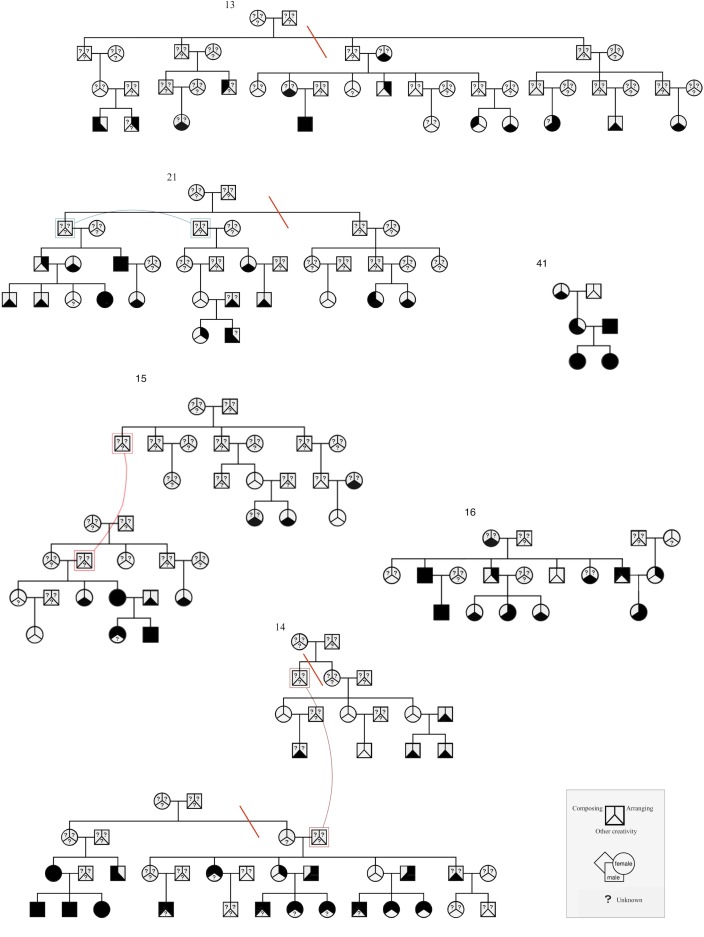
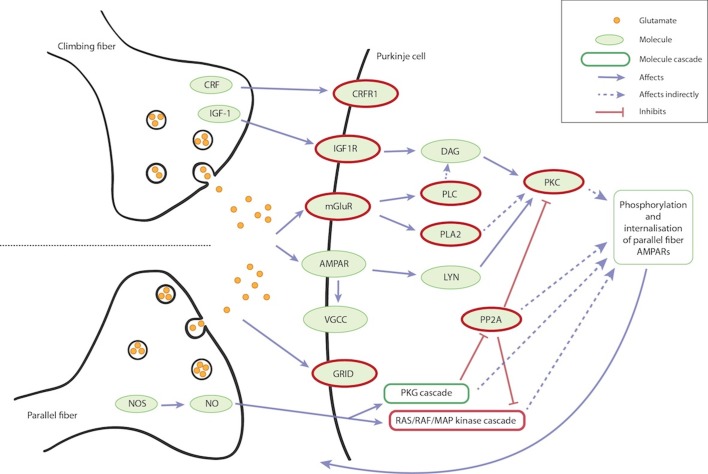
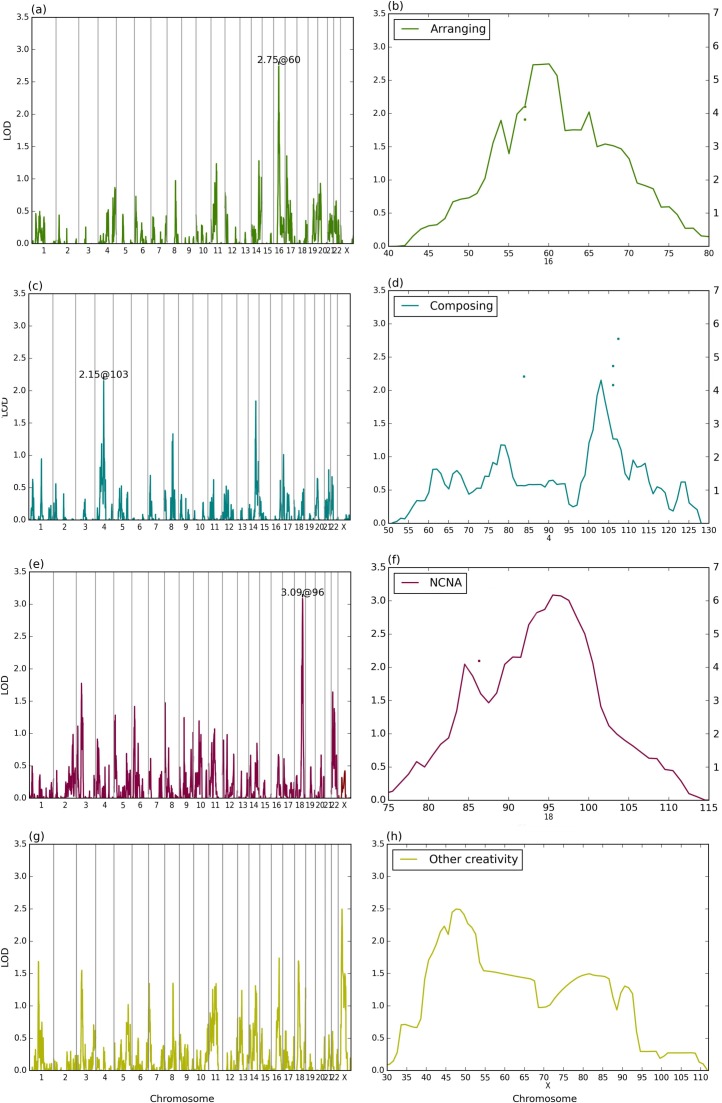
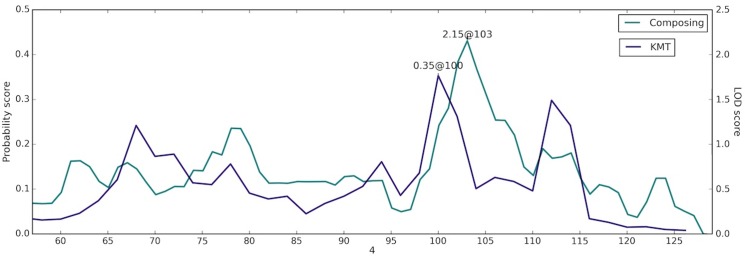
Creative activities in music represent a complex cognitive function of the human brain, whose biological basis is largely unknown. In order to elucidate the biological background of creative activities in music we performed genome-wide linkage and linkage disequilibrium (LD) scans in musically experienced individuals characterised for self-reported composing, arranging and non-music related creativity. The participants consisted of 474 individuals from 79 families, and 103 sporadic individuals. We found promising evidence for linkage at 16p12.1-q12.1 for arranging (LOD 2.75, 120 cases), 4q22.1 for composing (LOD 2.15, 103 cases) and Xp11.23 for non-music related creativity (LOD 2.50, 259 cases). Surprisingly, statistically significant evidence for linkage was found for the opposite phenotype of creative activity in music (neither composing nor arranging; NCNA) at 18q21 (LOD 3.09, 149 cases), which contains cadherin genes like CDH7 and CDH19. The locus at 4q22.1 overlaps the previously identified region of musical aptitude, music perception and performance giving further support for this region as a candidate region for broad range of music-related traits. The other regions at 18q21 and 16p12.1-q12.1 are also adjacent to the previously identified loci with musical aptitude. Pathway analysis of the genes suggestively associated with composing suggested an overrepresentation of the cerebellar long-term depression pathway (LTD), which is a cellular model for synaptic plasticity. The LTD also includes cadherins and AMPA receptors, whose component GSG1L was linked to arranging. These results suggest that molecular pathways linked to memory and learning via LTD affect music-related creative behaviour. Musical creativity is a complex phenotype where a common background with musicality and intelligence has been proposed. Here, we implicate genetic regions affecting music-related creative behaviour, which also include genes with neuropsychiatric associations. We also propose a common genetic background for music-related creative behaviour and musical abilities at chromosome 4.
音乐中的创造性活动代表了人类大脑复杂的认知功能,其生物学基础在很大程度上尚不清楚。为了阐明音乐中创造性活动的生物学背景,我们对有音乐经验的个体进行了全基因组连锁和连锁不平衡(LD)扫描,这些个体以自我报告的作曲、编曲以及与音乐无关的创造力为特征。参与者包括来自79个家庭的474名个体和103名单发个体。我们发现,在16p12.1 - q12.1区域与编曲存在连锁的有前景证据(LOD 2.75,120例),在4q22.1区域与作曲存在连锁(LOD 2.15,103例),在Xp11.23区域与非音乐相关创造力存在连锁(LOD 2.50,259例)。令人惊讶的是,在18q21区域发现了与音乐创造性活动相反表型(既不作曲也不编曲;NCNA)存在连锁的统计学显著证据(LOD 3.09,149例),该区域包含如CDH7和CDH19等钙黏蛋白基因。4q22.1区域与先前确定的音乐才能、音乐感知和表演区域重叠,这进一步支持该区域作为广泛音乐相关特征的候选区域。18q21和16p12.1 - q12.1的其他区域也与先前确定的具有音乐才能的基因座相邻。对提示性与作曲相关的基因进行通路分析表明,小脑长期抑制通路(LTD)存在过度富集,这是一种突触可塑性的细胞模型。LTD还包括钙黏蛋白和AMPA受体,其组成部分GSG1L与编曲相关。这些结果表明,通过LTD与记忆和学习相关的分子通路影响与音乐相关的创造性行为。音乐创造力是一种复杂的表型,有人提出它与音乐性和智力有共同背景。在这里,我们指出了影响与音乐相关创造性行为的基因区域,其中还包括与神经精神疾病相关的基因。我们还提出在4号染色体上与音乐相关创造性行为和音乐能力存在共同的遗传背景。