Sistrom Mark, Evans Benjamin, Benoit Joshua, Balmer Oliver, Aksoy Serap, Caccone Adalgisa
School of Natural Sciences, University of California, Merced, 5200 N. Lake Rd, Merced, CA, 95343, United States of America.
Department of Ecology and Evolutionary Biology, Yale University, 21 Sachem Street New Haven, CT 06520, United States of America.
PLoS One. 2016 Feb 24;11(2):e0147660. doi: 10.1371/journal.pone.0147660. eCollection 2016.
Trypanosoma brucei is a eukaryotic pathogen which causes African trypanosomiasis. It is notable for its variant surface glycoprotein (VSG) coat, which undergoes antigenic variation enabled by a large suite of VSG pseudogenes, allowing for persistent evasion of host adaptive immunity. While Trypanosoma brucei rhodesiense (Tbr) and T. b gambiense (Tbg) are human infective, related T. b. brucei (Tbb) is cleared by human sera. A single gene, the Serum Resistance Associated (SRA) gene, confers Tbr its human infectivity phenotype. Potential genetic recombination of this gene between Tbr and non-human infective Tbb strains has significant epidemiological consequences for Human African Trypanosomiasis outbreaks.
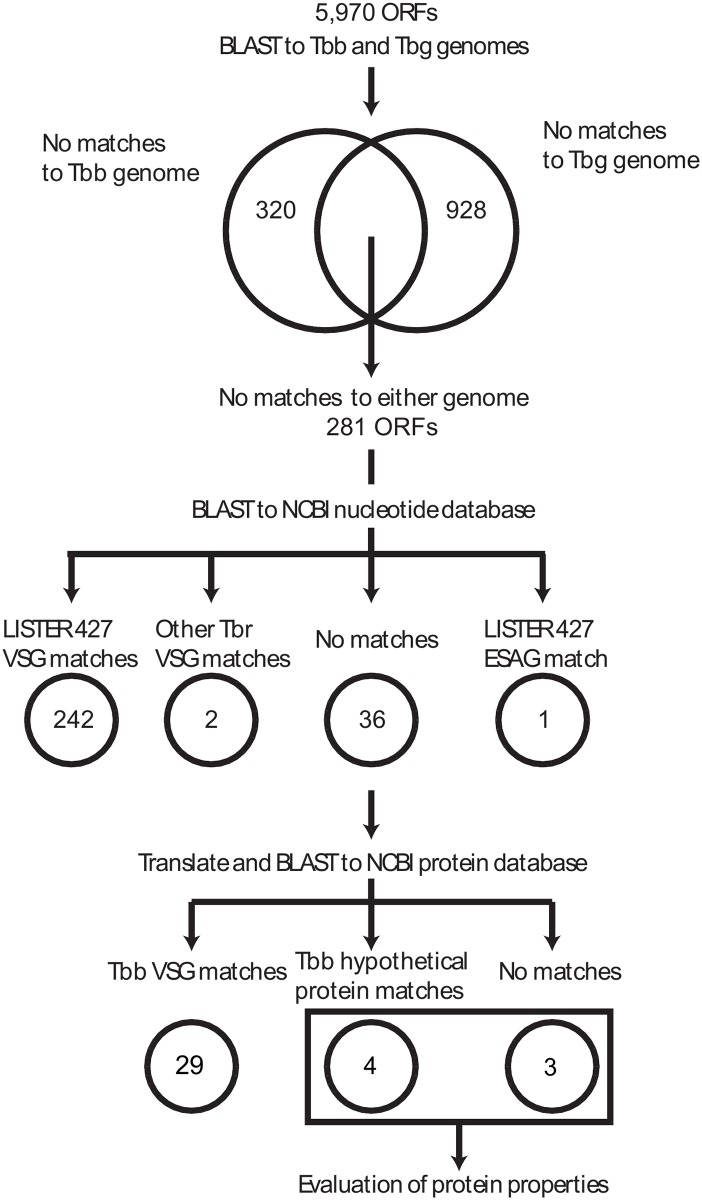
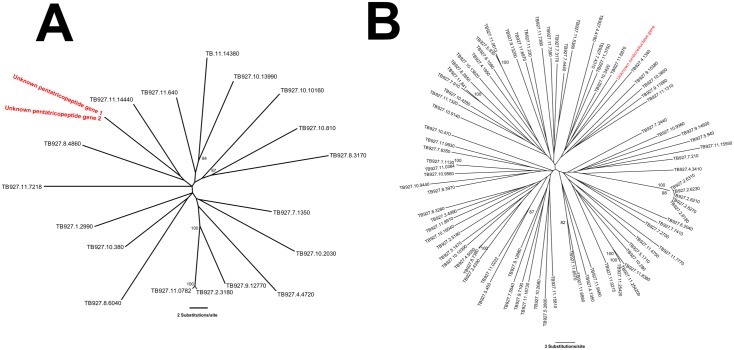
Using long and short read whole genome sequencing, we generated a hybrid de novo assembly of a Tbr strain, producing 4,210 scaffolds totaling approximately 38.8 megabases, which comprise a significant proportion of the Tbr genome, and thus represents a valuable tool for a comparative genomics analyses among human and non-human infective T. brucei and future complete genome assembly. We detected 5,970 putative genes, of which two, an alcohol oxidoreductase and a pentatricopeptide repeat-containing protein, were members of gene families common to all T. brucei subspecies, but variants specific to the Tbr strain sequenced in this study. Our findings confirmed the extremely high level of genomic similarity between the two parasite subspecies found in other studies.
We confirm at the whole genome level high similarity between the two Tbb and Tbr strains studied. The discovery of extremely minor genomic differentiation between Tbb and Tbr suggests that the transference of the SRA gene via genetic recombination could potentially result in novel human infective strains, thus all genetic backgrounds of T. brucei should be considered potentially human infective in regions where Tbr is prevalent.
布氏锥虫是一种导致非洲锥虫病的真核病原体。它以其可变表面糖蛋白(VSG)外壳而闻名,该外壳通过大量VSG假基因实现抗原变异,从而能够持续逃避宿主的适应性免疫。虽然罗德西亚布氏锥虫(Tbr)和冈比亚布氏锥虫(Tbg)可感染人类,但相关的布氏布氏锥虫(Tbb)会被人血清清除。单个基因,即血清抗性相关(SRA)基因,赋予Tbr其人类感染性表型。该基因在Tbr和非人类感染性Tbb菌株之间的潜在基因重组对人类非洲锥虫病的爆发具有重大的流行病学影响。
利用长读长和短读长全基因组测序,我们对一株Tbr菌株进行了混合从头组装,生成了4210个支架,总计约38.8兆碱基,占Tbr基因组的很大比例,因此是用于人类和非人类感染性布氏锥虫之间比较基因组学分析以及未来完整基因组组装的宝贵工具。我们检测到5970个推定基因,其中两个,一个醇氧化还原酶和一个含五肽重复序列的蛋白质,是所有布氏锥虫亚种共有的基因家族成员,但在本研究中测序的Tbr菌株中有特定变体。我们的发现证实了其他研究中发现的这两个寄生虫亚种之间极高的基因组相似性。
我们在全基因组水平上证实了所研究的两种Tbb和Tbr菌株之间的高度相似性。Tbb和Tbr之间极其微小的基因组差异表明,通过基因重组转移SRA基因可能会产生新的人类感染菌株,因此在Tbr流行的地区,所有布氏锥虫的遗传背景都应被视为可能具有人类感染性。