INTERTRYP, Institut de Recherche pour le Développement, University of Montpellier, Montpellier, France.
Vector and Vector Borne Diseases Institute, Majani Mapana, Off Korogwe Road, Box, 1026, Tanga, Tanzania.
BMC Microbiol. 2018 Nov 23;18(Suppl 1):162. doi: 10.1186/s12866-018-1281-x.
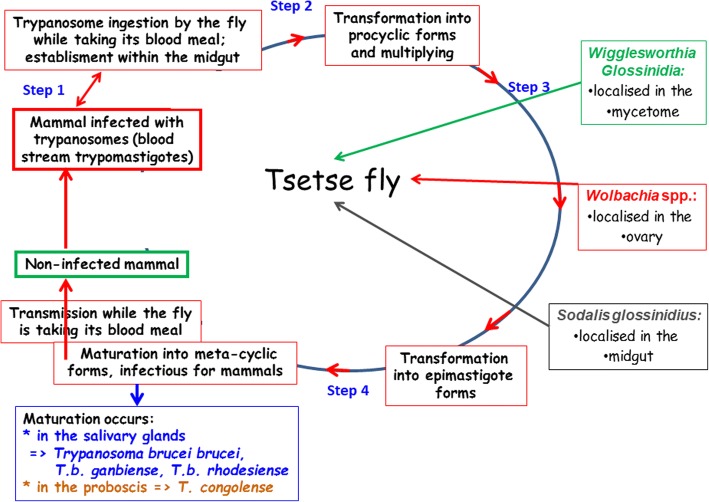
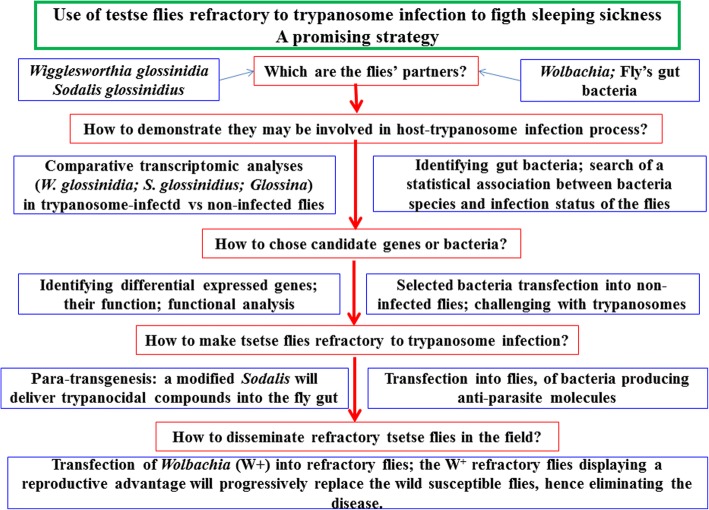
Research on the zoo-anthropophilic blood feeding tsetse flies' biology conducted, by different teams, in laboratory settings and at the level of the ecosystems- where also co-perpetuate African Trypanosoma- has allowed to unveil and characterize key features of tsetse flies' bacterial symbionts on which rely both (a) the perpetuation of the tsetse fly populations and (b) the completion of the developmental program of the African Trypanosoma. Transcriptomic analyses have already provided much information on tsetse fly genes as well as on genes of the fly symbiotic partners Sodalis glossinidius and Wigglesworthia, which account for the successful onset or not of the African Trypanosoma developmental program. In parallel, identification of the non- symbiotic bacterial communities hosted in the tsetse fly gut has recently been initiated: are briefly introduced those bacteria genera and species common to tsetse flies collected from distinct ecosystems, that could be further studied as potential biologicals preventing the onset of the African Trypanosoma developmental program. Finally, future work will need to concentrate on how to render tsetse flies refractory, and the best means to disseminate them in the field in order to establish an overall refractory fly population.
对实验室和生态系统层面上的嗜人动物血吸采采蝇的生物学进行了由不同团队开展的研究- 这也共同维持了非洲锥虫- 揭示并描述了采蝇细菌共生体的关键特征,这既依赖于 (a) 采蝇种群的延续,也依赖于 (b) 非洲锥虫发育计划的完成。转录组分析已经提供了关于采蝇基因以及共生伙伴 Sodalis glossinidius 和 Wigglesworthia 基因的大量信息,这些基因解释了非洲锥虫发育计划的成功启动或失败。同时,最近已经开始鉴定在采蝇肠道中寄生的非共生细菌群落:简要介绍了那些从不同生态系统中收集到的采蝇中常见的细菌属和种,它们可以作为潜在的生物制剂进一步研究,以防止非洲锥虫发育计划的启动。最后,未来的工作需要集中于如何使采蝇具有抗性,并找到在野外传播它们的最佳方法,以建立一个整体抗性的采蝇种群。