Vemuri Prashanthi, Lesnick Timothy G, Przybelski Scott A, Knopman David S, Machulda Mary, Lowe Val J, Mielke Michelle M, Roberts Rosebud O, Gunter Jeffrey L, Senjem Matthew L, Geda Yonas E, Rocca Walter A, Petersen Ronald C, Jack Clifford R
From the Departments of Radiology (P.V., V.J.L., J.L.G., M.L.S., C.R.J.), Health Sciences Research (T.G.L., S.A.P., M.M.M., R.O.R., W.A.R.), Neurology (D.S.K., M.M.M., R.O.R., W.A.R., R.C.P.), and Psychology (M.M., Y.E.G.), Mayo Clinic, Rochester, MN; and Departments of Psychiatry (Y.E.G.) and Neurology (Y.E.G.), Mayo Clinic, Scottsdale, AZ.
Neurology. 2016 Mar 22;86(12):1128-35. doi: 10.1212/WNL.0000000000002490. Epub 2016 Feb 24.
To investigate the effect of age, sex, APOE4 genotype, and lifestyle enrichment (education/occupation, midlife cognitive activity, and midlife physical activity) on Alzheimer disease (AD) biomarker trajectories using longitudinal imaging data (brain β-amyloid load via Pittsburgh compound B PET and neurodegeneration via (18)fluorodeoxyglucose (FDG) PET and structural MRI) in an elderly population without dementia.
In the population-based longitudinal Mayo Clinic Study of Aging, we studied 393 participants without dementia (340 clinically normal, 53 mild cognitive impairment; 70 years and older) who had cognitive and physical activity measures and at least 2 visits with imaging biomarkers. We dichotomized participants into high (≥14 years) and low (<14 years) education levels using the median. For the entire cohort and the 2 education strata, we built linear mixed models to investigate the effect of the predictors on each of the biomarker outcomes.
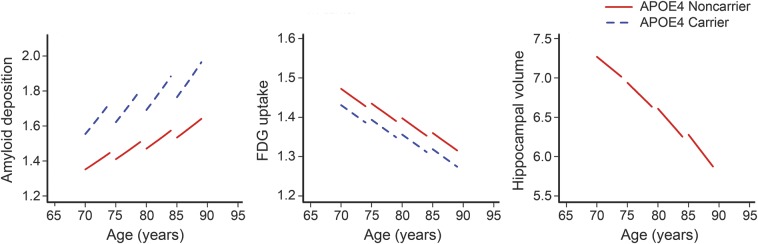
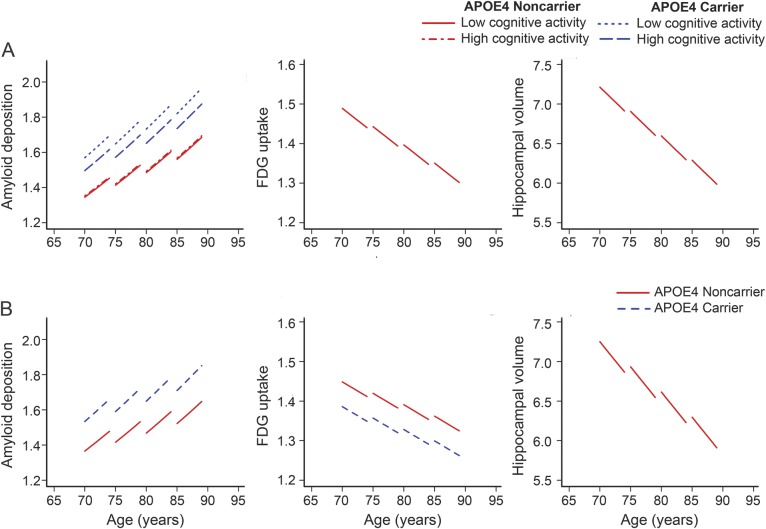
Age was associated with amyloid and neurodegeneration trajectories; APOE4 status appears to influence only the amyloid and FDG trajectories but not hippocampal volume trajectory. In the high-education stratum, high midlife cognitive activity was associated with lower amyloid deposition in APOE4 carriers. APOE4 status was associated with lower FDG uptake in the entire cohort and in participants with lower education but not the high-education cohort.
There were minimal effects of lifestyle enrichment on AD biomarker trajectories (specifically rates). Lifetime intellectual enrichment (high education, high midlife cognitive activity) is associated with lower amyloid in APOE4 carriers. High education is protective from the APOE4 effect on FDG metabolism. Differing education levels may explain the conflicting results seen in the literature.
利用纵向成像数据(通过匹兹堡化合物B正电子发射断层扫描(PET)测量脑β-淀粉样蛋白负荷,通过(18)氟脱氧葡萄糖(FDG)PET和结构磁共振成像(MRI)测量神经退行性变),在无痴呆的老年人群中研究年龄、性别、APOE4基因型和生活方式丰富度(教育/职业、中年认知活动和中年体育活动)对阿尔茨海默病(AD)生物标志物轨迹的影响。
在基于人群的纵向梅奥诊所衰老研究中,我们研究了393名无痴呆的参与者(340名临床正常,53名轻度认知障碍;年龄≥70岁),他们进行了认知和体育活动测量,并至少有2次接受成像生物标志物检查。我们使用中位数将参与者分为高(≥14年)低(<14年)教育水平两组。对于整个队列和两个教育分层,我们建立线性混合模型来研究预测因素对每个生物标志物结果的影响。
年龄与淀粉样蛋白和神经退行性变轨迹相关;APOE4状态似乎仅影响淀粉样蛋白和FDG轨迹,而不影响海马体积轨迹。在高教育分层中,中年高认知活动与APOE4携带者较低的淀粉样蛋白沉积相关。APOE4状态与整个队列以及低教育水平参与者较低的FDG摄取相关,但与高教育水平队列无关。
生活方式丰富度对AD生物标志物轨迹(特别是速率)的影响极小。终生智力丰富(高教育水平、中年高认知活动)与APOE4携带者较低的淀粉样蛋白水平相关。高教育水平可保护免受APOE4对FDG代谢的影响。不同的教育水平可能解释了文献中相互矛盾的结果。