Liu Min, Ma Li-Yun, Li Qiong-Yao, Huang Liang-Yu, Hu He-Ying, Tan Lan, Hu Hao
Department of Neurology, Qingdao Municipal Hospital, Dalian Medical University, Qingdao, China.
Department of Neurology, Qingdao Municipal Hospital, Qingdao University, Qingdao, China.
Front Aging Neurosci. 2025 Mar 4;17:1502154. doi: 10.3389/fnagi.2025.1502154. eCollection 2025.
Previous studies have found a correlation between varicose veins (VVs) and cognitive decline, and individuals with VVs have a higher prevalence of Alzheimer's disease (AD). However, the associations between VVs and the core pathologies of AD have not yet been investigated. The research was designed to analyze the relationships between VVs and cerebrospinal fluid (CSF) biomarkers of AD pathologies.
We included 1,298 participants from the Chinese Alzheimer's Biomarker and LifestylE (CABLE) database without dementia. Multiple linear regression (MLR) model was applied to assess the relationships between the VVs and CSF AD biomarkers. Then, we conducted subgroup analyses according to age, gender, education levels and carrier status. Additionally, mediation effects were assessed using causal mediation analyses with 10,000 bootstrapped iterations.
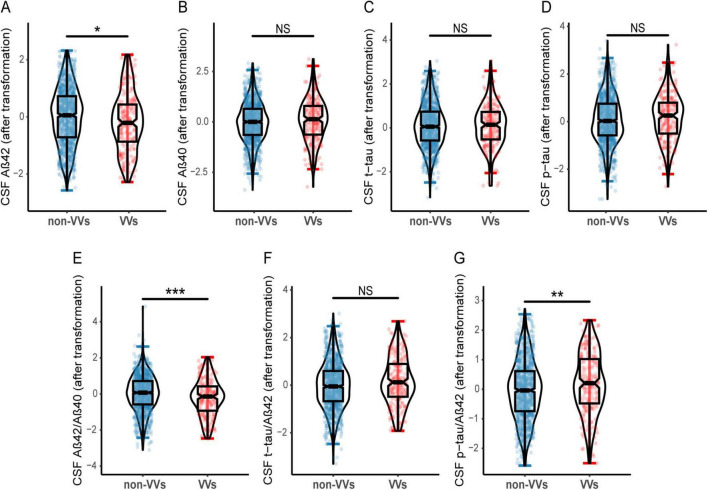
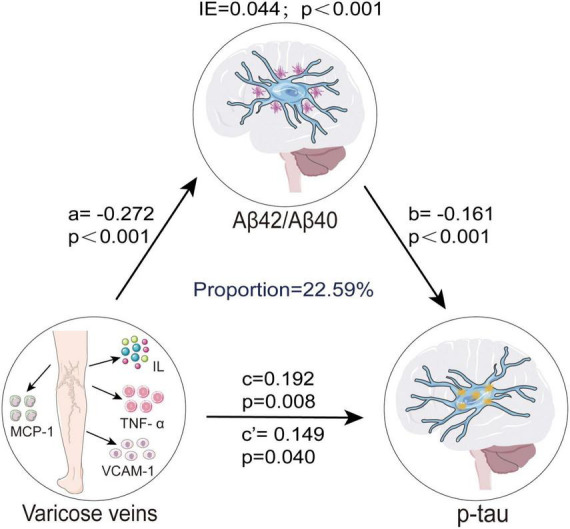
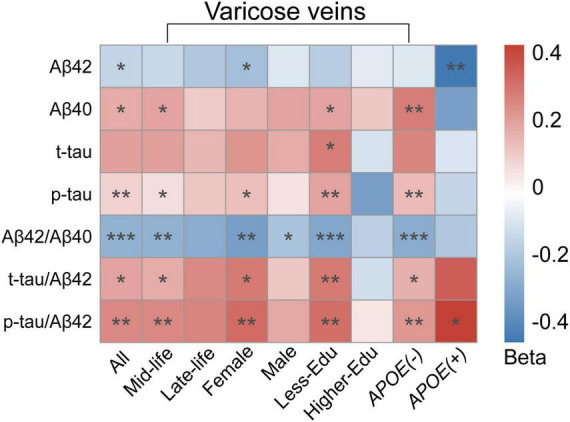
In total subjects, VVs had negative correlations with CSF Aβ (β = -0.157, = 0.038) and CSF Aβ/Aβ ratio (β = -0.272, < 0.001), as well as positive correlations with CSF Aβ (β = 0.170, = 0.024), CSF p-tau (β = 0.192, = 0.008), CSF t-tau/Aβ ratio (β = 0.190, = 0.011), and CSF p-tau/Aβ ratio (β = 0.248, = 0.001), after adjusting for age, sex, education levels and carrier status. Subgroup analyses demonstrated that the relations between VVs and CSF AD biomarkers were more significant in female, mid-life adults (40-65 years), less-educated individuals and non-carriers. Moreover, CSF Aβ/Aβ ratio might be a partial mediator of the association between VVs and p-tau pathology.
Our study found correlations between VVs and CSF AD biomarkers, suggesting that VVs may be a potential risk factor for the development of AD.
先前的研究发现静脉曲张(VVs)与认知功能下降之间存在关联,患有VVs的个体患阿尔茨海默病(AD)的患病率更高。然而,VVs与AD核心病理之间的关联尚未得到研究。本研究旨在分析VVs与AD病理的脑脊液(CSF)生物标志物之间的关系。
我们纳入了来自中国阿尔茨海默病生物标志物与生活方式(CABLE)数据库的1298名无痴呆症参与者。应用多元线性回归(MLR)模型评估VVs与CSF AD生物标志物之间的关系。然后,我们根据年龄、性别、教育水平和载脂蛋白E(ApoE)携带者状态进行亚组分析。此外,使用具有10000次自抽样迭代的因果中介分析评估中介效应。
在所有受试者中,调整年龄、性别、教育水平和ApoE携带者状态后,VVs与CSF Aβ(β = -0.157,P = 0.038)和CSF Aβ42/Aβ40比值(β = -0.272,P < 0.001)呈负相关,与CSF Aβ40(β = 0.170,P = 0.024)、CSF磷酸化tau蛋白(p-tau)(β = 0.192,P = 0.008)、CSF总tau蛋白(t-tau)/Aβ40比值(β =