Guo Christine C, Tan Rachel, Hodges John R, Hu Xintao, Sami Saber, Hornberger Michael
1 QIMR Berghofer Medical Research Institute, Herston, Queensland, Australia.
2 Neuroscience Research Australia, Sydney, Australia 3 School of Medical Sciences, University of New South Wales, Sydney, Australia.
Brain. 2016 May;139(Pt 5):1527-38. doi: 10.1093/brain/aww003. Epub 2016 Feb 16.
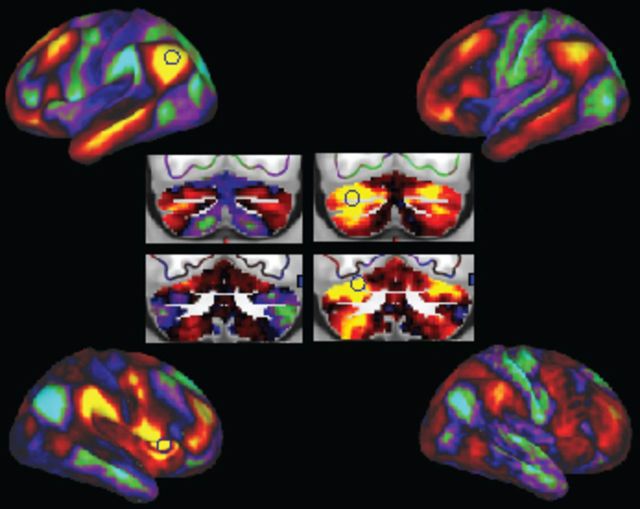
SEE SCHMAHMANN DOI101093/BRAIN/AWW064 FOR A SCIENTIFIC COMMENTARY ON THIS ARTICLE: Neurodegenerative diseases are associated with distinct and distributed patterns of atrophy in the cerebral cortex. Emerging evidence suggests that these atrophy patterns resemble intrinsic connectivity networks in the healthy brain, supporting the network-based degeneration framework where neuropathology spreads across connectivity networks. An intriguing yet untested possibility is that the cerebellar circuits, which share extensive connections with the cerebral cortex, could be selectively targeted by major neurodegenerative diseases. Here we examined the structural atrophy in the cerebellum across common types of neurodegenerative diseases, and characterized the functional connectivity patterns of these cerebellar atrophy regions. Our results showed that Alzheimer's disease and frontotemporal dementia are associated with distinct and circumscribed atrophy in the cerebellum. These cerebellar atrophied regions share robust and selective intrinsic connectivity with the atrophied regions in the cerebral cortex. These findings for the first time demonstrated the selective vulnerability of the cerebellum to common neurodegenerative disease, extending the network-based degeneration framework to the cerebellum. Our work also has direct implications on the cerebellar contribution to the cognitive and affective processes that are compromised in neurodegeneration as well as the practice of using the cerebellum as reference region for ligand neuroimaging studies.
关于本文的科学评论,请参阅施马曼(Schmahmann)的文献DOI101093/BRAIN/AWW064:神经退行性疾病与大脑皮质中不同且分布各异的萎缩模式相关。新出现的证据表明,这些萎缩模式类似于健康大脑中的内在连接网络,支持了基于网络的神经变性框架,即神经病理学在连接网络中传播。一个有趣但未经检验的可能性是,与大脑皮质有广泛连接的小脑回路可能会被主要的神经退行性疾病选择性地靶向。在这里,我们研究了常见类型神经退行性疾病中小脑的结构萎缩情况,并对这些小脑萎缩区域的功能连接模式进行了特征描述。我们的结果表明,阿尔茨海默病和额颞叶痴呆与小脑中不同且局限的萎缩有关。这些小脑萎缩区域与大脑皮质中的萎缩区域有着强大且选择性的内在连接。这些发现首次证明了小脑对常见神经退行性疾病的选择性易损性,将基于网络的神经变性框架扩展到了小脑。我们的工作还对小脑在神经退行性变中受损的认知和情感过程中的作用,以及将小脑用作配体神经影像学研究的参考区域的实践具有直接意义。