Zens Martin, Feucht Matthias J, Ruhhammer Johannes, Bernstein Anke, Mayr Hermann O, Südkamp Norbert P, Woias Peter, Niemeyer Philipp
Albert-Ludwigs-University Freiburg, Department of Microsystems Engineering (IMTEK), Design of Microsystems, Georges-Koehler-Allee 102, Freiburg i. Brsg., 79110, Germany.
University Medical Center Freiburg, Department of Orthopaedics and Trauma Surgery, Hugstetter Str. 55, Freiburg i. Brsg., 79106, Germany.
J Exp Orthop. 2015 Dec;2(1):7. doi: 10.1186/s40634-015-0023-3. Epub 2015 Apr 2.
In a noticeable percentage of patients anterolateral rotational instabilities (ALRI) remain after an isolated ACL reconstruction. Those instabilities may occur due to an insufficiently directed damage of anterolateral structures that is often associated with ACL ruptures. Recent publications describe an anatomical structure, termed the anterolateral ligament (ALL), and suggest that this ligament plays a significant role in the pathogenesis of ALRI of the knee joint. However, only limited knowledge about the biomechanical characteristics and tensile properties of the anterolateral ligament exists.
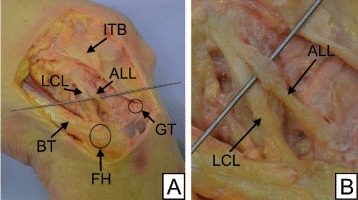
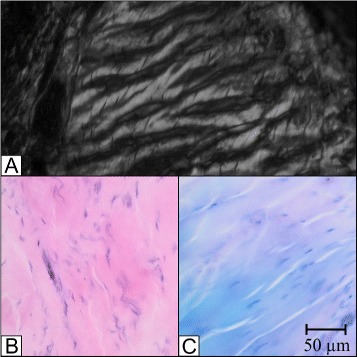
The anterolateral ligament was dissected in four fresh-frozen human cadaveric specimens and all surrounding tissue removed. The initial length of the anterolateral ligament was measured using a digital caliper. Tensile tests with load to failure were performed using a materials testing machine. The explanted anterolateral ligaments were histologically examined to measure the cross-sectional area.
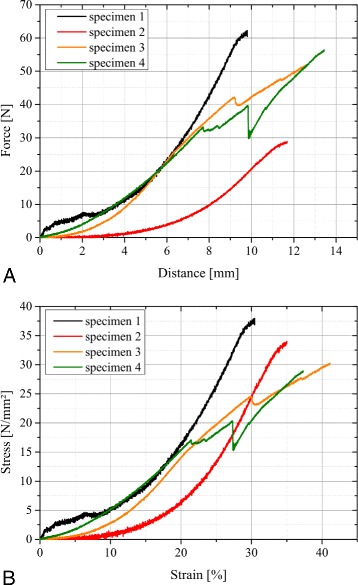
The mean ultimate load to failure of the anterolateral ligament was 49.90 N (± 14.62 N) and the mean ultimate strain was 35.96% (± 4.47%). The mean length of the ligament was 33.08 mm (± 2.24) and the mean cross-sectional area was 1.54 m m (2) (± 0.48 m m (2)). Including the areal measurements the maximum tension was calculated to be 32.78 [Formula: see text] (± 4.04 [Formula: see text]).
The anterolateral ligament is an anatomical structure with tensile properties that are considerably weaker compared to other peripheral structures of the knee. Knowledge of the anterolateral ligament's tensile strengths may help to better understand its function and with graft choices for reconstruction procedures.
在相当比例的患者中,单纯前交叉韧带(ACL)重建术后仍存在前外侧旋转不稳定(ALRI)。这些不稳定可能是由于前外侧结构损伤方向不当所致,而这通常与ACL断裂有关。最近的出版物描述了一种名为前外侧韧带(ALL)的解剖结构,并表明该韧带在膝关节ALRI的发病机制中起重要作用。然而,关于前外侧韧带的生物力学特性和拉伸性能的知识有限。
在四个新鲜冷冻的人体尸体标本中解剖前外侧韧带,并去除所有周围组织。使用数字卡尺测量前外侧韧带的初始长度。使用材料试验机进行直至破坏的拉伸试验。对取出的前外侧韧带进行组织学检查以测量横截面积。
前外侧韧带的平均最终破坏载荷为49.90 N(±14.62 N),平均最终应变率为35.96%(±4.47%)。韧带的平均长度为33.08 mm(±2.24),平均横截面积为1.54 mm²(±0.48 mm²)。包括面积测量在内,计算出的最大张力为32.78[公式:见正文](±4.04[公式:见正文])。
前外侧韧带是一种具有拉伸性能的解剖结构,与膝关节的其他周围结构相比,其拉伸性能明显较弱。了解前外侧韧带的拉伸强度可能有助于更好地理解其功能以及重建手术中移植物的选择。