Chiu Chih-Yung, Yeh Kuo-Wei, Lin Gigin, Chiang Meng-Han, Yang Shu-Chen, Chao Wei-Ju, Yao Tsung-Chieh, Tsai Ming-Han, Hua Man-Chin, Liao Sui-Ling, Lai Shen-Hao, Cheng Mei-Ling, Huang Jing-Long
Department of Pediatrics, Chang Gung Memorial Hospital at Keelung, and Chang Gung University, Taoyuan, Taiwan.
Community Medicine Research Centre, Chang Gung Memorial Hospital, Keelung, Taiwan.
PLoS One. 2016 Feb 25;11(2):e0149823. doi: 10.1371/journal.pone.0149823. eCollection 2016.
A detailed understanding of the metabolic processes governing rapid growth in early life is still lacking. The aim of this study was to investigate the age-related metabolic changes in healthy children throughout early childhood.
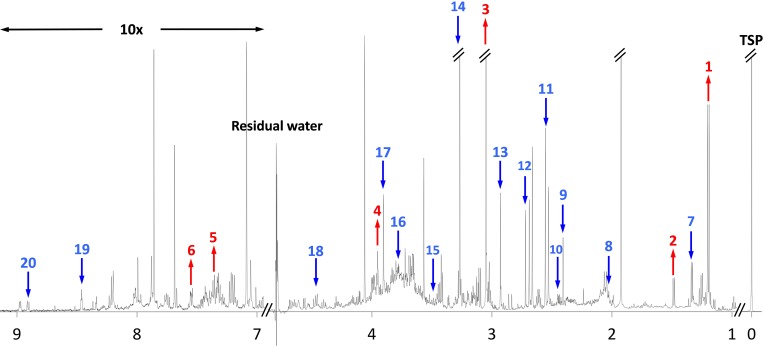
Healthy children from a birth cohort were enrolled in this study from birth through 4 years of age. Urinary metabolites were assessed at 6 months, and 1, 2, 3, and 4 yr of age by using 1H-nuclear magnetic resonance (NMR) spectroscopy coupled with multivariate statistical analysis including principal components analysis (PCA) and partial least-squares discriminant analysis (PLS-DA). Metabolic pathway analysis was performed using the MetPA web tool.
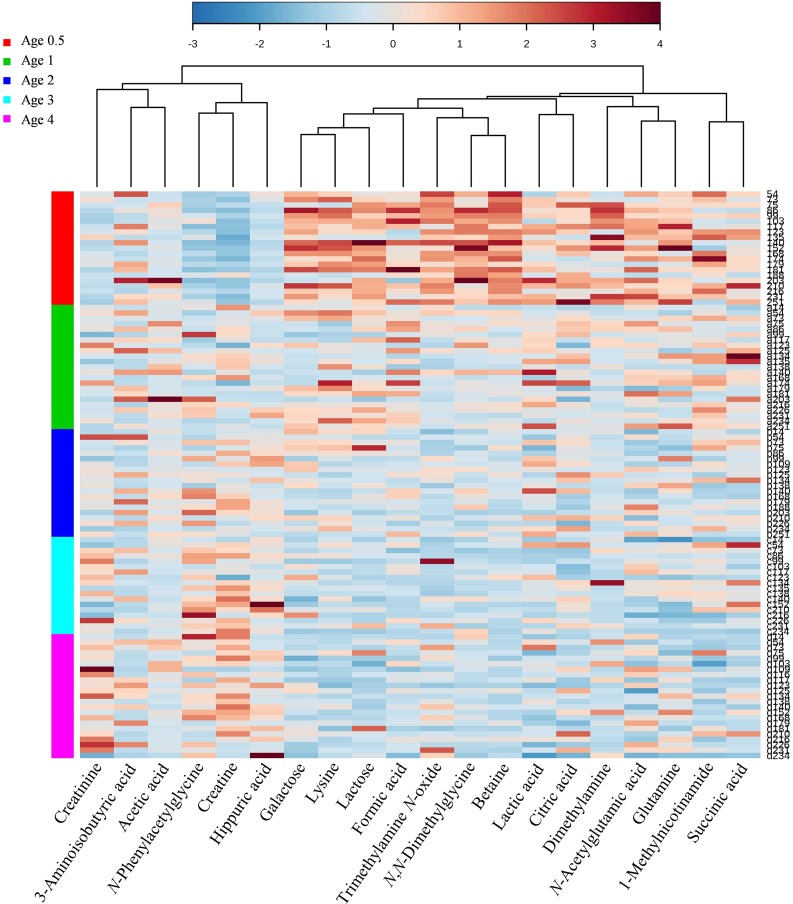
A total of 105 urine samples from 30 healthy children were collected and analyzed. Metabolites contributing to the discrimination between age groups were identified by using supervised PLS-DA (Q2 = 0.60; R2 = 0.66). A significantly higher urinary trimethylamine N-oxide (TMAO) and betaine level was found in children aged 6 months. Urinary glycine and glutamine levels declined significantly after 6 months of age and there was a concomitant compensatory increase in urinary creatine and creatinine. Metabolic pathway analysis using MetPA revealed similar nitrogen metabolism associated energy production across all ages assessed. Pathways associated with amino acid metabolism were significantly different between infants aged 6 months and 1 year, whereas pathways associated with carbohydrate metabolism were significantly different between children at ages 2 and 3 years.
Urine metabolomics ideally represents dynamic metabolic changes across age. Urinary metabolic profiles change significantly within the first year of life, which can potentially provide crucial information about infant nutrition and growth.
目前仍缺乏对早期生命中快速生长所涉及代谢过程的详细了解。本研究旨在调查健康儿童在整个幼儿期与年龄相关的代谢变化。
从一个出生队列中选取健康儿童,从出生到4岁参与本研究。在6个月、1岁、2岁、3岁和4岁时,通过使用1H核磁共振(NMR)光谱结合包括主成分分析(PCA)和偏最小二乘判别分析(PLS-DA)在内的多变量统计分析来评估尿液代谢物。使用MetPA网络工具进行代谢途径分析。
共收集并分析了30名健康儿童的105份尿液样本。通过监督PLS-DA(Q2 = 0.60;R2 = 0.66)确定了有助于区分年龄组的代谢物。发现6个月大的儿童尿液中氧化三甲胺(TMAO)和甜菜碱水平显著更高。6个月大后,尿液中的甘氨酸和谷氨酰胺水平显著下降,同时尿液中的肌酸和肌酐有相应的代偿性增加。使用MetPA进行的代谢途径分析显示,在所有评估年龄中,与氮代谢相关的能量产生相似。6个月大的婴儿和1岁婴儿之间,与氨基酸代谢相关的途径有显著差异,而2岁和3岁儿童之间,与碳水化合物代谢相关的途径有显著差异。
尿液代谢组学理想地反映了不同年龄阶段的动态代谢变化。尿液代谢谱在生命的第一年中发生显著变化,这可能为婴儿营养和生长提供关键信息。