Román Marta, Castells Xavier, Hofvind Solveig, von Euler-Chelpin My
Department of screening, Cancer Registry of Norway, Oslo, Norway.
National Advisory Unit for Women's Health, Oslo University Hospital, Oslo, Norway.
Cancer Med. 2016 Jun;5(6):1298-306. doi: 10.1002/cam4.646. Epub 2016 Feb 25.
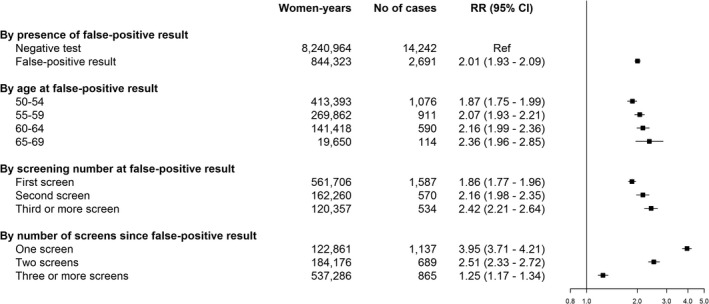
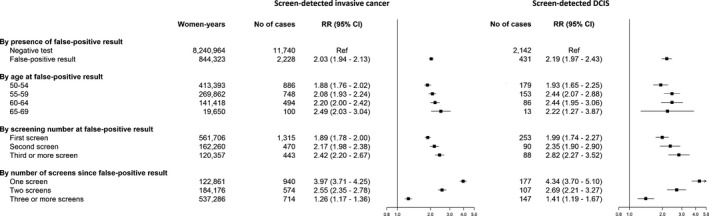
Women with false-positive results are commonly referred back to routine screening. Questions remain regarding their long-term outcome of breast cancer. We assessed the risk of screen-detected breast cancer in women with false-positive results. We conducted a joint analysis using individual level data from the population-based screening programs in Copenhagen and Funen in Denmark, Norway, and Spain. Overall, 150,383 screened women from Denmark (1991-2008), 612,138 from Norway (1996-2010), and 1,172,572 from Spain (1990-2006) were included. Poisson regression was used to estimate the relative risk (RR) of screen-detected cancer for women with false-positive versus negative results. We analyzed information from 1,935,093 women 50-69 years who underwent 6,094,515 screening exams. During an average 5.8 years of follow-up, 230,609 (11.9%) women received a false-positive result and 27,849 (1.4%) were diagnosed with screen-detected cancer. The adjusted RR of screen-detected cancer after a false-positive result was 2.01 (95% CI: 1.93-2.09). Women who tested false-positive at first screen had a RR of 1.86 (95% CI: 1.77-1.96), whereas those who tested false-positive at third screening had a RR of 2.42 (95% CI: 2.21-2.64). The RR of breast cancer at the screening test after the false-positive result was 3.95 (95% CI: 3.71-4.21), whereas it decreased to 1.25 (95% CI: 1.17-1.34) three or more screens after the false-positive result. Women with false-positive results had a twofold risk of screen-detected breast cancer compared to women with negative tests. The risk remained significantly higher three or more screens after the false-positive result. The increased risk should be considered when discussing stratified screening strategies.
筛查结果为假阳性的女性通常会被转回常规筛查。关于她们患乳腺癌的长期预后仍存在疑问。我们评估了筛查结果为假阳性的女性患经筛查发现的乳腺癌的风险。我们使用来自丹麦哥本哈根、菲英岛,挪威以及西班牙基于人群的筛查项目的个体层面数据进行了联合分析。总体而言,纳入了来自丹麦(1991 - 2008年)的150383名接受筛查的女性、来自挪威(1996 - 2010年)的612138名女性以及来自西班牙(1990 - 2006年)的1172572名女性。采用泊松回归来估计筛查结果为假阳性与阴性的女性患经筛查发现的癌症的相对风险(RR)。我们分析了1935093名年龄在50 - 69岁且接受了6094515次筛查检查的女性的信息。在平均5.8年的随访期间,230609名(11.9%)女性获得了假阳性结果,27849名(1.4%)被诊断为经筛查发现的癌症。假阳性结果后经筛查发现癌症的校正RR为2.01(95%CI:1.93 - 2.09)。首次筛查时结果为假阳性的女性RR为1.86(95%CI:1.77 - 1.96),而第三次筛查时结果为假阳性的女性RR为2.42(95%CI:2.21 - 2.64)。假阳性结果后的筛查测试中患乳腺癌的RR为3.95(95%CI:3.71 - 4.21),而在假阳性结果后的三次或更多次筛查后降至1.25(95%CI:1.17 - 1.34)。与检测结果为阴性的女性相比,筛查结果为假阳性的女性患经筛查发现的乳腺癌的风险高出两倍。在假阳性结果后的三次或更多次筛查后,该风险仍显著更高。在讨论分层筛查策略时应考虑到这种风险增加的情况。