Institute of Clinical Neuroanatomy, Neuroscience Center, Goethe-University Frankfurt, D-60590, Frankfurt/Main, Germany.
Ernst Strüngmann Institute (ESI) for Neuroscience in Cooperation with Max Planck Society, D-60528, Frankfurt/Main, Germany.
Acta Neuropathol Commun. 2016 Feb 25;4:19. doi: 10.1186/s40478-016-0285-8.
Neuronal death and subsequent denervation of target areas are hallmarks of many neurological disorders. Denervated neurons lose part of their dendritic tree, and are considered "atrophic", i.e. pathologically altered and damaged. The functional consequences of this phenomenon are poorly understood.
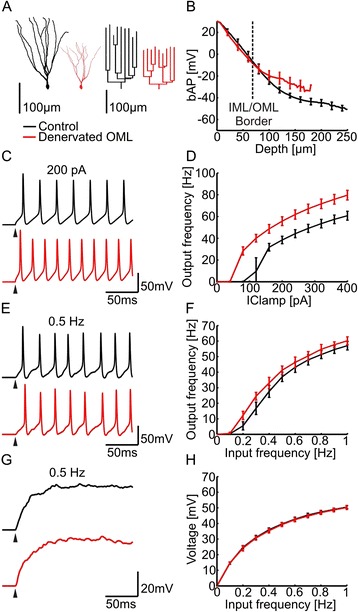
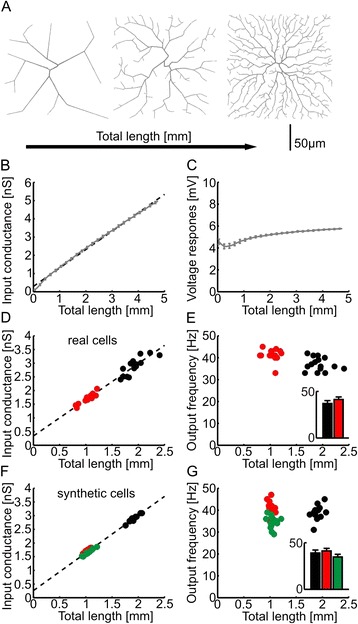
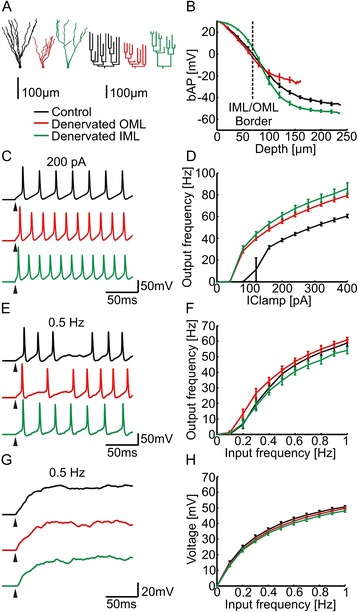
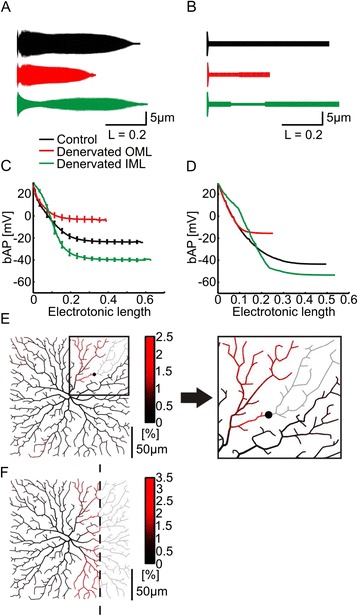
Using computational modelling of 3D-reconstructed granule cells we show that denervation-induced dendritic atrophy also subserves homeostatic functions: By shortening their dendritic tree, granule cells compensate for the loss of inputs by a precise adjustment of excitability. As a consequence, surviving afferents are able to activate the cells, thereby allowing information to flow again through the denervated area. In addition, action potentials backpropagating from the soma to the synapses are enhanced specifically in reorganized portions of the dendritic arbor, resulting in their increased synaptic plasticity. These two observations generalize to any given dendritic tree undergoing structural changes.
Structural homeostatic plasticity, i.e. homeostatic dendritic remodeling, is operating in long-term denervated neurons to achieve functional homeostasis.
神经元死亡和随后的靶区去神经支配是许多神经紊乱的标志。去神经支配的神经元失去部分树突,被认为是“萎缩的”,即病理性改变和损伤的。这一现象的功能后果知之甚少。
我们使用三维重建颗粒细胞的计算模型表明,去神经诱导的树突萎缩也起到了维持平衡的作用:通过缩短树突,颗粒细胞通过精确调整兴奋性来补偿输入的损失。因此,存活的传入神经能够激活细胞,从而使信息再次通过去神经区域传输。此外,从体部向突触逆行传播的动作电位在树突分支的重组部分得到增强,导致其突触可塑性增加。这两个观察结果适用于任何经历结构变化的特定树突。
结构的稳态可塑性,即稳态树突重塑,在长期去神经支配的神经元中起作用,以实现功能的稳态。