1. Hong-Hui Hospital, Xi'an Jiaotong University, College of Medicine, Xi'an, Shaanxi, China, 710054.
2. Department of Biochemistry and Molecular Genetics, University of Colorado School of Medicine, Aurora, CO, USA, 80045.
J Cancer. 2016 Jan 10;7(3):314-23. doi: 10.7150/jca.13332. eCollection 2016.
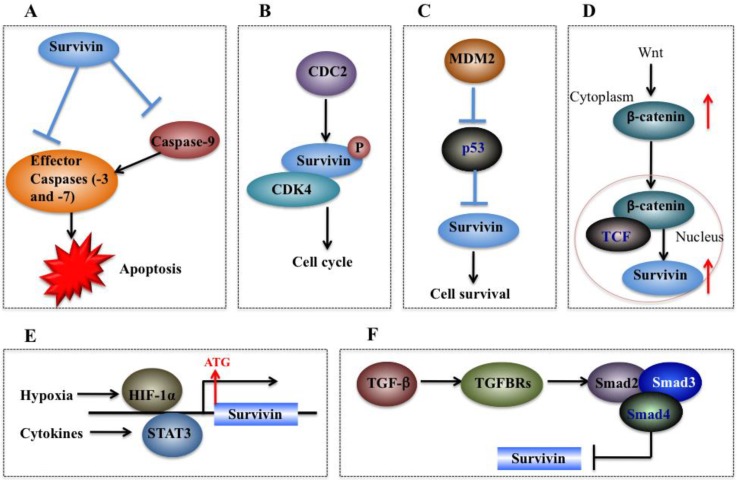
Survivin is the smallest member of the inhibitor of apoptosis protein family, which has key roles in regulating cell division and inhibiting apoptosis by blocking caspase activation. Survivin is highly expressed in most human cancers, such as lung, pancreatic and breast cancers, relative to normal tissues. Aberrant survivin expression is associated with tumor cell proliferation, progression, angiogenesis, therapeutic resistance, and poor prognosis. Studies on the underlying molecular mechanisms indicate that survivin is involved in the regulation of cytokinesis and cell cycle progression, as well as participates in a variety of signaling pathways such as the p53, Wnt, hypoxia, transforming growth factor, and Notch signaling pathways. In this review, recent progress in understanding the molecular basis of survivin is discussed. Therapeutic strategies targeting survivin in preclinical studies are also briefly summarized.
Survivin 是凋亡抑制蛋白家族中最小的成员,它在通过阻断半胱天冬酶激活来调节细胞分裂和抑制细胞凋亡方面起着关键作用。Survivin 在大多数人类癌症中高度表达,例如肺癌、胰腺癌和乳腺癌,与正常组织相比。异常的 survivin 表达与肿瘤细胞增殖、进展、血管生成、治疗抵抗和预后不良有关。对潜在分子机制的研究表明,Survivin 参与了细胞分裂和细胞周期进程的调节,并且参与了各种信号通路,如 p53、Wnt、缺氧、转化生长因子和 Notch 信号通路。在这篇综述中,讨论了对 survivin 分子基础的理解的最新进展。还简要总结了针对 survivin 的临床前研究中的治疗策略。